Chain Bridge

Contents
I'd choose USDC when both payment routes work and the priority is a narrower cash-and-cash-equivalent reserve policy. USDT can be the practical choice when the recipient requires it or its available route delivers a better net payment. Start with account eligibility, the receiving network and the way back to spendable dollars; then compare the issuer risk you're willing to hold.
USDC and USDT are separate dollar stablecoins issued by Circle and Tether. Their dollar targets don't make their market prices, redemption rights or supported routes identical.
Choose the route before the ticker
For a payment, ask the recipient which token and network they accept. A service accepting USDT on Tron hasn't thereby agreed to accept USDC on Ethereum. Circle's official USDC identifiers and Tether's supported protocols and token identifiers establish the issuer side of that check. The receiving platform's deposit instructions must match it.
For a trading balance, compare the pair you'll trade and the withdrawal you'll eventually use. For money held between payments, reserve composition and issuer access deserve more weight. I wouldn't accept a worse or unsupported exit merely because a token looks preferable in a general comparison.
| Decision | USDC | USDT |
|---|---|---|
| Who issues it? | Circle; holder terms depend on jurisdiction. | Tether International, S.A. de C.V. |
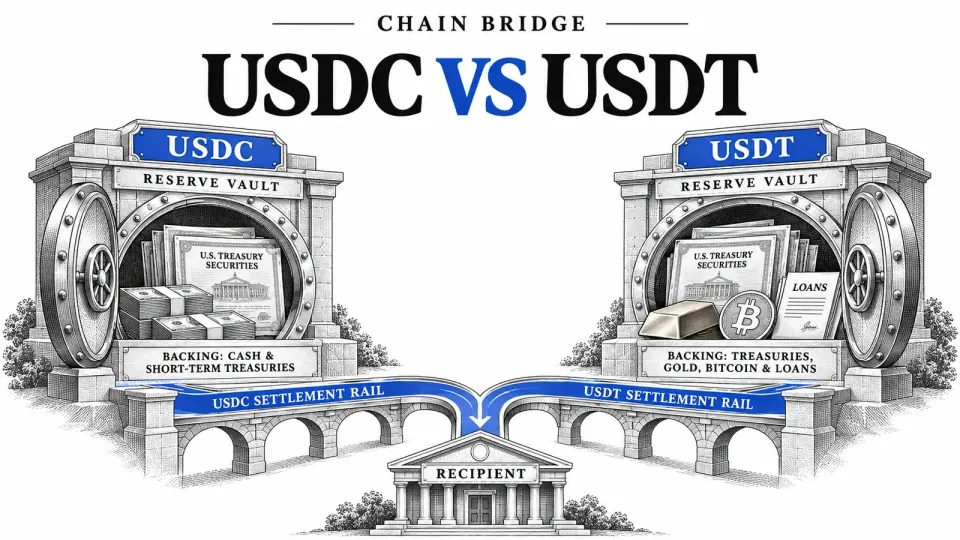
| Reserve preference | Cash and cash equivalents, including short Treasury exposure. | A broader portfolio, including assets beyond cash equivalents. |
| Reserve reporting | Weekly holdings disclosure and monthly third-party assurance. | Quarterly reserve reports with independent assurance. |
| Direct issuer access | Circle Mint eligibility applies; personal US retail access isn't the same as buying on an exchange. | Verified, eligible customer access, a large minimum and issuer fees. |
| Payment cost | Compare the actual token, network, platform and exit quote. Neither ticker fixes the total fee. | |
The reserve and access differences behind this table are set out below. Token identity deserves its own check too: a bridge-issued version adds another dependency. If a balance is labeled USDC.e, check how it differs from native USDC before comparing it with USDT.
Compare reserve policy and the scope of assurance
Circle describes USDC's backing as highly liquid cash and cash equivalents held separately from its operating funds. The majority is in the Circle Reserve Fund, a government money market fund managed by BlackRock that can hold cash, short-dated US Treasuries and overnight Treasury repurchase agreements. The remaining reserve is cash at banks. Circle publishes weekly reserve information and monthly third-party assurance under AICPA attestation standards.
Tether's September 30, 2026 reserve report shows a majority in cash, cash equivalents and other short-term deposits, including Treasury bills and reverse repurchase agreements. It also lists precious metals, Bitcoin, public equities, other investments, corporate bonds and secured loans. Those assets introduce different market, credit and liquidity exposures from a portfolio confined to cash equivalents.
That narrower reserve policy is why I'd favor USDC when the receiving and cash-out routes are otherwise suitable. It doesn't remove dependence on banks, custodians or operating access. Nor does a broader portfolio prove that USDT will fail: the point is to identify the exposures rather than attach a safety score to a ticker.
The word audit needs care. BDO's opinion in Tether's September report is a reasonable-assurance engagement under ISAE 3000 Revised, limited to the specified financial figures and reserves at the reporting date. The report says it isn't the company's financial statements; its notes fall outside the assurance opinion. It separately states that Tether's 2025 financial statements were audited. A reserve attestation and an annual financial-statement audit answer different questions, so “Tether has never been audited” isn't a sound shortcut.
Circle likewise describes its financial-statement audit separately from reserve assurance. Monthly versus quarterly reporting changes how frequently a holder receives evidence. Neither cadence certifies today's exchange withdrawal, a future market price or immediate access to dollars during a disruption.
Separate direct redemption from your exchange exit
Owning a token doesn't automatically give you an issuer account. Circle Mint serves institutions, rather than individuals using it for personal purposes. Under Circle's non-EEA USDC terms, direct redemption is for eligible, registered Circle Mint customers. An individual buying USDC through a platform therefore needs to assess that platform's sale and bank-withdrawal route.
This is a US-first comparison. Circle's separate EEA retail redemption policy provides another route for eligible retail holders, with identity, transaction and bank-account requirements. The US institutional-access rule shouldn't be extended to every holder worldwide.
Tether's direct-service terms require a verified, eligible customer. They exclude US persons except Eligible Contract Participants accepted at Tether's discretion. That restriction matters for a US reader considering issuer redemption; it doesn't establish a blanket rule about every secondary-market platform or every American's token holding.
Tether's published issuer fees set a $100,000 minimum for direct acquisition or redemption. Redemption costs the greater of $1,000 or 0.1%; acquisition costs 0.1%. The nonrefundable verification fee is 150 USD in Tether tokens, and paying it doesn't guarantee approval.
At the $100,000 minimum, the redemption fee alone is $1,000, or 1% of the amount redeemed. At $1 million, 0.1% equals the $1,000 floor; above that amount, the percentage sets the fee. These are calculations from the fee schedule, before other applicable costs. They aren't the fee for selling USDT on an exchange or the network fee for sending tokens to another wallet.
For a personal payment, I would establish the usable exit first. Confirm account and bank-withdrawal eligibility, the amount you'll receive after charges, and any holding or processing restrictions. An attractive issuer redemption promise won't help if the available route is a different service with different conditions.
Compare the full cost, including the sale price
Keep three costs separate: buying or swapping into the token, sending it on the chosen network, and converting it into the money the recipient needs. A platform may quote a withdrawal charge alongside the blockchain cost. A bank withdrawal adds another step. Compare final dollars received for the same starting cost rather than stopping at a “cheap transfer” label.
The bid is the price a buyer offers; the ask is the price a seller requests. Their difference is the bid-ask spread. For a holder selling tokens, the bids and available quantities determine the gross proceeds; a narrow spread alone doesn't show how close those bids are to a dollar.
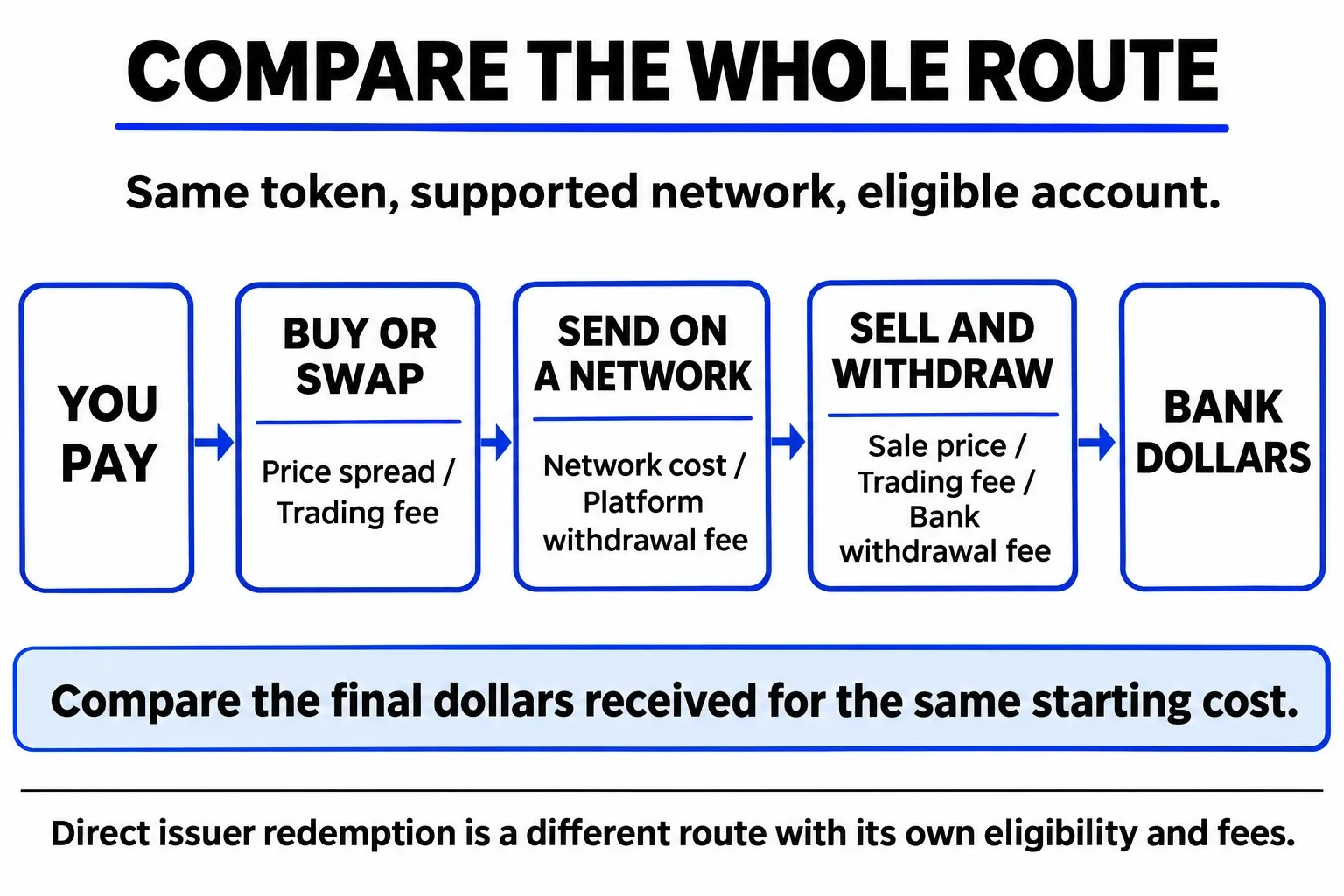
A two-venue order-book check shows why spread and payout need separate attention. For each market below, a hypothetical sale of 1,000 tokens was calculated against the listed bids. The public snapshots were captured on November 25, 2026, around 05:33 UTC; they show gross dollars before trading fees, transfer costs and bank withdrawal charges.
| Public market | Best bid | Best ask | Gross sale of 1,000 tokens |
|---|---|---|---|
| Kraken USDC/USD | $0.99980 | $0.99990 | $999.80 |
| Kraken USDT/USD | $0.99865 | $0.99866 | $998.65 |
| Bitstamp USDC/USD | $0.99978 | $0.99981 | $999.78 |
| Bitstamp USDT/USD | $0.99866 | $0.99868 | $998.66 |
Each displayed best bid had enough listed volume for that calculation. USDT had the narrower bid-ask spread on both venues, yet its calculated dollar proceeds were lower because its bids were further below a dollar. No order was placed. These snapshots aren't executable quotes or evidence that either market always gives the better result; fees and later prices can change the choice. A public order book also doesn't confirm that your account is eligible to trade the pair or withdraw bank dollars.
I wouldn't use global market capitalization as a substitute for this check. The relevant liquidity is the amount available at acceptable prices in your pair and route. Keep venue results separate: averaging gross proceeds across exchanges would conceal the different fees and access conditions you still need to assess.
Check network support and the controls you still depend on
Both issuers support multiple networks, but an old chain list can be misleading. Tether's current protocol guidance says it no longer issues or is obligated to redeem tokens on Kusama, Bitcoin Cash SLP, Omni, EOS and Algorand. Historical contract information remains on that page. Check the current token-specific entry and the receiving service rather than relying on an old comparison's network count.
For a native USDC route, the Base transfer checks show how issuer identity, the sending network and the receiving platform fit together. The USDC network guides help with other supported routes. Choosing a network is a separate decision from choosing Circle or Tether.
Self-custody also leaves issuer controls in place. Circle's terms describe on-chain blocklisting, while Tether's terms permit token freezing and service restrictions under the stated legal and contractual conditions. A hardware wallet changes who holds the signing keys; it doesn't remove those powers.
Neither token is an FDIC-insured bank deposit or carries SIPC protection under those issuer terms. If the requirement is insured bank cash or an asset without a central issuer's freezing authority, neither USDC nor USDT meets it. Before choosing between them, agree on the recipient's exact token and network, then compare an available net payout and decide which reserve and issuer conditions you accept.