Chain Bridge

Contents
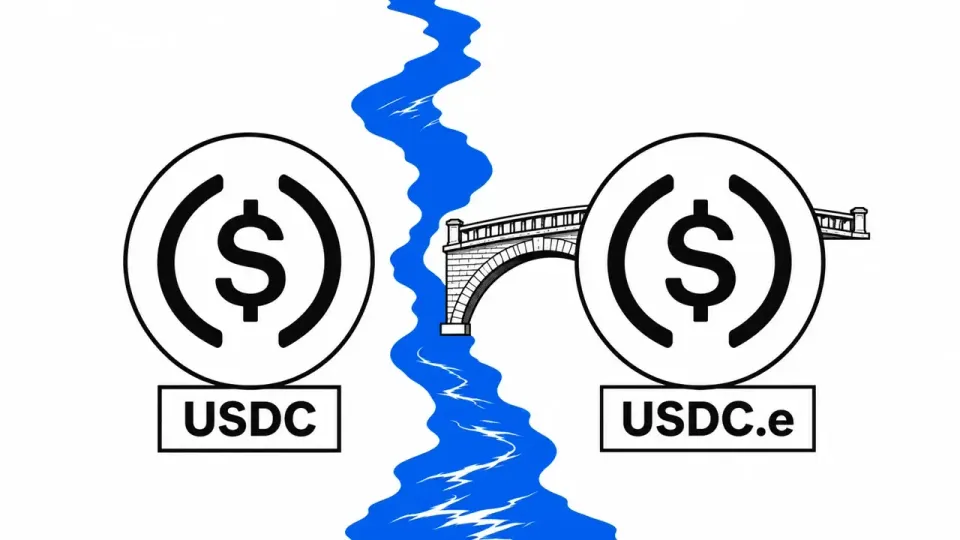
USDC.e is a bridged representation of USDC, while native USDC is issued directly by Circle on a supported blockchain. They can appear beside each other in the same wallet, but they are separate token contracts. Before depositing either, check the receiving service's exact token and network support; a similar ticker isn't enough.
Identify the token you hold
Open the asset details in your wallet and find the network and contract address. Compare native USDC against Circle's official contract directory. If it doesn't match, don't assume a familiar logo proves it's the native token. Contract addresses must be interpreted on their own chain.
The Arbitrum One documentation gives a concrete example: native USDC uses 0xaf88d065e77c8cC2239327C5EDb3A432268e5831, while bridged USDC.e uses 0xff970a61a04b1ca14834a43f5de4533ebddb5cc8. Both are on Arbitrum One. These addresses don't identify USDC on a different network.
| Question | Native USDC | USDC.e |
|---|---|---|
| Who issues it? | Circle's issuing entities | A third-party bridge or platform |
| What additional dependency matters? | Issuer, reserves and chain | The bridge and the assets backing its representation, as well as the underlying asset and chain |
| Does Circle CCTP apply? | For supported native-USDC routes | Not directly to the bridged token |
| Will an exchange accept it? | Only where that token and chain are supported | Only where the bridged token and chain are explicitly supported |

Understand what changes with a bridge
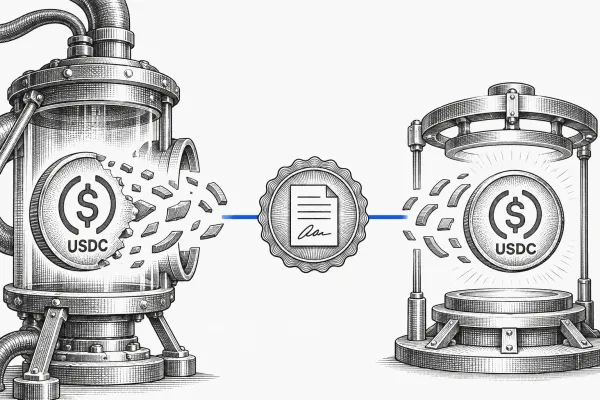
Circle explains that USDC.e adds reliance on a third-party bridge. In a common lock-and-mint design, native USDC is held on the source chain and a representation is created on another. The bridged token's usable value depends on that mechanism continuing to work.
I'd use native USDC for a new payment when both parties support it, because it avoids that extra bridged representation. That preference doesn't make native USDC risk-free or USDC.e automatically fraudulent. The actual contract, bridge and intended application determine the remaining risks.
There is also an upgrade exception: Circle's Bridged USDC Standard can allow an eligible token to become native in place. The contract may persist after that transition. Check current issuer and chain documentation rather than treating an old label as permanent.
If the destination only accepts native USDC
Don't send USDC.e first and hope the exchange converts it. Check whether a same-chain swap into the supported native contract is available. Review the token pair, liquidity, minimum received, fees and approval request before signing. A quoted one-dollar target doesn't guarantee a one-for-one trade after costs.
A swap changes the asset on a chain; a bridge moves value between chains. If your destination uses another chain, changing only the token isn't sufficient. Circle's CCTP works with supported native-USDC routes, so USDC.e needs an appropriate conversion before such a route can apply. Keep enough of the source chain's gas asset to pay for the required transactions.
Native issuance doesn't give every wallet holder direct access to Circle Mint. Direct redemption has eligibility and account requirements; a consumer may instead use a supported exchange or market route.
Check the deposit screen before sending
Confirm the asset, network, minimum deposit and any memo requirements in the receiving service's own deposit instructions. If a small test is above its minimum, verify it is credited before sending the remainder. An on-chain success doesn't by itself prove an exchange will credit an unsupported deposit.
USDC naming isn't uniform across chains. Base's older bridged token is commonly called USDbC; native USDC on Base has its own contract. Never use a suffix as a substitute for checking the contract and receiving support.