Chain Bridge

Contents
Native USDC on Polygon PoS uses the contract 0x3c499c542cef5e3811e1192ce70d8cc03d5c3359. Before sending, match that token and the Polygon network to the receiving wallet or service. Polygon also has bridged USDC.e, so a balance labeled USDC or an address beginning with 0x isn't enough to establish compatibility.
Identify which Polygon token you hold
Circle's mainnet contract directory lists the native address above for Polygon PoS. Circle's explanation of the two Polygon tokens identifies the older bridged contract as 0x2791bca1f2de4661ed88a30c99a7a9449aa84174. These are separate assets on the same network.
| Asset on Polygon PoS | Contract identifier | What to check |
|---|---|---|
| Native USDC, issued by Circle | Starts 0x3c499, ends c3359 | The receiver supports native USDC on Polygon. |
| Bridged USDC.e from Ethereum | Starts 0x2791b, ends 84174 | The receiver explicitly accepts this bridged token. |
Compare the entire address, not just the shortened identifiers in the table. Open the token's details in your wallet or follow its transfer to a Polygon explorer, then compare its contract with the issuer's listing. The name and logo are useful labels; the contract tells you which asset you're examining.
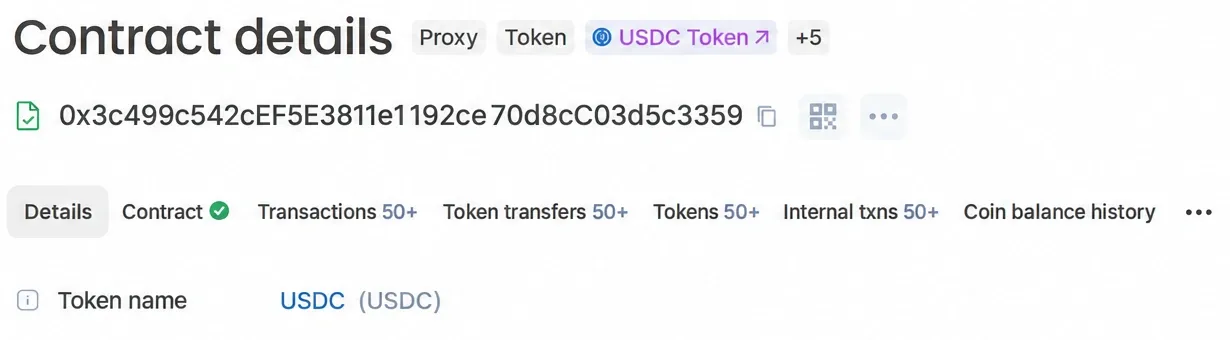
Don't paste either token-contract address into the destination field of a normal payment. A contract identifies the asset; your recipient supplies the receiving address. For the broader distinction between the two forms, the USDC and USDC.e comparison explains why support for one doesn't establish support for the other.
Choose a route that delivers the right token
I'd choose the route by its final asset and network before comparing the fee. A cheap withdrawal doesn't help if it delivers a token your recipient can't credit. Circle's Polygon acquisition walkthrough separates exchange withdrawals, swaps on Polygon and transfers from another blockchain.
- Starting with dollars at an exchange: check whether your account offers a USDC withdrawal on Polygon, then confirm which Polygon token it sends. Buying USDC inside the exchange doesn't by itself choose its eventual withdrawal network.
- Already holding another asset on Polygon: a supported swap can exchange that asset for native USDC. Verify the output contract, quoted amount, price impact, fees and requested approvals before confirming.
- Holding USDC on another blockchain: use a route that explicitly delivers native USDC on Polygon. A normal token transfer on the starting chain doesn't move it to a different chain.
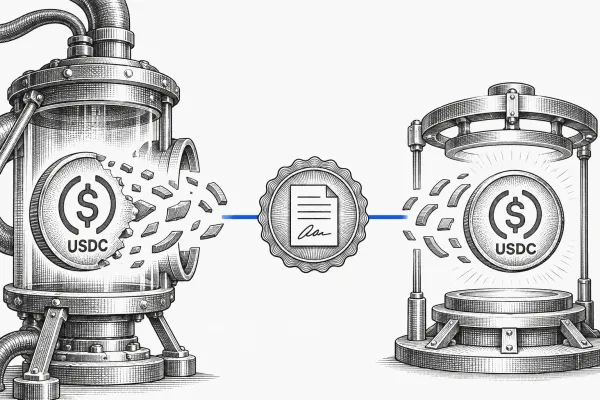
A bridge can deliver native USDC or a bridged representation, depending on its mechanism. Circle's walkthrough explains that CCTP burns native USDC on the source chain and mints it on the destination chain. Check the actual route and output token rather than assuming that every bridge produces the same asset. If the receiving network is Base, use the separate Base contract and transfer checks; the Polygon address above doesn't identify Base USDC.
Check the destination before sending
- Ask the recipient for the receiving address and confirm USDC on Polygon PoS. For an exchange deposit, use the network and instructions shown inside that account.
- Confirm native USDC versus USDC.e. If the receiving service doesn't make this clear, stop and ask its support team before transferring.
- Read any deposit minimum, confirmation requirement and service restrictions. For Coinbase or another exchange, use its current deposit options; an old announcement or a currency-converter page doesn't establish what your account accepts.
- Choose the matching asset and Polygon network on the sending side. Review the destination address, amount received and total fee.
- Where the destination's minimum allows it, send a small test amount and wait for it to be credited. Send the remainder only after the receiving account shows the expected asset.
Circle's Polygon USDC page specifically warns against sending bridged USDC.e to Circle Mint. That restriction concerns Circle Mint and its APIs; it doesn't mean every wallet or exchange has the same deposit policy. Check your actual recipient.
Keep POL available for a normal wallet transfer
Polygon's token documentation identifies POL as the network's gas token, replacing MATIC. For a normal self-custody transfer, keep enough POL on Polygon to cover the wallet's fee estimate. A USDC balance alone doesn't pay that native gas fee.
Use the estimate shown for your transaction instead of budgeting a fixed dollar fee from an article. An exchange withdrawal may charge its own fee under different rules. Follow the terms of the route you're using rather than buying an unrelated token on another network.
If the transfer was sent but the balance is missing
Find the transaction hash in the sending wallet or service. Open it on an explorer for the network that processed it, and check the status, recipient and transferred token contract. A successful on-chain transfer and a credited exchange deposit are different checkpoints.
If the transfer is still pending, don't repeat it just because the receiving balance hasn't changed. If it succeeded to your own wallet, check Polygon and the relevant token contract in that wallet. For an exchange deposit, compare the receipt with its supported network, token and deposit rules, then send the transaction hash to official support if credit is missing. Recovery of an unsupported deposit is a service decision, not a result this checklist can promise.
Keep your recovery phrase and private keys private. A transaction hash can identify the transfer for support; sharing wallet secrets gives someone control of the funds.
Keep mainnet and testnet separate, too. Circle lists Polygon PoS Amoy USDC under testnets and states that testnet tokens have no financial value. Adding a mainnet token to a wallet won't turn an Amoy balance into spendable mainnet USDC. Before your next transfer, return to the bridges and tokens hub and choose the checks for your recipient's network.