Chain Bridge

Contents
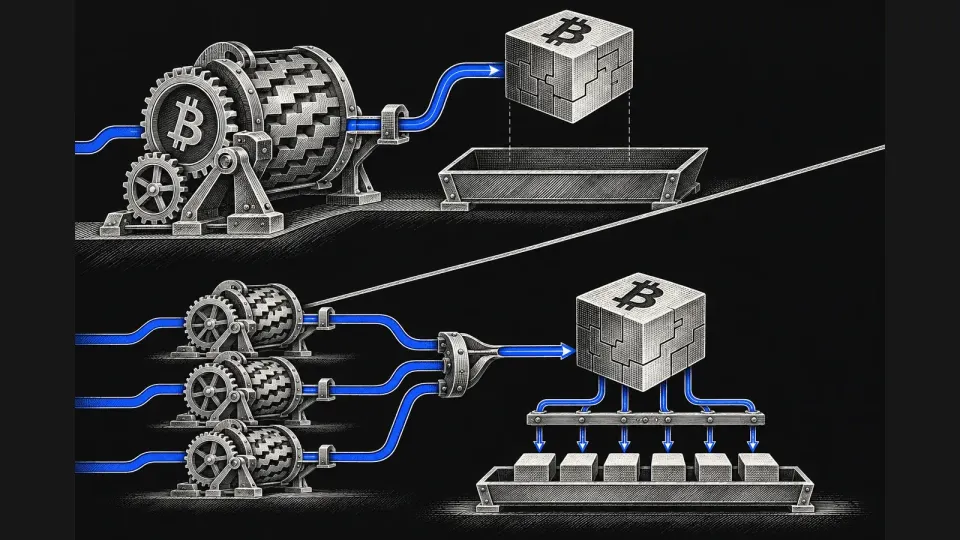
Choose a shared-reward Bitcoin pool if mining receipts need to help cover recurring costs. Choose solo mining only when you can afford your chosen operating period with no block reward at all. I'd make shared rewards the default for a working mining budget: solo mining keeps the reward from your own accepted block, but it can leave you paying bills through a very long dry spell.
A hosted service called a “solo pool” can still be solo mining. The deciding question is who receives the reward when another participant finds a block. If that reward isn't shared with you, the service hasn't pooled your payout risk.
Separate reward sharing from the mining infrastructure
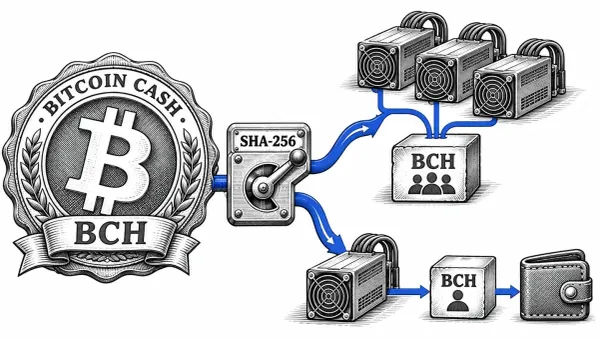
The Bitcoin developer guide's mining overview distinguishes solo block rewards from rewards shared among pool participants. Both routes still depend on useful hashing work and valid blocks. Pooling changes how the proceeds are distributed.
Scroll sideways to compare every column of the three routes.
| Route | What earns your reward? | What you rely on |
|---|---|---|
| Shared-reward pool | Your accepted contribution under the pool's accounting rules; you can earn when another participant finds the block | Operator accounting, fees, withdrawal rules and service availability |
| Hosted solo service | Your own valid block accepted by the network, less any service fee | The service's work delivery, node connectivity, reward construction and block submission |
| Self-hosted solo | Your own valid block accepted by the network | Your node, mining backend, connectivity, configuration and maintenance |
For example, solo.ckpool's own service description explicitly says it isn't a shared pool despite its name. It supplies the solo infrastructure and charges a 2% fee. Other participants finding blocks there don't create proportional rewards for your ordinary shares. Read any other service's actual reward terms before assuming it works the same way.
A share meets an easier reporting target than a Bitcoin block. In a shared pool it helps account for contributed work; in a solo service it can show that your miner is working. Lowering that reporting difficulty can make shares appear more often, but it doesn't increase the probability that a given hash meets Bitcoin's block target.
Compare expected return separately from payment timing
Under equal useful work, difficulty and block-value assumptions, fair pooling preserves a miner's expected gross reward while reducing its variation. Meni Rosenfeld's analysis of pooled mining derives that relationship. A larger pool doesn't make your hardware calculate more hashes, and solo mining doesn't create an expected-return bonus simply because you keep a whole found-block reward.
If a shared pool credits your worker with finding a block, its reward is still distributed under the agreed pool rules. Keeping that block's full reward would require the solo arrangement to have been in place beforehand. Looking back at a lucky pool submission doesn't establish what an alternative solo run would have earned.
Net results can differ because of commissions, stale or rejected work, service outages and the handling of transaction fees. Self-hosting can remove an external service commission while adding node and maintenance costs. A poorly maintained solo setup can also waste otherwise useful work. Compare those costs before calling a fee saving a profit advantage.
Shared rewards also have different timing. PPS-style accounting credits accepted work without waiting for the pool's own next block; PPLNS distributes actual block rewards across eligible work. A shared PPLNS pool can still have quiet periods, while a withdrawal threshold can delay either method's arrival in your wallet. “Pool mining” alone doesn't promise daily payments.
A solo block reward also has a spending delay. Bitcoin's coinbase maturity rule prevents spending that newly created reward for at least 100 blocks. Finding a block and having spendable funds aren't the same moment; a block lost from the accepted chain doesn't leave a spendable reward.
Calculate the chance over the period you can fund
Use a useful hashrate estimate that reflects uptime and work losses, then choose the period you can afford. The Bitcoin Wiki's difficulty formula gives the approximate mean interval between found blocks as D × 2^32 / h seconds, where D is network difficulty and h is hashes per second. One TH/s is one trillion hashes per second; one PH/s is one thousand TH/s.
For a fixed hashrate and difficulty, the Poisson model in Rosenfeld's analysis gives λ = h × t / (D × 2^32) expected blocks in t seconds. The probability of at least one is 1 − exp(−λ). Expected blocks and the probability of a block are different quantities.
The following is a hypothetical calculation: difficulty stays at 150 trillion for a full 365-day year, useful hashrate stays constant, and invalid or stale work is excluded. These are neither today's network measurements nor a forecast. The very long mean intervals show the scale of the choice under frozen conditions.
Scroll sideways to read the calculated probabilities and mean intervals.
| Useful hashrate | Chance of at least one block in 365 days | Mean interval at the same fixed conditions |
|---|---|---|
| 1 TH/s | About 0.004895% | About 20,429 years |
| 200 TH/s | About 0.974% | About 102 years |
| 10 PH/s | About 38.71% | About 2.04 years |
Even the 10 PH/s example has a greater than 60% chance of finding no block during that year. There is no universal hashrate at which solo mining becomes sensible: the relevant combination is useful work, current difficulty, operating costs, your funding horizon and tolerance for a zero-reward outcome. Update the inputs when conditions change.
Read a mean waiting time without starting a countdown
After one calculated mean interval, the chance of at least one block is about 63.21%, leaving 36.79% for zero blocks. A calculator saying “one block every X days” isn't promising a block by day X. The chart shows the probability from the start of each stated interval.
Select Enlarge image to read the details.
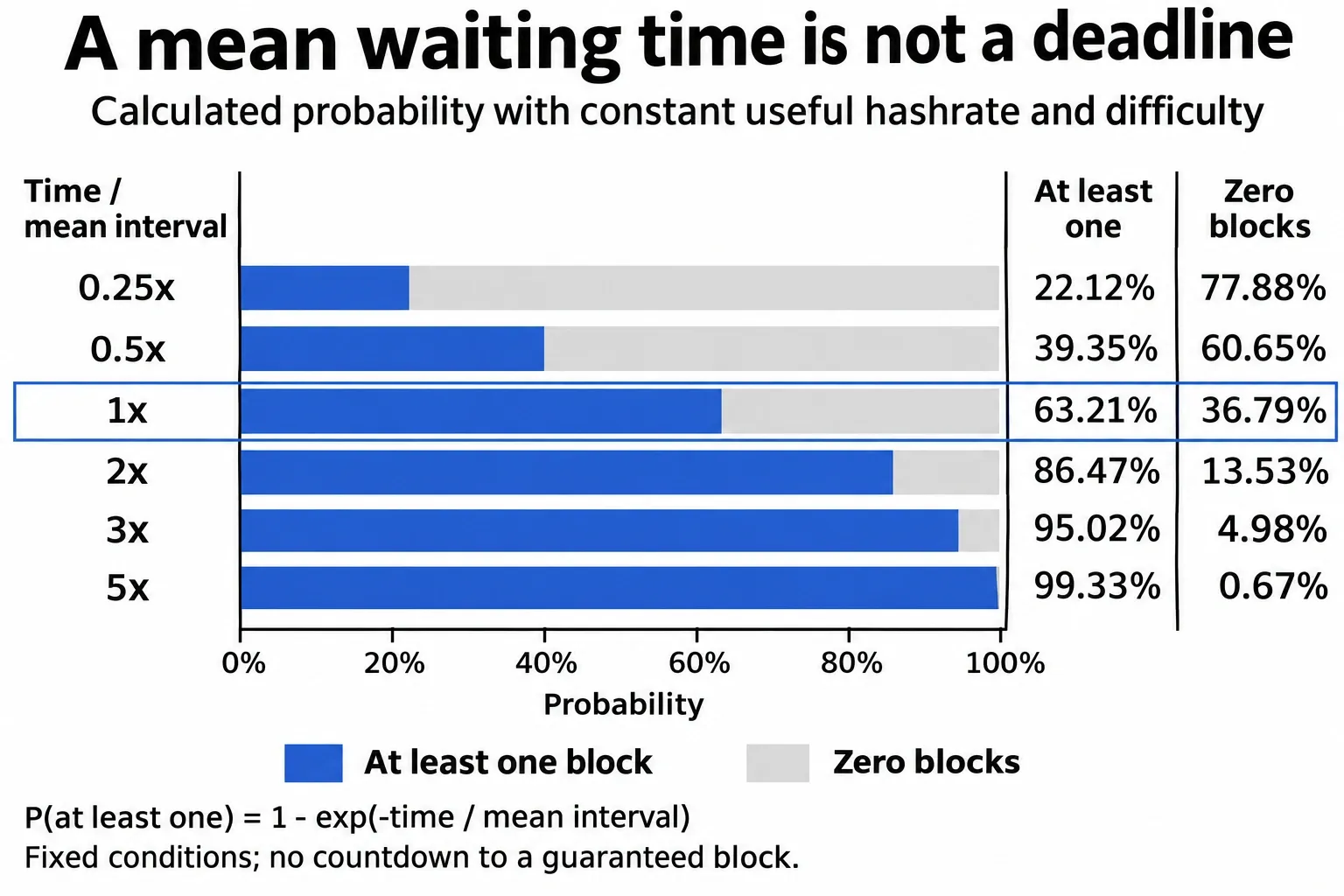
Block finding is memoryless under those fixed conditions. If you have already waited one mean interval without a block, the probability for the next equal interval remains 63.21%. The chart's 86.47% at two intervals describes the whole two-interval period before it begins; it isn't the conditional chance after an unsuccessful first interval.
Your best share records a past hash result. It doesn't accumulate credit toward a future block or make one overdue. More useful hashing increases the number of opportunities; a long losing streak doesn't improve the next hash's odds.
Keep reported wins and dry spells in their original conditions
Two published Litecoin reports show why a success story is a poor budget forecast. In nehgekim's January 2018 week-eight update, the solo experiment still had zero mainnet blocks, with 1.9 GH/s reported at that point. Earlier updates show changing hashrate, so eight weeks cannot be treated as a constant-1.9-GH/s trial. The testnet successes discussed in the same post are a separate result.
In a January 2019 report by DigiHODL, one L3+ had found one block in two months, initially without running around the clock. These are two users' historical Scrypt/Litecoin observations with different dates, equipment and uptime. They provide no matched average, no Bitcoin hashrate threshold and no evidence that copying the successful miner will reproduce that outcome.
The original experiment also changed its reward arrangement later. Its follow-up about rental funding says unlucky periods became unaffordable after the project had moved into a different shared setup. That experience supports a concrete planning question: can you fund the dry spell without depending on the next block arriving?
Choose the risk your budget and operating setup can carry
Write down the cash you will spend even if solo revenue is zero: electricity, hosting, repairs and any node or service costs. Keep the equipment purchase separate from recurring bills so both remain visible. In a simple energy example, a constant 3 kW load for 30 days uses 2,160 kWh; at $0.10/kWh, energy alone costs $216. Use measured whole-setup power and your actual tariff, including applicable charges, for your own budget.
I'd use shared rewards when the purpose is to offset those recurring bills, then compare the operator's accounting method, commission, minimum withdrawal and unpaid-balance exposure. Smoother receipts can still fall short of expenses. Solo is an optional risk allocation when the whole planned zero-reward cost is affordable, not a repair for an unprofitable machine.
Splitting hashrate lets you limit that allocation. In the fixed-difficulty example above, sending half of the 200 TH/s to solo makes its one-year chance about 0.488%, down from 0.974% with all 200 TH/s there. The shared side earns under its own rules. Splitting doesn't multiply your total expected gross reward or guarantee that the pooled portion pays the power bill.
Choose a hosted solo service when you accept its fee and operational dependence in exchange for avoiding your own node/backend maintenance. Choose self-hosting for direct control of that infrastructure only if you will keep it synchronized, connected and monitored. A modern Stratum ASIC needs a mining backend between it and Bitcoin Core; pointing it at a node's RPC port isn't a complete solo setup. The Bitcoin Core setup route covers the node's part of that job.
Before changing endpoints, obtain a receiving address from a wallet you control and verify the service's format. Pool fields need no seed phrase or private key. Confirm active jobs and accepted work after connecting; a local hashrate display alone doesn't establish useful work at your chosen endpoint. For an ESP32 device, use the NerdMiner pool compatibility checks: a conventional ASIC pool's payout label doesn't establish support for ultra-low share difficulty.
Start with the reward contract, calculate the zero-reward horizon you can fund, and choose the infrastructure you can maintain. The mining library separates hardware, pool connections and node tasks when you're ready to act on that choice.