Chain Bridge

Contents
Choose a Scrypt ASIC by its exact power requirements before comparing advertised mining income. For a smaller installation, I'd shortlist a lower-power model such as the ElphaPex DG 2 Mini; an Antminer L9 belongs on a shortlist only when its industrial electrical supply and cooling requirements fit the site. Both are Scrypt machines, but their purchase costs, output and operating demands need separate estimates.
Confirm Scrypt support before choosing a coin
A Scrypt ASIC is dedicated hardware for Scrypt mining work. Dogecoin's mining guide describes Scrypt-specific ASICs and merged mining with Litecoin. The ASIC does the hashing; a computer used to configure or monitor it doesn't supply the advertised mining performance.
An ASIC isn't automatically a Bitcoin miner. LitecoinPool's compatibility FAQ distinguishes Litecoin's Scrypt from Bitcoin's SHA-256d: a Bitcoin ASIC can't become a Litecoin miner just by changing its pool address. Match the algorithm on the manufacturer's exact model specification, then check support at the intended pool.
Compare the exact model and operating mode
These two examples show different site requirements. The figures below are manufacturer specifications at the stated conditions. They aren't a ranking of every available Scrypt miner, and a model name shared across listings doesn't establish an identical batch or performance tier.
| Specification | Antminer L9 | ElphaPex DG 2 Mini |
|---|---|---|
| Scrypt hashrate | 16 GH/s typical; actual variation ±3% | 2.4 GH/s listed |
| Wall power at 25°C | 3,360 W typical; actual variation ±5% | 550 W ±10% |
| Wall energy efficiency at 25°C | 210 J/GH typical; actual variation ±5% | 230 J/GH ±10% |
| AC input voltage | 220–277 V, single-phase | 100–240 V |
| Network connection | RJ45 Ethernet | RJ45 Ethernet or Wi-Fi |
| Published temperature range | Operation: −20 to 45°C | Storage and operation: 0 to 40°C |
Focus the table and scroll sideways to read all columns.
BITMAIN's L9 specification supplies the L9 column; ElphaPex's DG 2 Mini product details supply the compact model's column. Both manufacturers reduce the maximum operating temperature with altitude in the specified higher-altitude range. Check that limit for the installation rather than using the headline temperature alone.
The L9's lower listed joules per gigahash means less nominal energy per unit of Scrypt work at those stated values. It doesn't mean a lower total electricity bill: its listed hashrate and wall power are much higher. The figures have tolerances, so they don't establish a measured efficiency advantage for every delivered unit.
I'd use the manufacturer's specification to resolve a catalogue conflict. For example, Hashrate.no's Scrypt table lists the DG 2 Mini at 530 W, while ElphaPex's product page specifies 550 W ±10% at 25°C. Use the latter as the documented planning basis unless the supplier provides a different applicable manufacturer specification for the exact unit and mode being sold. Don't average those entries into a supposed test result.
Give the candidate a workable power and cooling route
A 120 V supply falls within the DG 2 Mini's published input range; it falls outside the L9's 220–277 V range. That makes the compact model a possible voltage match, not approval to use any household outlet. Confirm the actual PSU, cord, connector, circuit capacity and other loads before ordering. An adapter changes a connection, not the supply voltage or the circuit's capacity.
The daily energy requirement makes the size difference easier to budget. At a constant nominal wall draw for 24 hours, the L9 calculation is 3.360 kW × 24 = 80.64 kWh; the DG 2 Mini calculation is 0.550 kW × 24 = 13.2 kWh. These are calculated planning values at the listed power, excluding external cooling. They don't predict actual uptime, measured consumption or equal mining output.
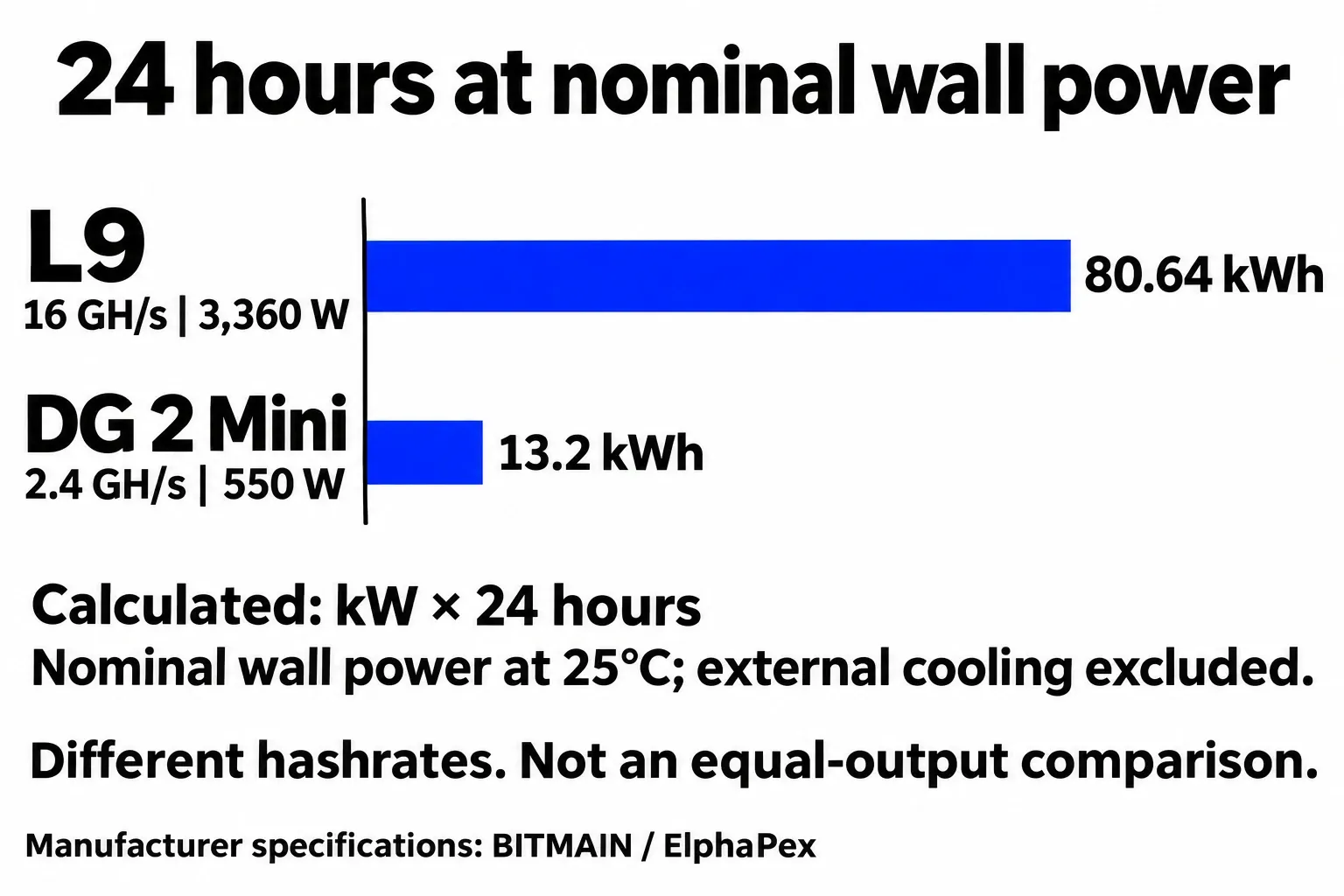
Multiply the appropriate kWh estimate by your effective electricity price, then add separate ventilation or cooling consumption. Keep the calculation consistent with the operating mode behind the revenue estimate. A reduced-power profile needs its own supported hashrate and wall-power evidence.
Plan where inlet air comes from and where hot exhaust leaves. Compare the inlet conditions with the exact machine's operating limits, including seasonal conditions and altitude. Check the cooling type in the offer: a similarly named variant may require a different cooling system. Resolve that requirement before treating it as an alternative for the same site.
Noise needs its own evidence. BITMAIN lists the L9 at 75 dBA at 25°C with the fans at maximum RPM, but that specification doesn't establish the sound level at your desk. The cited DG 2 Mini product page provides no noise figure. I wouldn't buy it for a bedroom on the strength of its smaller size or a seller's “quiet” label. Ask for an applicable operating-noise demonstration and the conditions behind it.
Check the network route too. The L9's listed connection is Ethernet; the DG 2 Mini also lists Wi-Fi. Match the actual installation to supported connectivity rather than assuming every compact ASIC has wireless networking.
Separate compatible work from coins paid to you
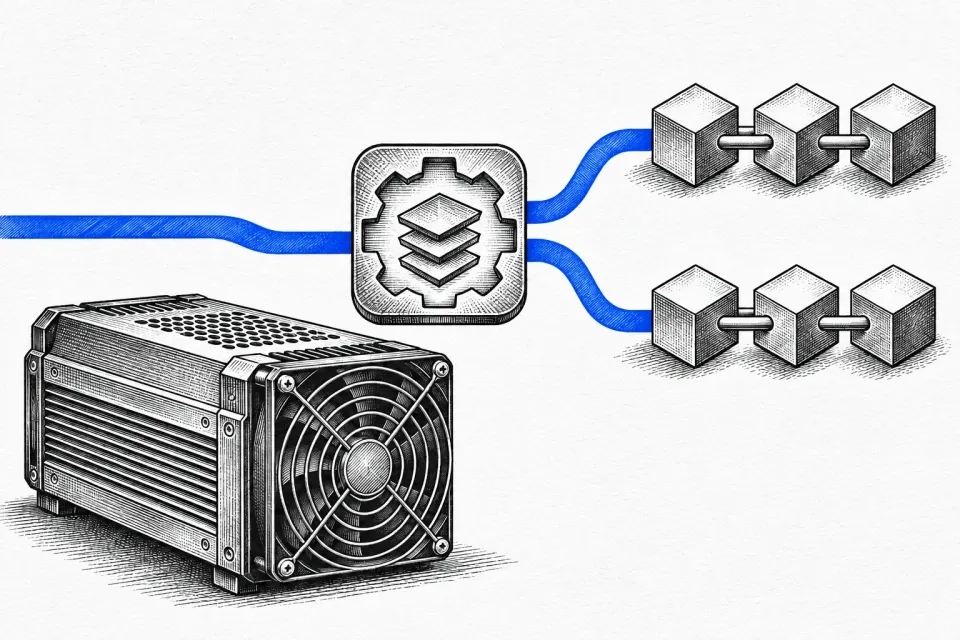
Merged mining can let compatible Scrypt work support Litecoin and Dogecoin together. It doesn't mean buying two machines or doubling the hashrate on the specification sheet. The pool's supported chains and reward rules determine which rewards reach your account and in what form.
For example, LitecoinPool's merged-mining FAQ explains that its pool handles merged mining automatically. Its account setup requires Litecoin and Dogecoin receiving addresses. Other merged-mined coins listed in its FAQ help support its LTC/DOGE PPS reward ratio rather than being paid directly as those extra coins. A miner manufacturer's list of compatible coins isn't a promise that your chosen pool will send each one to you.
Before buying, establish the pool's exact reward method, paid assets, fees and withdrawal conditions for the intended route. In a profitability calculator, count a merged-mining revenue total once. Adding that total to its already-included LTC and DOGE components inflates the estimate. Keep electricity, applicable service charges and conversion costs visible without deducting fees twice.
Finish the shortlist with a complete offer
Ask the seller to identify the exact model, hashrate tier, cooling type, operating mode, included power equipment and the specification that applies to delivery. Older and newer variants can share a family name. A stock photo and a daily-profit box don't resolve what you will receive.
Compare the delivered equipment cost with the electrical, cooling and network work needed to operate it. Include applicable shipping, import charges and taxes. A positive operating margin still has to recover that initial cost. Recalculate with weaker revenue, downtime and repair costs before committing to a purchase. Check who handles repairs and what happens if the delivered unit doesn't match the agreed model or performance conditions.
Warranty terms can change the value of a reseller offer. ElphaPex's cited DG 2 Mini page states that its 180-day warranty begins on the shipping date and applies to the original direct purchaser; after resale, warranty responsibility lies with the reseller. The page also excludes shipping, customs duties and applicable taxes from the retail price and states that submitted orders can't be cancelled or refunded. Resolve the actual seller's terms before payment rather than assuming manufacturer coverage transfers.
My shortlist would start with the DG 2 Mini where its lower nominal power and supported supply fit the intended installation. I'd consider the L9 where the higher-output installation is already feasible and the complete cost estimate still works under weaker revenue and downtime assumptions. If neither has a suitable site or credible economics, postpone the purchase. The mining library provides the next route for pool activation, electrical planning or operating-cost checks.