Chain Bridge

Contents
Choose PPS-style accounting when you need rewards credited for accepted work without depending on your pool finding a block. Choose PPLNS when you can absorb uneven block rewards and its actual fees make that trade worthwhile. For Bitcoin, compare FPPS and PPS+ too: the treatment of transaction fees can change the result more than the acronym suggests.
I'd start with FPPS if mining receipts need to help cover a regular electricity bill. That reduces exposure to the pool's block-finding luck; it doesn't guarantee enough income to pay the bill. Your accepted work, network difficulty and operating costs still matter, and an unpaid pool balance remains a claim on the operator.
Compare the reward components before comparing fees
A pool share is a proof of work that meets the pool's easier target. It lets the operator account for your contribution without waiting for you to find a Bitcoin block. Compare difficulty-weighted accepted work, rather than raw share counts: shares at different assigned difficulties don't represent equal work.
PPS means Pay Per Share. In the classical model, each accepted share earns its expected share of the block subsidy, less the pool's commission. PPLNS means Pay Per Last N Shares: a found block's reward is allocated across eligible work in a recent window. Meni Rosenfeld's analysis of pool reward systems explains the central difference: PPS transfers block-finding variance to the operator, while PPLNS leaves that variability in the miners' rewards.
Bitcoin block income has a subsidy and transaction fees. A pool commission is the separate charge the operator deducts. The f2pool payout-scheme definitions distinguish the following methods. Check the specific coin's terms before treating a pool's label as a complete contract.
On a phone, scroll sideways to read every reward component.
| Method | Subsidy accounting | Transaction-fee accounting | Pool-luck exposure |
|---|---|---|---|
| PPS | Expected value of accepted work | Excluded in the classical subsidy-only model | The operator bears subsidy variance |
| FPPS | Expected value of accepted work | An estimated or averaged fee component under the pool's formula | Both components are smoothed against the pool's own block luck |
| PPS+ | PPS | PPLNS allocation of fees from blocks actually found | The fee component remains variable |
| PPLNS | Actual blocks allocated across the eligible window | Actual fees, when included in that pool's terms | The miner bears variation in actual block rewards |
For a concrete hybrid, ViaBTC's published PPS+ rules charge 4% on the subsidy component and 2% on the transaction-fee component. Its PPLNS option charges 2% on both. Calling the whole PPS+ reward a fixed payment would hide the variable part.
FPPS formulas also differ. Braiins' FPPS specification calculates a daily subsidy component and a trimmed average transaction-fee component, then deducts its pool fee. FPPS therefore smooths the pool's own luck; it doesn't freeze your BTC earnings across difficulty changes or guarantee an unchanged dollar value.
Follow your work through the PPLNS window
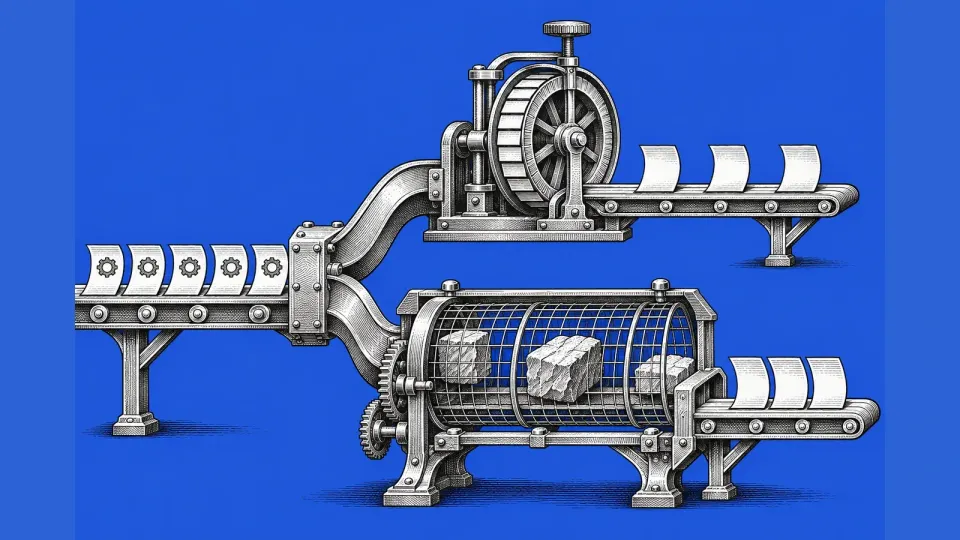
The N in PPLNS describes a work window, not a universal number of hours or the last N blocks. A pool can express that window as a quantity of normalized shares or a multiple of network difficulty. A larger window generally spreads a share's possible rewards across more block opportunities, while extending the time before that share finishes earning.
When you join, you have little historical work in the window. As you submit work, your portion grows. After you stop, eligible work can continue earning from subsequent blocks until it leaves the window. The window's progress depends on work submitted to the pool, so don't assume a fixed waiting time from another pool's guide.
Pool size affects the pattern too. A smaller PPLNS pool can have longer gaps between blocks and more uneven receipts over the same calendar period. A longer window can smooth the allocation of your work, but it cannot create blocks the pool hasn't found. Choosing a larger pool doesn't by itself increase the expected value of each unit of your work.
An interruption doesn't inherently impose an extra penalty on every earlier share. Rosenfeld's analysis of intermittent mining in fair, hopping-proof reward methods separates expected payment per share from the greater variability an intermittent miner can experience. That property requires the described accounting design; it isn't proof that every service using the PPLNS label implements identical rules.
For example, ViaBTC specifies a five-difficulty-round window and distribution after a block reaches six confirmations. Those are its rules, not a definition of every PPLNS pool. Before switching methods, check how the operator handles already submitted work and method changes. Don't assume a switch retroactively converts that work into PPS credits.
Read a short earnings comparison with its conditions
A published ViaBTC comparison by mikeywith reports roughly 800 TH/s on PPLNS from December 12–18, 2021. Across those seven daily entries, the median was 0.00352051 BTC, with a range of 0.00221123–0.00422250 BTC. The seven-day total was 0.02481428 BTC.
The same operator then reported two PPS+ days, December 20–21, averaging 0.004345625 BTC per day, after maintenance and a change of method. These are different dates and observation lengths, without a matched accepted-work record. They show the uneven daily receipts in that PPLNS run; they don't establish a percentage advantage for PPS+ or a forecast for today's hardware.
Select Enlarge image to read the details.
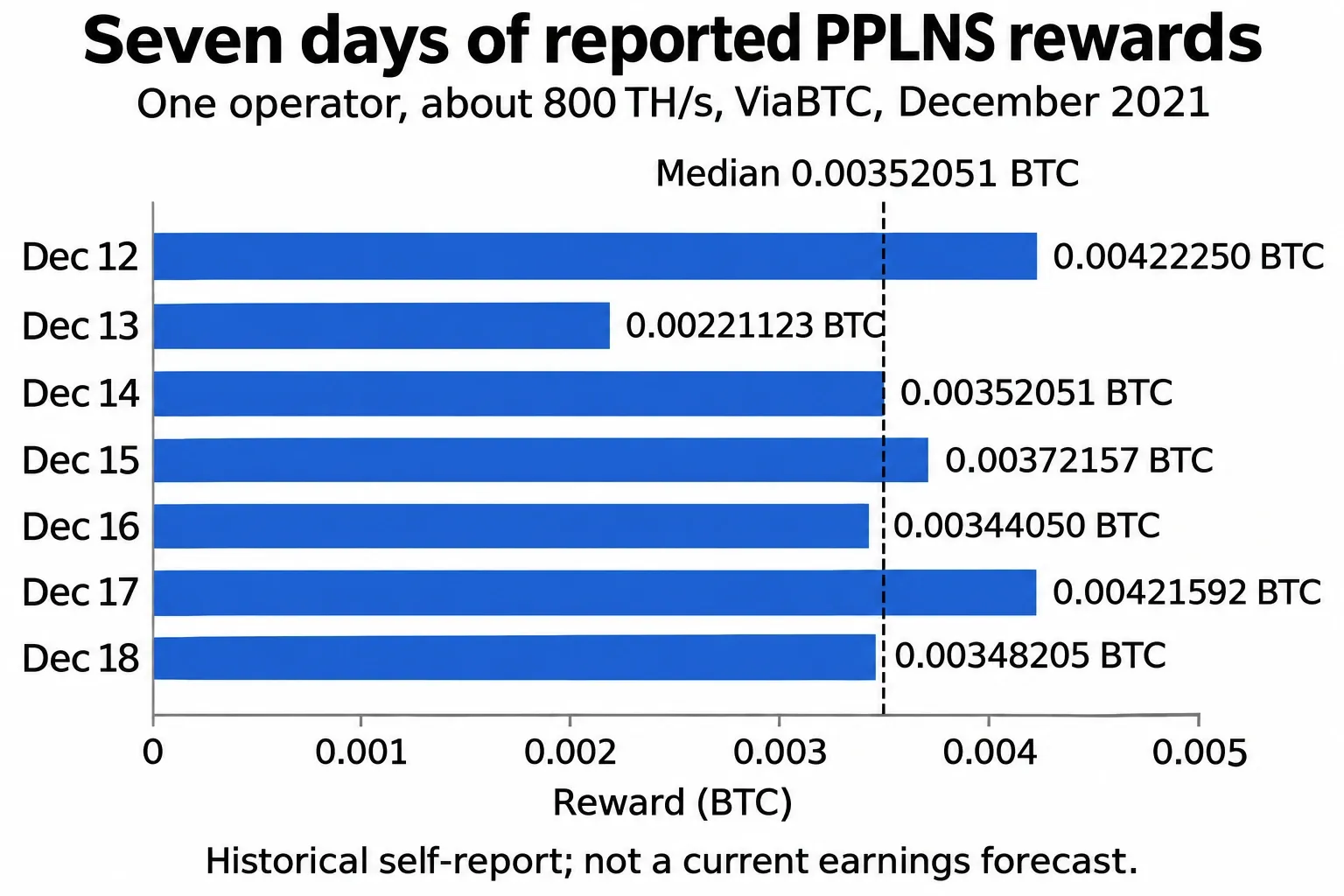
I wouldn't combine this run with unrelated miners' results to produce an average pool ranking. A useful comparison needs the same amount of accepted work and comparable reward conditions. A few quiet PPLNS days are also insufficient evidence of a broken connection: check accepted work and the pool's actual block results separately.
Calculate the fee difference on the same gross reward
The f2pool Bitcoin guide lists a 4% FPPS commission and a 2% PPLNS commission. That creates an expected fee saving for PPLNS under otherwise equal reward assumptions. It doesn't make PPLNS pay more in every period.
Here is a hypothetical calculation, not a mining measurement. Assume the same accepted work has a gross expected subsidy-plus-fee value of 100,000 satoshis. Hold difficulty and the fee valuation constant, ignore withdrawal costs, and suppose the FPPS formula credits that expected value. For the PPLNS rows, vary the actual gross reward attributable to that work; the percentages below are defined against this example's 100,000-satoshi baseline.
Scroll sideways to read the assumptions and net amounts.
| Scenario | Gross reward | Commission | Net credited reward |
|---|---|---|---|
| FPPS at the assumed expected value | 100,000 sats | 4% | 96,000 sats |
| PPLNS actual reward at 80% of baseline | 80,000 sats | 2% | 78,400 sats |
| PPLNS actual reward at 100% of baseline | 100,000 sats | 2% | 98,000 sats |
| PPLNS actual reward at 120% of baseline | 120,000 sats | 2% | 117,600 sats |
At the same gross value, the fee difference is 2,000 sats, or about 2.08% of the 96,000-sat FPPS net amount. In this simplified example, PPLNS matches FPPS when its gross reward reaches about 97.96% of the baseline: 96,000 divided by 0.98. These are arithmetic thresholds, not probabilities of a good month.
The equal-gross assumption matters. Comparing subsidy-only PPS against PPLNS that also includes transaction fees changes two variables at once. An FPPS operator can also use a different network-fee average from the actual fees a PPLNS pool earns. Compare the reward components before attributing every difference to commission.
Choose a method your cash flow can support
- Regular bills and little room for uneven receipts: favor a documented FPPS arrangement, or PPS+ if you're comfortable with its variable transaction-fee component. Check the operator and withdrawal rules before relying on the balance.
- Enough reserves to tolerate variable rewards: consider PPLNS when the verified fee saving is worthwhile. Judge it over an appropriate work window, including rewards still attributable to work after you stop.
- Short sessions or frequent interruptions: PPS-style credits are easier to reconcile. Fair PPLNS doesn't automatically confiscate earlier work, but its delayed and uneven receipts may be inconvenient.
Accrual and withdrawal are separate. A pool can credit PPS-style rewards while your balance remains below its payment threshold. For example, f2pool lists a default Bitcoin threshold of 0.005 BTC; reaching it is separate from earning each credit. An apparent zero wallet payment doesn't by itself diagnose the reward method.
For a tiny ESP32 device, establish NerdMiner pool compatibility first. A conventional ASIC pool's accounting policy doesn't establish support for ultra-low-difficulty work, and a minimum payout can be impractical for a very small contribution. Neither PPS nor PPLNS increases the hashing capacity of the device.
Before moving hashrate, record the method and fee for the specific coin, then confirm the withdrawal threshold and treatment of unfinished work. Keep the previous working endpoint so you can recover from a connection problem. The mining guides provide the next route once you've chosen the reward arrangement.