Chain Bridge

Contents
For a small Bitcoin ASIC, I'd start with Braiins Pool if you want FPPS rewards and can use its low-threshold payout options. Consider f2pool when its Bitcoin withdrawal threshold fits your output and you want a choice between FPPS and PPLNS. Choose OCEAN when direct block-reward payments and control over block construction matter enough to accept variable receipts and its payout requirements.
The best Bitcoin mining pool is one you can use, reconcile and withdraw from. A large share of network blocks doesn't establish those conditions. This choice concerns an ASIC you own or can direct through a hosting provider; buying a cloud-mining contract is a separate decision.
Confirm that you can choose the pool
Check your ASIC's supported algorithm and connection requirements first. The f2pool Bitcoin mining guide specifies SHA256d ASICs and an account-based connection. A pool's support for Bitcoin doesn't establish compatibility with every tiny miner: an ESP32 device needs the separate NerdMiner pool compatibility checks.
With hosted hardware, ask who controls the pool endpoint and payout address. Get confirmation that you can change them, inspect the worker's accepted work and recover the previous configuration. If the host fixes the pool or receives the rewards before settling with you, the hosting agreement determines part of your choice.
Then check the operator's current account and location rules for your circumstances. A US server address is a connection location, not proof that every US applicant qualifies. Don't move hashrate until the account and receiving route you need are available.
Keep shared-pool services separate from solo endpoints in the same directory. A solo endpoint offers a different reward outcome, so its low fee isn't an equivalent substitute for the shared rewards considered here.
Match the shortlist to your payout and control needs
These published terms identify useful starting points. They don't rank measured earnings. The fee belongs beside its reward method, and a special firmware or negotiated rate needs its own conditions.
On a phone, scroll sideways to read the full comparison. You can also focus the table and use the arrow keys.
| Pool and reason to consider it | Published reward terms | Decisive payout or setup check |
|---|---|---|
| Braiins Pool: small contributions and smoother credits | FPPS; ordinary published pool fee 2.5% | On-chain minimum 0.0002 BTC; 0.0001 BTC charge below 0.005 BTC. Lightning supports 1 satoshi through 0.005 BTC, with no pool payout fee. |
| f2pool: conventional account management and method choice | Bitcoin FPPS 4% or PPLNS 2% | Lowest listed Bitcoin threshold is 0.005 BTC, also the default. Larger selectable thresholds are available. |
| OCEAN: address-based mining and block-template choice | Published fee 2%; 1% for miners making their own blocks through DATUM | Lightning uses BOLT12 with address-ownership signing and a compatible receiver. The documented on-chain fallback threshold is 0.01048576 BTC. DATUM requires a synced Bitcoin node and gateway. |
Braiins' reward and payout terms make it my first shortlist entry for a small miner who needs FPPS accounting and an achievable withdrawal route. Its FPPS formula smooths the pool's own block luck; network conditions still change rewards. Frequent small on-chain payouts can be expensive, so the low minimum alone isn't a reason to use that route.
The f2pool Bitcoin account and payment rules suit a miner whose output supports the threshold and who wants to choose the reward arrangement within one service. PPLNS leaves receipts dependent on actual block results. Its lower listed commission doesn't establish higher receipts over your chosen week.
OCEAN's published fees and direct-payment model offer a different priority: newly generated bitcoin paid from block rewards, with no ordinary account required to start. Its TIDES reward design allocates actual block income, so budget for uneven receipts. For the discounted own-template route, the DATUM setup requirements add a synced node and gateway. Start with the Bitcoin node guide if that prerequisite is new to you.
For a fleet with several people managing operations, I'd also examine Luxor's workspace permissions, change logs and approval workflows. Those advertised controls address an operational need. Ask for the applicable account, fee and withdrawal terms before comparing an offer with the public terms above; the product page doesn't establish a better net return.
Check the route from credited rewards to your wallet
A pool can credit rewards while your wallet receives nothing because the payout rule hasn't been met. Estimate the accumulation time before selecting an operator. Use expected net credited BTC per day for your actual operating schedule, then divide the selected threshold by that amount. This estimates time to eligibility, before payout scheduling or confirmation delays.
Braiins evaluates automatic payout rules daily at 9:00 UTC. f2pool's Bitcoin guide says an eligible balance is paid within 24 hours. Neither schedule means that an on-chain transaction will be confirmed at that exact time.
For a hypothetical constant credit of 1,000 sats a day, a 20,000-sat threshold takes 20 days to accumulate; a 500,000-sat threshold takes 500 days. Those correspond to Braiins' 0.0002 BTC on-chain minimum and f2pool's lowest listed 0.005 BTC threshold. They aren't forecasts for a particular ASIC, and Braiins' small on-chain payment still incurs the charge in the table.
Inspect the payout rule itself before directing the miner. In the Braiins payout-rule controls, the receiving network and wallet are separate choices from the trigger and amount. The 0.1 BTC value below is an example setting, not the default or minimum. Choose the amount for your output and costs.
Select Enlarge image to read the details.
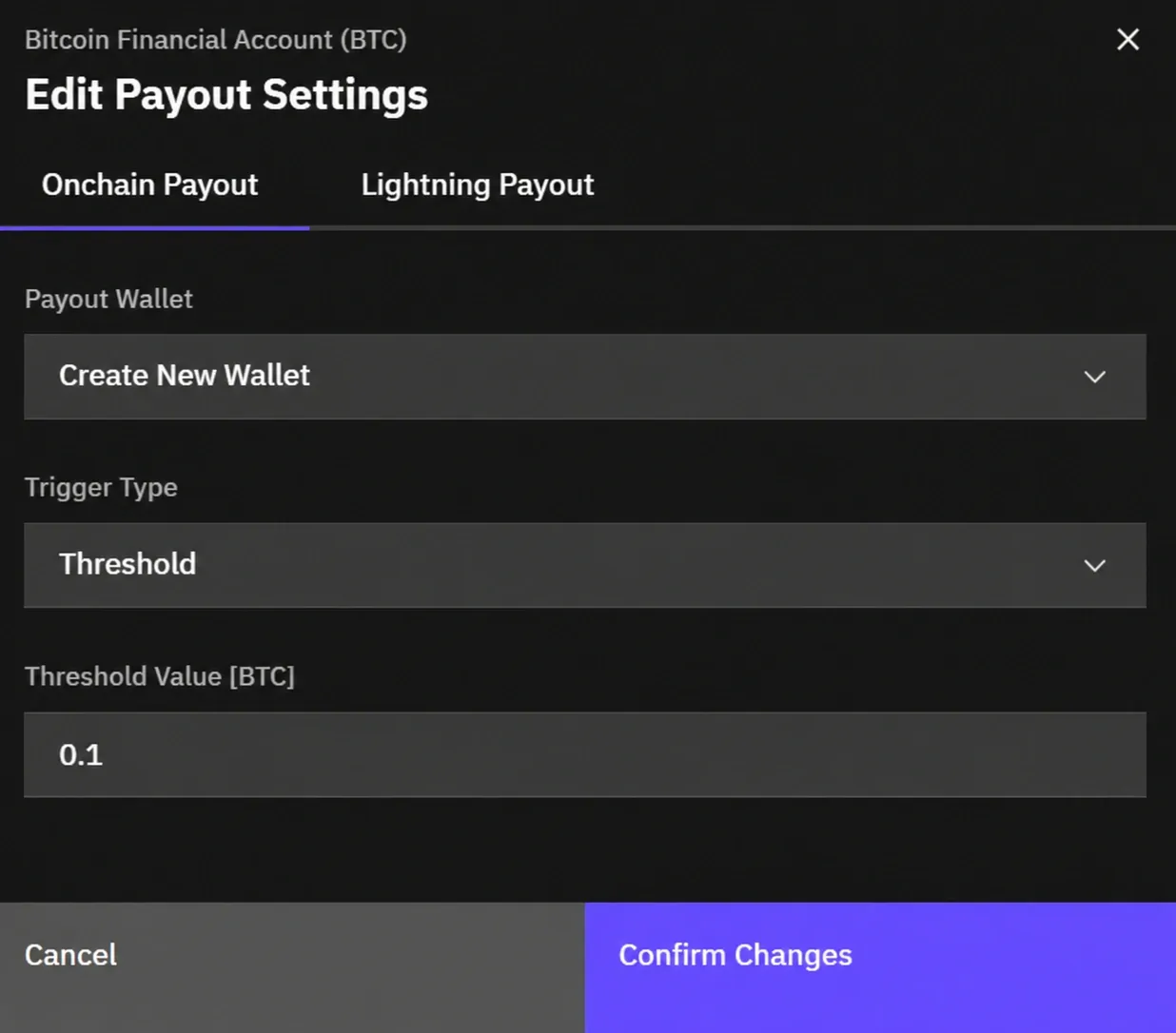
Lightning also needs a usable receiving route. Braiins supports automatic payouts to a compatible Lightning Address; the receiving node must be reachable. A custodial wallet adds another party holding your funds. A self-custodial receiver needs the connectivity and channel capacity to accept the payment.
OCEAN uses a different arrangement. Its BOLT12 payout requirements include an offer, sufficient inbound liquidity and a signed message linking the offer to your mining address. The page also lists wallet-version compatibility problems. Confirm your exact receiver is supported before choosing OCEAN for small Lightning payments; a generic “supports Lightning” label is insufficient.
Require comparable evidence for a profitability claim
Public directories such as MiningPoolStats' Bitcoin pool list help identify operators and reported activity. Their hashrate and block columns don't measure the net amount your worker will receive. A pool with more blocks usually has more contributing work; its miners also share those rewards.
A published ViaBTC trial by mikeywith shows why cash-flow tolerance belongs in the decision. The operator reported about 800 TH/s on PPLNS for December 12–18, 2021. Across seven daily entries, the median reward was 0.00352051 BTC, with a range of 0.00221123–0.00422250 BTC. This is one historical operator's run, demonstrating uneven daily receipts.
The same report's two PPS+ days followed maintenance and a method change. Different dates and observation lengths prevent a matched earnings comparison. I wouldn't turn those figures into a current pool ranking or combine them with unrelated rigs' dollar earnings.
For a useful comparison, record difficulty-weighted accepted work and credited BTC over the same period. Match the treatment of transaction fees, and account for payout charges separately. With block-based rewards, include work still eligible for later rewards; ending the comparison before it settles can distort the result. Keep electricity and hosting costs in the final operating-profit calculation.
Choose with a way to verify and leave
Before switching, save the applicable terms and the old pool's working configuration. Check the settlement rules for the old balance and unfinished reward window. Moving the endpoint doesn't move an unpaid balance into the new service.
Protect control of the receiving address too. For example, Braiins' payout-lock recovery requires a wallet signature; an exchange account may not provide that ability. Confirm you can meet the recovery requirement before locking the setup. Smooth FPPS credits don't remove the risk of money remaining with an operator.
Choose the candidate that meets your payout needs, then verify the matching worker's accepted work and credited rewards after connection. Check the first completed payment at the receiving wallet. The mining-pool category and broader mining guides keep the compatibility and operating tasks together.