Chain Bridge

Contents
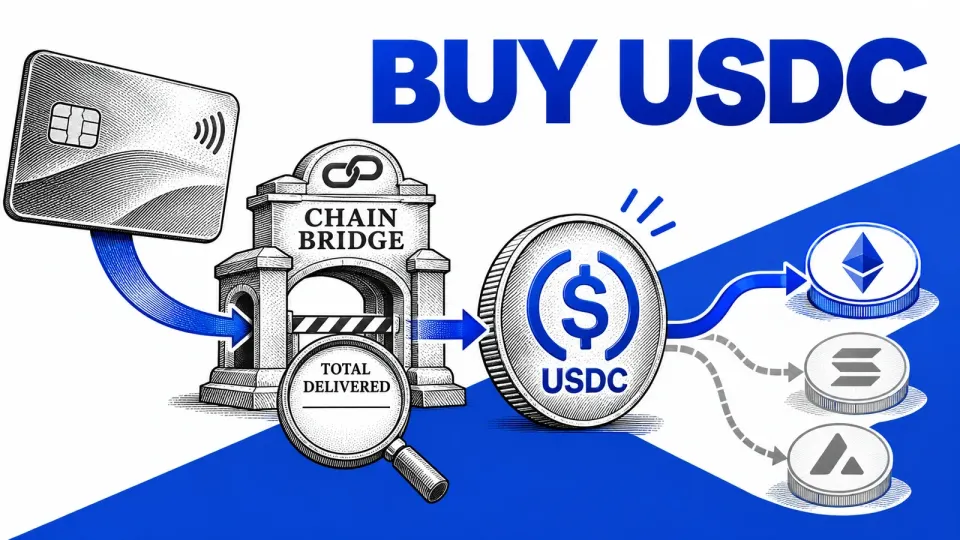
Buy USDC through an exchange or a wallet's payment provider that serves your location, then choose the exact network your destination accepts. Compare the total dollars charged with the USDC you'll receive after delivery fees, and check when you can withdraw it. I'd settle the destination first: a slightly cheaper purchase can become an expensive detour if it leaves your tokens on the wrong network.
For a US buyer, a bank-funded exchange purchase is worth comparing when there's time to wait for funds to become transferable. A card or wallet on-ramp can be more convenient for direct delivery to your own address. Choose using the final quote and withdrawal conditions shown for your account; neither route is automatically cheapest or instant.
Choose the receiving network before paying
Start at the place you'll use the USDC. If you're funding a service, confirm that its deposit instructions accept USDC on your chosen network. For your own wallet, confirm support for that network and token. Circle's USDC contract directory identifies native USDC on each supported chain; the ticker alone doesn't identify the asset.
For example, native USDC on Ethereum and native USDC on Base have different token contracts. A provider must offer the network you need, and the recipient must accept it. Changing a wallet's selected network doesn't transfer the tokens to another chain. Check native USDC versus a bridged token such as USDC.e before paying for a similarly named asset.
Use the receiving address supplied by your wallet or the service's deposit instructions. The token contract in Circle's directory identifies the asset; it isn't your receiving address.
I prefer a direct purchase or withdrawal onto the destination's supported network when the full cost is sensible. Adding a bridge introduces another transaction and another set of support conditions. For USDC received on Base, also plan for ETH on Base if you'll later make an ordinary self-custody transfer, unless your wallet or app sponsors the fee. Receiving USDC doesn't itself provide that gas balance.
Compare an exchange purchase with direct wallet delivery
The routes differ mainly in custody and the extra step between buying and using the tokens. An exchange can hold your purchased balance until you withdraw it. A wallet's on-ramp provider processes payment and sends crypto to the selected wallet. MetaMask's buying guide explains the provider's role: MetaMask compiles quotes, while the selected provider fulfills the order.
| Route | Useful starting point | Check before paying |
|---|---|---|
| Bank-funded exchange | You can wait for the funding hold and want to compare the exchange's available purchase or trading quote. | Account and regional eligibility, funding cost, exact USDC withdrawal network, withdrawal fee and release time. |
| Card-funded exchange | Your supported card is convenient, and the exchange offers the withdrawal network you need. | Payment fee, conversion quote and any withdrawal hold. A completed purchase can still be unavailable to send. |
| Wallet on-ramp | You want delivery to your own supported wallet address through an eligible payment provider. | Provider verification, available payment method, token and network, final amount delivered and payment status. |
Use a provider that supports your actual country or US state and complete its identity checks. A global landing page or a USDC price chart doesn't establish account eligibility. MetaMask filters its purchase options by region, and its guide says exchange purchases also generally require identity verification. If the needed method or network isn't offered, choose another eligible route before sending money.
For the exchange route, complete verification before funding the account, check the payment conditions, and request the USDC purchase quote for your amount. After confirming, verify that the order completed and the USDC was credited. If the destination is outside the exchange, the purchase is followed by a separate withdrawal on the supported network; check its fee and the amount available to send before confirming it.
Buying directly from the issuer is a different service. Circle Mint is for institutional customers and isn't available to individuals buying for personal use. Retail buyers use secondary-market providers; a promise of an unofficial “Circle minting account” shouldn't determine your payment.
Compare dollars charged with USDC delivered
Request quotes for the same dollar budget and destination network. Include payment and processing charges, any spread in the conversion rate, and the fee for getting the USDC to the destination. When a quoted receive amount already includes a deduction, don't subtract that cost again.
USDC's intended $1 value doesn't guarantee a one-dollar retail purchase price after fees. Circle's USDC terms distinguish the intended peg from prices on third-party platforms. Use an executable quote for your own order rather than multiplying the number of tokens by $1 and assuming that's the amount your payment method will be charged.
MetaMask provides a useful concrete example. Its fee explanation for wallet purchases lists a 1% MetaMask fee, calculated on the fiat value requested. The quote's processing fee includes MetaMask's fee together with the provider's fee; its network fee is listed separately. Adding another 1% to that processing fee would double-count MetaMask's share.
Kraken's fee schedule also separates costs that a “zero trading fee” headline can hide: its Kraken+ trading-fee waiver has plan and monthly-volume conditions, and spread and card-processing charges still apply. Kraken Pro uses a separate fee schedule. Compare the route you're using, including any later crypto withdrawal, rather than applying one product's advertised rate to another.
Hypothetical quote comparison: both routes charge your payment method $500 in total. Route A delivers 497 USDC directly to the required wallet. Route B credits 499 USDC at an exchange, then deducts 3 USDC for withdrawal, leaving 496 USDC at the same destination. Route A delivers one more USDC. Its effective cost is $500 ÷ 497, about $1.006 per delivered USDC, compared with about $1.008 for Route B. These are example amounts, not provider quotes.
I'd choose the higher delivered amount only after confirming that both routes meet the deadline and support the same token. If you intend to keep the balance at the exchange, calculate that different endpoint separately. A later on-chain transfer will need its own fee check.
Buy USDC through a wallet provider
MetaMask offers a documented example of the direct-wallet route. Its current support guide covers Mobile v7.61 or later and Extension v13.48 or later. The mobile sequence below uses that guide; available providers and payment methods depend on your region.
Before funding a self-custody wallet, secure the recovery method for the setup you chose. MetaMask's recovery and private-key guidance explains that anyone with your Secret Recovery Phrase or private keys can control your funds. Never provide them to a payment provider or support agent.
- Open MetaMask Mobile and select Buy under the account balance, then choose Buy on the next screen. Confirm the region and currency used for your quotes.
- Select USDC on the network you need. The token selector allows a search by name or address; check the token's network badge as well as its name.
- Enter the purchase amount and choose an available payment method. Compare the provider options and the final USDC amount before continuing.
- Complete the selected provider's verification and payment flow. First-time Transak purchases can require an identity check in the wallet; other providers can take you to their own platform.
- Review the final order details, including the receiving wallet, token and network, then confirm only if they match your intended destination. Check the order status and resulting wallet balance after processing.
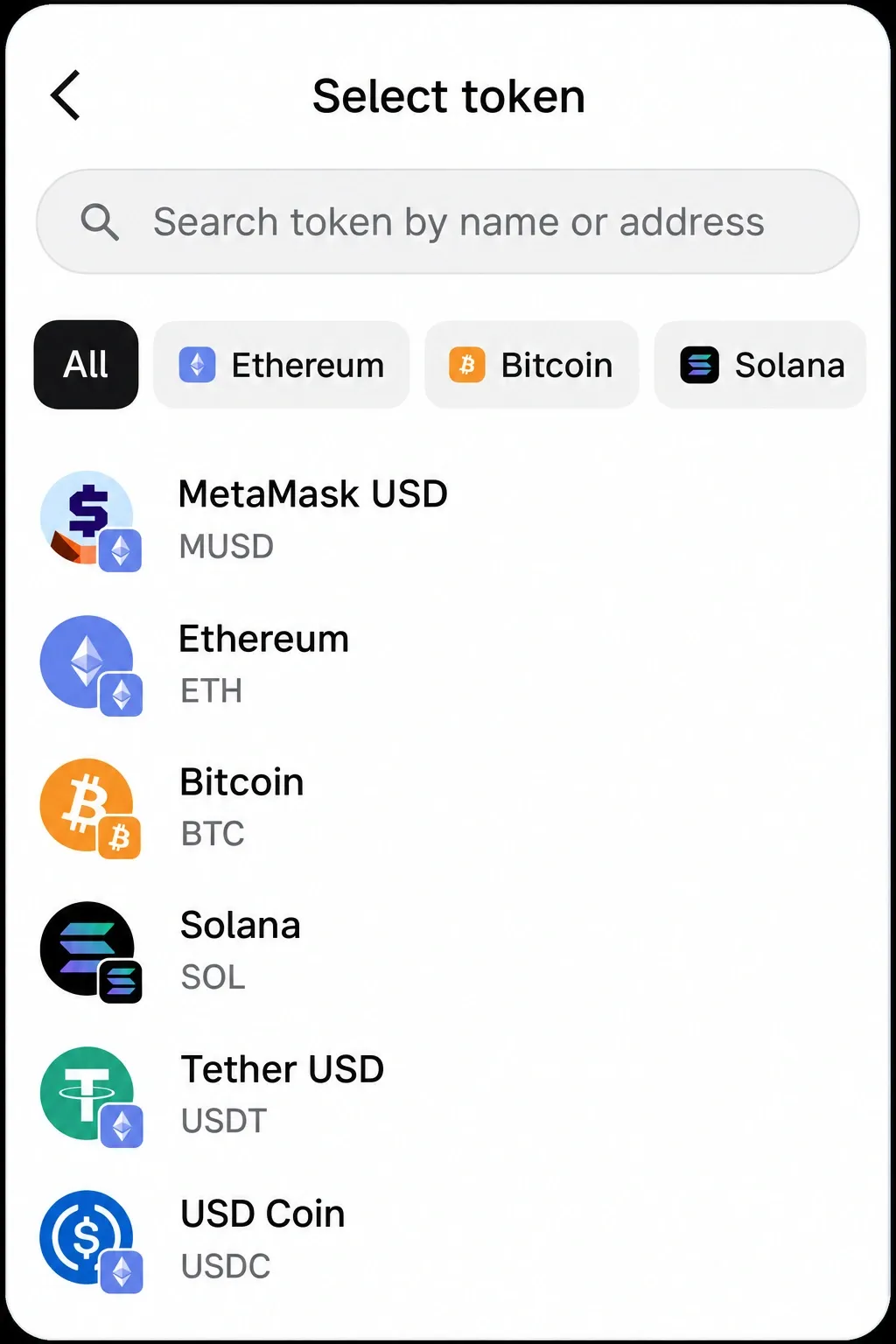
The extension can follow a different route. MetaMask says a wallet previously connected to MetaMask Portfolio is directed there for purchases instead of buying natively in the extension. In Portfolio, the documented route is Move crypto → Buy. Follow the options presented for that wallet rather than trying to force the mobile screens onto the extension.
A self-custody wallet gives you control of its keys, but that doesn't remove the issuer's token restrictions. Circle's USDC terms for holders outside the EEA include address-blocking rights and redemption conditions. Keep the payment provider's account requirements separate from the token's rules.
Verify that the purchase can reach its destination
For an exchange purchase, check the amount available to withdraw after the order completes. Kraken's withdrawal-hold policy gives a concrete reason to check this before buying: ACH Plaid purchases have a seven-day withdrawal hold, while certain card or digital-wallet purchases can have a 72-hour hold. Trading remains available during these holds; that doesn't mean the corresponding funds can leave the account.
If you're withdrawing, generate the receiving address from the destination wallet or service, select the matching USDC network at the exchange, and review the fee and amount to arrive. Follow any minimum or extra deposit instruction from the recipient. I favor a small first transfer when it meets those minimums and the extra fee is acceptable; wait for the recipient to credit it before considering the rest.
For an on-ramp purchase that remains pending, check the provider's order status and any requested verification. MetaMask says the provider executes the on-chain delivery and is the first support contact for a failed purchase or a charge without received crypto. Keep the order reference and use official support. A second purchase won't resolve the first order's status.
Once the USDC arrives, confirm the token, network and amount at the destination. The USDC network guides cover the next transfer checks; the wider bridges and tokens hub helps when the source and destination networks differ.