Chain Bridge


Contents
A crypto bridge aggregator compares routes across multiple providers, often combining a bridge with token swaps. Choose a route only after checking the exact destination asset, minimum received, total payment and underlying providers. A high quoted output doesn't compensate for an unsupported deposit or a recovery process you can't use.
I'd use the aggregator to discover options, then inspect the selected route as a separate decision. The interface may combine several operations, but each still has its own execution conditions.
Open the route behind the quote
0x describes bridge aggregation as a layer connecting multiple bridge liquidity sources through one integration. LI.FI also combines DEXs and solvers. An aggregator therefore isn't necessarily the protocol carrying value between chains, and two different websites can offer the same underlying bridge.
Expand the route details before comparing alternatives. Identify the source-chain swap, the bridge or solver and any destination-chain swap. Check the receiving address and exact output contract. If you need native USDC, a route ending in a bridged USDC representation may leave another conversion to do.
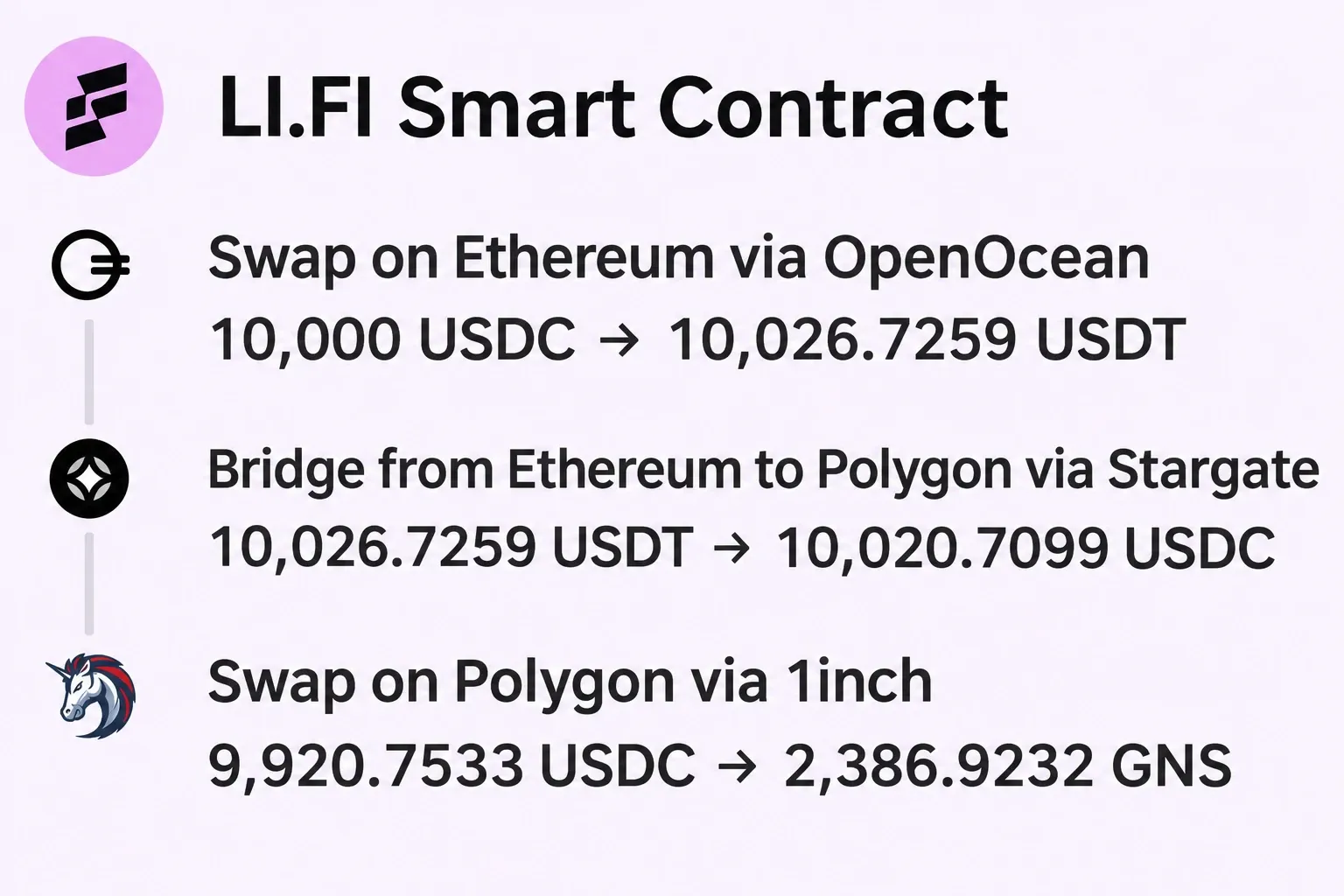
In LI.FI's explanation of this route, the destination swap uses a conservative intermediate amount; remaining unswapped funds go to the user. The final token amount alone doesn't describe every asset a route can deliver.
Compare the same transfer
Keep the input amount, source asset and receiving requirements identical across quotes. Refresh offers close together, because liquidity and prices can change between quotation and execution. If the receiving app needs USDC on Base, confirm the Base network and supported USDC contract before treating any route as an alternative.
| Compare | Read in the route | Decision |
|---|---|---|
| Destination output | Network, token contract, recipient and final amount | Reject an output the receiving app won't accept |
| Execution tolerance | Estimated output, minimum received and price impact | Choose an acceptable minimum; don't infer it from a headline rate |
| Total payment | Included fees, extra payments, approval gas and execution gas | Count each cost once and keep the required gas asset |
| Completion work | Additional signatures, chain switches or claims | Confirm you can perform every required step |
| Failure handling | Provider, status tracker, refund eligibility and returned asset | Know the recovery path before funding the route |
Scroll the table sideways on a narrow screen.
The estimated output and minimum received serve different purposes. LI.FI's slippage documentation distinguishes the expected amount from the quoted minimum and notes that price impact can reduce the expected output before slippage is applied. Its routes can have different per-step or route-wide tolerance rules. Read the returned minimum rather than calculating it from one displayed percentage.
I wouldn't raise slippage merely to make a failing quote proceed. A wider tolerance permits a worse execution result; it doesn't stop prices moving. First refresh the quote and inspect the route's liquidity and price-impact warning. Reject a minimum you wouldn't accept even if the transaction succeeds.
Separate included fees from extra payments
A small service-fee label isn't the full cost. The exchange rate affects the final output, and a route can charge for the bridge and destination execution as well as source-chain gas. In LI.FI's cost model, some fees are already reflected in the quoted output. Adding those fees again overstates the payment.
Check separately for payments outside the input amount. These can include a token-approval transaction and the source transaction's network fee. A destination execution cost may already be paid by a provider and recovered through the quote; that doesn't mean you'll have native gas for your next action after arrival. Keep the transfer's execution cost separate from an optional destination gas top-up.
Also inspect the number of actions. LI.FI distinguishes single-step quotes from routes that can require another transaction on the destination chain. One route card doesn't promise one signature or one transaction. Confirm support for your wallet and receiving-address type too; a route available for an ordinary wallet may reject a smart-contract destination.
Before approving a token, match the spender to the official route and review the allowance. I prefer an amount limited to the intended trade when the flow supports it, because an unlimited allowance exposes more tokens if the approved contract is abused. MetaMask explains token permissions separately from connecting a wallet: disconnecting the site doesn't revoke an on-chain allowance. Approval confirmation also doesn't mean the bridge transfer has happened.
Check the provider and recovery responsibility
Review the aggregator's contracts and the selected bridge's security model. Ethereum's bridge documentation explicitly retains smart-contract and technology risks for aggregators. Audit reports can help assess reviewed code, but they don't establish that a route is safe in every circumstance. A broad provider list adds choices, not a common security guarantee.
If a direct bridge supports exactly the required output, compare its current offer too. I'd favor a simpler supported route when it delivers an acceptable result and avoids an unnecessary extra swap. Compare its actual costs and recovery rules; the word direct alone doesn't prove lower fees or lower risk.
Before submission, find the official tracker and refund instructions for the selected provider. LI.FI states that refund policies depend on the bridge: some refunds are automatic, while other transfers can remain unresolved. Establish who can initiate recovery, the eligibility conditions and the asset and chain on which funds would return.
Verify the final outcome before retrying
Retain the route or order ID, source transaction hash and quoted destination output. After the source transaction confirms, use the route tracker and destination explorer to check delivery. Source confirmation establishes only that stage of the operation.
Read the status detail as well as its main label. LI.FI's status guide includes completed, partial and refunded outcomes. Its intermediate-token explanation describes a completed route that delivers a different asset when the destination swap can't complete as planned. Check the actual chain, contract and amount before deciding another swap or support request is needed.
An unknown transaction or a timeout isn't proof of failure. Check the correct source-chain receipt and official tracker before submitting a duplicate transfer. If a custodial destination is involved, confirm its deposit credit separately. Contact support through the provider's official site with the transaction details; never disclose a recovery phrase or sign an unexplained recovery request.