Chain Bridge

Contents
To compare Bitcoin mining pool fees, check both the commission deducted from eligible mining rewards and the cost of getting the resulting balance into your wallet. A low advertised percentage can lose its advantage when small payouts carry a fixed charge. I'd compare the same reward components first, then choose a payout rule that balances cost against the amount you're willing to leave with the operator.
Separate mining revenue from the charges you pay
Transaction fees inside mined Bitcoin blocks are part of mining revenue. A pool commission is the operator's deduction from the reward it credits under your chosen method. A payout fee is a separate charge for sending that balance to your receiving wallet. The phrase “transaction fee” can refer to the first or the last of these, so read the surrounding terms.
A minimum payout is a threshold, not a commission. It determines when a payment becomes possible; it doesn't describe how much is deducted. The minimum allowed payout and the minimum free payout can also be different amounts.
Before comparing percentages, confirm that the offers credit the same components. Subsidy-only PPS and a method that includes transaction-fee revenue have different reward bases. FPPS uses a calculated fee component, while PPS+ can allocate that component from actual pool blocks. Those differences affect the gross amount before commission. Choose the reward arrangement for your cash-flow needs, then compare its costs.
Read the rate beside its coin, method and conditions
The following published Bitcoin terms show why a single percentage can be incomplete. They're examples of fee structures, rather than a ranking of pools or a promise that every account receives the same offer. Use the terms attached to your own account, including any agreed discount.
Scroll sideways to read the reward base and conditions.
| Published arrangement | Commission | Read with the rate |
|---|---|---|
| Braiins Pool standard FPPS | 2.5% of the calculated reward | Subsidy and transaction-fee components; payout charges are separate. Its advertised Braiins OS pool-fee waiver is conditional. |
| ViaBTC PPS+ | 4% on the subsidy component; 2% on transaction-fee revenue | The components use different accounting rules. Its PPLNS option lists 2% on both. |
| f2pool Bitcoin | 4% FPPS or 2% PPLNS | The lower commission accompanies a different reward arrangement. The default payout threshold is 0.005 BTC. |
A “0% pool fee” offer still needs its conditions. Braiins advertises that waiver for mining with Braiins OS, whose licensing rules separately provide for a development fee. Don't treat a waived pool commission as proof that the combined firmware-and-pool arrangement costs nothing. Compare the applicable license charge and supported hardware before considering a firmware change.
Another conditional rate appears on OCEAN's own site: 2%, or 1% for miners making their own blocks with DATUM. A directory showing an unconditional zero would miss that published distinction. I'd resolve a disagreement with the operator's actual contract rather than average conflicting directory numbers.
Apply each percentage to the correct reward component
For a two-component reward, calculate S × (1 − fS) + T × (1 − fT). Here, S is the eligible gross subsidy credit, T is the eligible gross transaction-fee credit, and the two f values are their commission rates written as decimals. These are credits under the selected reward formula, not necessarily your share of one particular block.
In a hypothetical example using ViaBTC's published component rates, let the gross credits be 100,000 sats of subsidy and 20,000 sats of transaction fees. The deductions are 4,000 and 400 sats, leaving 115,600 sats before payout charges. The total commission is 4,400 / 120,000, or about 3.67% of that example's combined gross credit. Adding 4% and 2% to claim a 6% total would apply both rates to the wrong base.
Start from gross credits only when you're applying the commission yourself. If a dashboard or revenue export already gives the amount after pool fees, subtracting the commission again understates the result. Also check whether a calculator's “revenue” includes the pool fee; the label alone doesn't establish that.
This arithmetic compares charges, not actual earnings between different reward methods. Different accepted work, network conditions or transaction-fee formulas can change the gross credit. A short payout comparison cannot isolate commission unless those inputs are comparable.
Calculate the cost of your payout frequency
Braiins' published on-chain rules distinguish a 0.0002 BTC minimum payout from a 0.005 BTC minimum free payout. An on-chain payout below 0.005 BTC carries a 0.0001 BTC charge; payouts at or above that free threshold have no pool payout fee. In satoshis, those amounts are 20,000, 500,000 and 10,000 respectively.
The comparison below shows two calculated payout schedules using those charges. Start with the same 500,000 sats of confirmed credit after pool commission. Five withdrawals of 100,000 sats incur five 10,000-sat charges, totaling 50,000 sats. Waiting for one 500,000-sat withdrawal avoids that pool payout charge. For this example, each stated withdrawal is the balance debited, and its charge is deducted from that amount. Wallet receipts are 450,000 and 500,000 sats. Other wallet costs and changes to the terms are excluded.
Select Enlarge image to read the details.
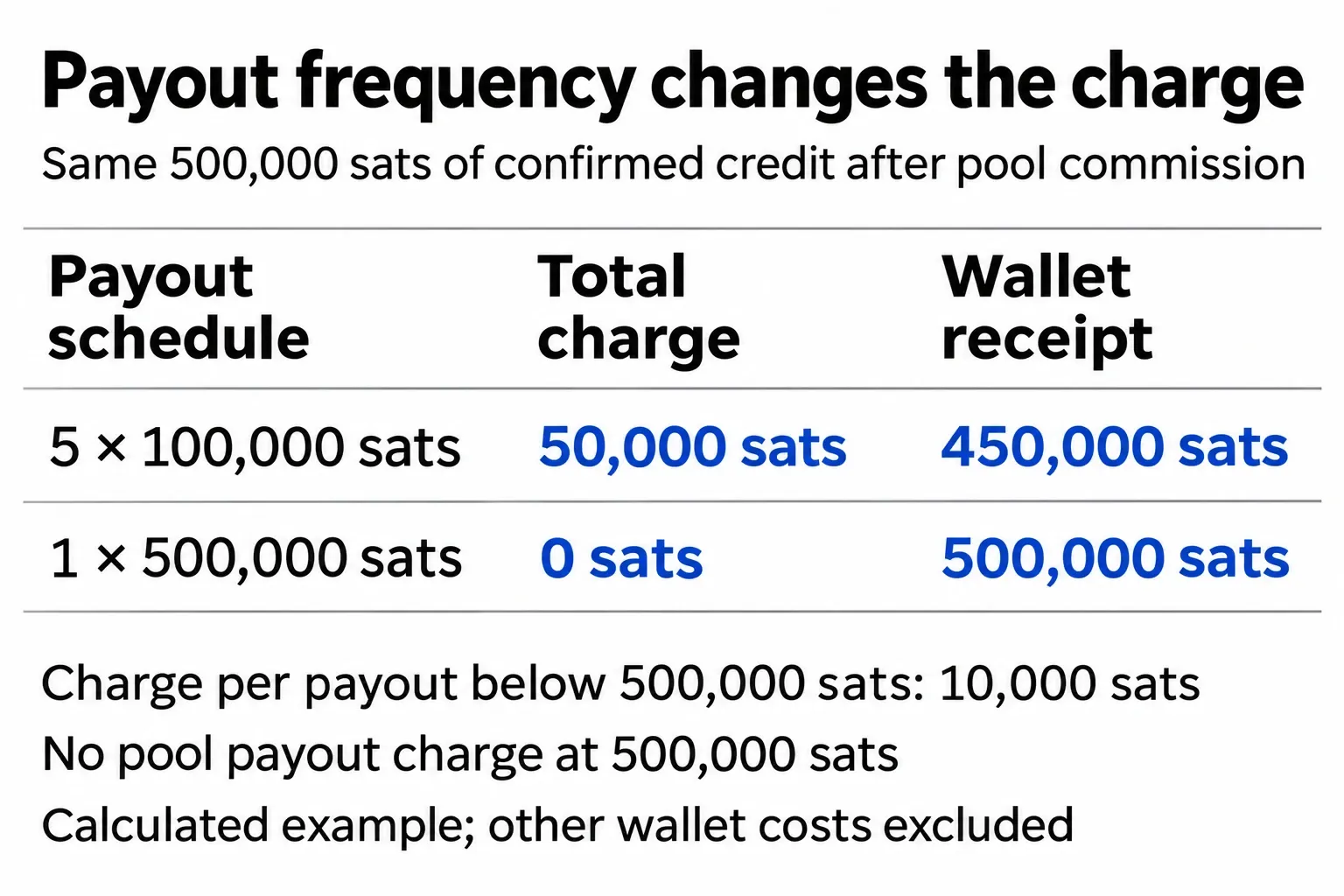
The 50,000-sat difference is 10% of the credited balance in this example. That makes payout policy worth checking even when two headline commissions differ only slightly. Raising your threshold trades fewer charges for more funds held by the pool and a longer wait. I'd set a maximum unpaid balance I can accept before choosing the cheapest schedule.
Check the receiving route before calling a payout free
Braiins lists no pool payout fee for Lightning and a range from 1 sat to 0.005 BTC. A compatible receiving wallet and a working payment route are still necessary. Its Lightning payment explanation distinguishes custodial wallets, which hold funds for you, from running your own receiving node and channels. Channel creation can have an on-chain cost, and a wallet provider can have its own terms. “Free from the pool” doesn't describe the complete cost or custody arrangement.
Estimate the wait to your threshold from the balance already available: (threshold − available balance) / expected daily net credit, when the threshold exceeds the balance and daily credit is positive. For example, a 500,000-sat threshold, 100,000-sat balance and hypothetical 20,000 sats per day imply about 20 days. This assumes unchanged credit; a reward delay, changed difficulty or downtime can extend it. Reaching the threshold also doesn't replace the pool's payout schedule or network confirmation.
Before moving to a new pool, check the old account's remaining balance and the documented way to receive it. A lower future commission doesn't automatically recover funds below the previous threshold. For an ESP32 device, establish NerdMiner pool compatibility first: a conventional Bitcoin fee schedule doesn't establish support for ultra-low-difficulty work.
Before choosing, save the terms for the exact coin and reward method. Include the commission basis and every condition attached to a discount. Then record the payout limits for your chosen receiving route. After a payout, reconcile the credited amount with the stated deductions and the amount received by your wallet. Keep operating costs in a separate profitability calculation. The mining library provides the next hardware or connection task.