Chain Bridge

Contents
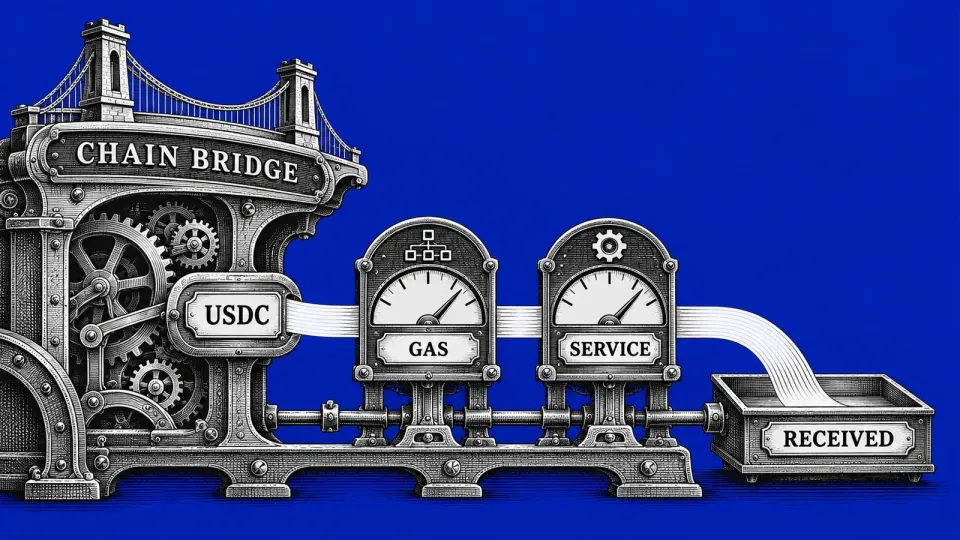
There isn't one fixed fee for transferring USDC. Check the exact amount the recipient will receive, then add any gas or service charge paid outside that quote. I compare routes only after confirming the same destination network and usable token, because a cheap transfer to the wrong network doesn't solve the payment.
Separate the charges before comparing routes
| Charge | Where to check | Accounting rule |
|---|---|---|
| Network fee | The sending wallet's transaction review | Add it if paid separately. Don't add it again when the service already includes it. |
| Exchange withdrawal fee | The selected USDC withdrawal network and final confirmation | Check whether it reduces the recipient's amount or increases your total debit. |
| Bridge, relay or application fee | The complete route quote | Check the output after deductions and any later claim transaction. |
| Swap execution | Quoted output, minimum received and fee details | Compare the delivered token amount; avoid adding a displayed fee twice if it's already reflected. |
| Recipient's next action | The destination wallet or cash-out service | Keep it separate unless both routes are being compared through that same final action. |
An ordinary same-network wallet transfer doesn't exchange USDC for another asset. Ethereum charges for computation in ETH; the gas explanation distinguishes gas used from its price. Don't use the simple ETH-transfer gas limit as the cost of an ERC-20 USDC transfer.
For an exchange withdrawal, use the exchange's fee rather than replacing it with a blockchain calculator. Kraken's withdrawal schedule, for example, has separate USDC network rows and minimums, and says the final fee appears at confirmation. A withdrawal minimum isn't another fee to add.
Compare equal outcomes without counting fees twice
Start with USDC you already hold. Set the same amount available to spend, destination network, accepted USDC contract and recipient account for each quote. If one route requires a swap or bridge before the transfer, include that step. An advertised send fee alone doesn't describe the route.
Illustrative calculation, not a live quote: suppose a route debits 100 USDC and delivers 99 USDC after its service fee, with another $0.20 equivalent paid separately in gas. The USDC shortfall is 1, and the additional gas cost is $0.20. Using $1 per USDC only as this example's accounting assumption, the total cost is $1.20. Adding the displayed 1 USDC fee again would incorrectly produce $2.20.
Now suppose another quote delivers all 100 USDC but charges 0.80 USDC separately, plus $0.20 equivalent in gas. Its cost is $1 under the same assumption, but you need 100.80 USDC available. Reduce the transfer amount and refresh the quote if your total USDC budget is only 100. A route that delivers more by debiting more isn't automatically better.
Record the quote time and distinguish expected output from minimum received on a swap route. Check which amount the recipient needs. A slippage setting isn't automatically an extra fee, and a minimum output isn't a promise that the expected amount will arrive.
Refresh the estimate for the actual recipient. Creating a new token account or writing a new balance can make a first transfer cost more than a repeat transfer. Align's fee methodology separates existing and new recipients, and explicitly excludes exchange withdrawals, bridging and conversion spreads from its network estimates. That makes the figures useful for understanding network costs, but insufficient for choosing a complete route.
Circle's CCTP upfront-fee explanation gives a useful example of this distinction: fees can be deducted from the transferred USDC or paid separately through an upfront-fee route. The same transfer label can therefore describe different sender debits and recipient outputs. Read the actual service quote rather than assuming a protocol name means a free end-to-end transfer.
Check how the wallet pays for gas
For an ordinary transfer, keep the fee token on the network you're sending from. ETH on Ethereum doesn't pay a Base transaction just because Base also uses ETH. Having enough USDC to cover the payment doesn't establish that you have enough gas.
Some wallets let you pay that cost using USDC instead. MetaMask's gas-included transactions require Smart Transactions and Estimate balance changes to be enabled. In the confirmation screen, the token dropdown beside Network fee shows eligible balances on that network and an estimate including a small MetaMask fee. Check that your network and token are supported; this isn't a universal feature of USDC.
Gas included also doesn't mean free. Reserve enough of the selected token for both the transfer and its fee. If the feature isn't offered, prepare the network's ordinary fee token instead of repeatedly submitting the same request.
When sending through MetaMask Extension, choose Send, select the network and USDC, enter the recipient and amount, then choose Continue. Review the estimated network fee and recipient before confirming. These are the documented Extension controls; a send-and-swap quote adds another pricing decision.
Reduce the whole route's cost
I would first remove unnecessary conversions and network changes. If the recipient accepts the USDC you already hold on its current network, a direct transfer avoids the extra route. If you must change networks, compare the complete bridge output with a supported exchange withdrawal, including any initial deposit or conversion needed to use that exchange.
For a payment that can wait, refresh the wallet estimate when network demand changes. Don't reduce the gas limit arbitrarily to force a lower-looking number. Ethereum's documentation distinguishes a transaction rejected before inclusion from one that runs out of gas during execution; the latter can consume the supplied gas while reverting the transfer.
Leave enough funds for any destination claim or later outgoing transaction. If you need to buy or move a fee token just to complete the route, include the cost of obtaining it. For an unfamiliar recipient, I favor a small first transfer when the service's minimum allows it, even though a second transfer adds another fee. Verifying that the destination credits the right asset is worth more than saving one network charge.
A route priced for USDC delivery ends when usable USDC arrives. A route priced for bank money must also include conversion and withdrawal costs. Keep those outcomes distinct when using a provider's “zero fee” promotion.
Check the actual fee after sending
Save the service quote and transaction hash. Open the transaction through your wallet's Activity view, confirm its network and outcome, then compare the final network charge with the estimate. An exchange's internal withdrawal request is a different record from the eventual blockchain transaction.
For Ethereum account history, MetaMask's gas-history instructions point to Analytics → TxnFees on Etherscan. The Transactions tab also offers a CSV export. The account summary helps reconcile network spending; it doesn't include every exchange, bridge or conversion charge in your route.

If the transaction failed after processing, don't assume its gas charge will be refunded. Check the failure before trying again. If it succeeded but the recipient wasn't credited, verify the network, token and recipient, then use the receiving service's official support rather than paying a supposed recovery agent.
Use the USDC network guides to check receiving compatibility, the native and bridged USDC comparison when token labels differ, and the bridge guides for a route that changes networks.