Chain Bridge

Contents
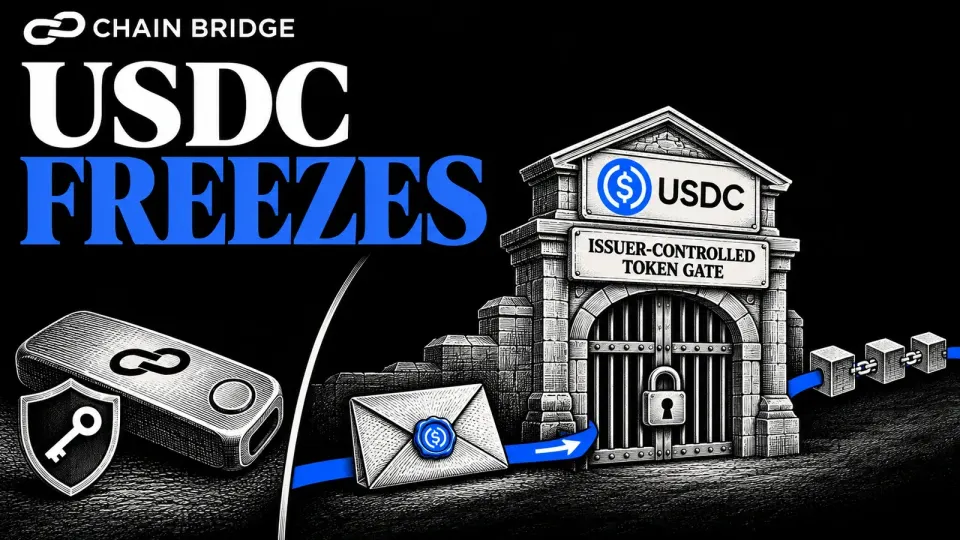
Yes, USDC can be restricted even when you control it with a cold or hardware wallet. The device protects your signing keys, while Circle retains controls that can stop USDC transfers involving an address. That possibility doesn't predict that your address will be blocked; if a transfer has failed, I'd identify the actual restriction before changing wallets or paying anyone to fix it.
For this decision, separate control of your keys from permission to transfer the token. Moving USDC off an exchange removes that exchange's custody of those funds, but the token's issuer controls remain.
A cold wallet protects keys; USDC stays on-chain
A hardware wallet signs transactions with a private key held on the device. The USDC balance remains recorded on its blockchain, rather than sitting inside the hardware. Ledger's explanation of wallets and offline signing describes that distinction. Disconnecting the device doesn't disconnect your address from the token contract.
The signature establishes your authorization to request a transfer. The token contract must also allow that transfer. Circle doesn't need your seed phrase to apply an issuer restriction, and replacing the device while restoring the same account doesn't remove a restriction attached to that address.
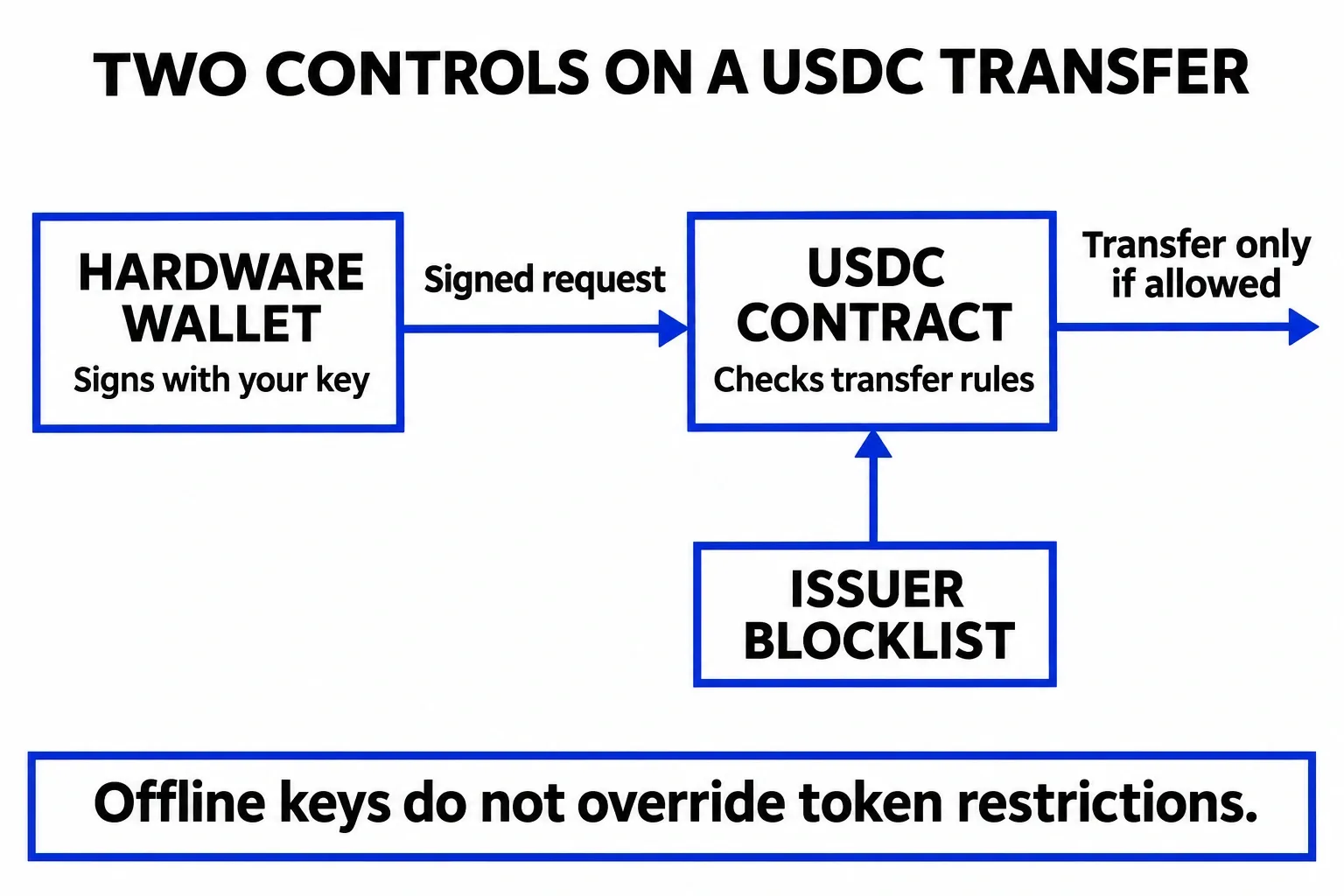
I'd keep using appropriate key protection if I chose to hold USDC. A hardware wallet addresses a different risk from an issuer freeze. It also can't make an unsafe transaction safe merely because you signed it on a device; Ledger's own guide warns that signing a malicious transaction can still put assets at risk.
Circle can restrict an address without taking its keys
Circle's USDC terms for holders outside the EEA reserve the right to block on-chain transfers to and from an address under its blocklisting policy. Those terms apply to holders without a Circle Mint account as well as account customers. Self-custody doesn't remove that issuer dependency.
The linked Circle Stablecoin Access Denial Policy says the control exists on every blockchain where Circle issues its stablecoin. It applies to an address: all Circle stablecoin controlled by the denied address becomes unavailable for on-chain transfer. The policy explicitly says individual token units cannot be singled out for access denial.
That scope matters when someone talks about "tainted coins." The policy describes legal and security exceptions to its general policy against access denial, including binding legal requirements, certain urgent government or law-enforcement requests, and threats to the stablecoin network. It doesn't establish a universal number of transaction hops that makes your address safe or unsafe. A freeze by itself also doesn't establish a court's finding about the holder.
An address-level USDC restriction is different from losing its private key or freezing every asset in the wallet. The USDC control doesn't itself give Circle the keys to spend your other assets. A broader legal order, exchange restriction or compromised key can create additional problems, so I wouldn't infer that everything else is accessible from the USDC status alone.
The contract checks explain the cold-wallet limit
For EVM networks, Circle's published stablecoin contract repository describes two separate controls. A blocklist prevents listed addresses from sending or receiving the token. A contract pause prevents transfers across the affected token contract, rather than targeting only one holder.
The published blocklist code exposes a read-only isBlacklisted(address) check. Its blacklist and unBlacklist functions require the designated blacklister role. Possessing the private key of an affected holder's account doesn't grant that administrative role.
A true result from that read-only check means the supplied address is listed in the contract state being inspected. A false result only clears that particular check: another address involved in the transfer, a contract pause or a provider restriction may still prevent access. Record the network and time of the check so a later change isn't mistaken for the same result.
There is a useful trap in Circle's EVM token design: version 2.2 changed allowance behavior so a blocked address can perform approval-related operations, while transfers remain blocked. A successful approval therefore doesn't prove that USDC can move. I'd avoid signing an approval as a diagnostic experiment; it adds an authorization without answering the transfer question.
These published controls support a precise conclusion: offline signing cannot override the token's transfer restrictions. They don't provide a forecast of your likelihood of being blocked. Function names and account models also differ across chains, so the EVM examples aren't instructions for checking Solana or another non-EVM network.
A failed send doesn't establish an issuer freeze
Start with the exact network and token identifier. Compare them with Circle's official USDC contract list. A matching ticker or logo isn't enough. If you hold a bridge-issued representation, the distinction between native USDC and USDC.e adds a separate contract and bridge dependency to investigate.
| Observed problem | Useful evidence | Next action |
|---|---|---|
| An exchange won't allow withdrawal | The provider's account notice and withdrawal status; whether an on-chain transaction exists. | Use the exchange's official support. An account hold alone doesn't prove Circle blocked your personal address. |
| A transaction is pending or cannot be submitted | The network, transaction hash if available, native fee balance and exact wallet error. | Investigate submission and network fees before treating it as a blocklist event. |
| The contract rejects a transfer | The actual error, current token contract and relevant sender/recipient blocklist state. | Distinguish an address restriction from another contract condition; don't repeatedly pay for retries. |
| The affected token contract is paused | The contract's pause state and an issuer incident notice. | Follow the issuer's update for that contract; changing signing devices doesn't clear a pause. |
| The balance is missing from the wallet app | The selected network/account and its balance on the correct chain. | Resolve the display or account mismatch before concluding that funds were frozen or taken. |
For an Ethereum transaction, Ethereum's transaction documentation separates signing, broadcast and inclusion, and explains the gas fee. An offline signature alone doesn't mean the network received or included the request. A fee or submission error is therefore a different diagnostic starting point from a confirmed token-contract rejection.
If the error points to an issuer restriction, have the appropriate read-only state checked on the correct chain and current token contract. For EVM USDC, that includes the relevant sending and receiving addresses, not only your wallet address. A check against another token, an old implementation or the wrong network won't establish your transfer's status. Viewing public state shouldn't require your seed phrase, a token approval or a paid "unlock" transaction.
Read the affected components and incident details on Circle's service-status page. A general service indicator doesn't establish an individual address's blocklist state. Similarly, a clear on-chain check doesn't clear a separate exchange account hold or guarantee that a later transfer will succeed.
Request a review through the responsible provider
Preserve the network and token identifier, then record the affected address and transaction hash if one exists. Save the exact error and any provider notice with its time. I'd include that evidence in the first support request because it distinguishes a wallet display problem from an exchange restriction or an issuer-controlled transfer rejection.
For an exchange account hold, contact that exchange through its own site. For a confirmed issuer restriction, use the official Circle support route linked in its terms and ask which review process applies. A retail holder doesn't need to pretend to be a Circle Mint customer. If a legal order is involved, qualified legal advice may be needed to address the order itself.
Circle's access-denial policy allows a reversal when the relevant authority formally confirms that the legal obligation or order no longer applies, or when a security incident no longer requires intervention. That is a conditional possibility, not a promise of recovery or a timetable. The existence of an administrative removal function doesn't let a wallet vendor or an unsolicited support agent exercise it.
Never send a seed phrase or private key to someone offering to unfreeze USDC. Those secrets authorize access to your account; they aren't needed to review a public transaction or explain an issuer decision. I would stop a conversation that asks for a token approval or an advance "release fee" as proof that the issuer restriction will be removed.
Choose custody with the issuer dependency in view
A hardware wallet can give you control over signing and remove an exchange as the custodian of withdrawn funds. It doesn't make USDC resistant to its issuer's controls. I wouldn't buy another device, bridge the balance or try alternate addresses as a supposed unfreeze method; none grants the administrative authority needed to remove the restriction.
Before relying on a USDC balance for a payment, establish that you control the correct account and that the intended token transfer is available. The USDC network guides help resolve the network and asset. If access is already restricted, preserve the evidence and pursue the responsible provider's review process before sending more funds.