Chain Bridge

Contents
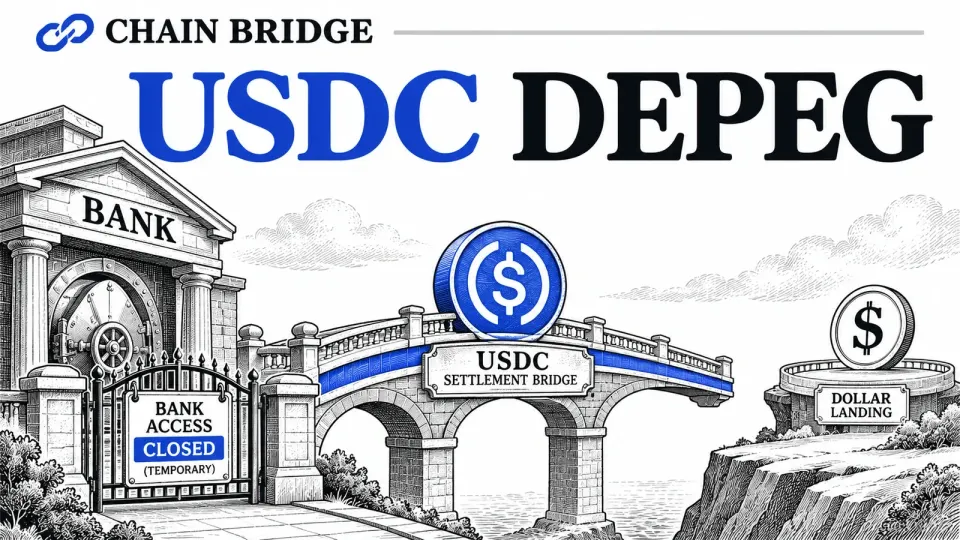
A USDC depeg means its market price has moved away from its dollar target. If you see a discount, I'd first check the exact token, trading pair and executable sale quote, then separate a local liquidity problem from trouble accessing the issuer's reserves or redemption service. The March 2023 episode recovered after intervention and resumed processing, but that history doesn't promise a floor or a recovery date for another event.
Your decision turns on when you need spendable dollars and which exit you can use. A wallet's displayed price, Circle's redemption commitment and the amount your exchange will pay are different pieces of evidence.
Check what is trading below a dollar
Start with the asset itself. Match its network and token identifier against Circle's official USDC identifiers. A bridged representation adds another dependency; the distinction between native USDC and USDC.e matters before attributing a discount to Circle.
Next, read the pair. A USDC/USDT quote compares two tokens; it isn't automatically a US dollar price. For your intended sale amount, inspect the available bid, meaning the price buyers offer, or the swap quote, then check the resulting currency, fees and whether deposits, withdrawals and bank settlement are available to your account. The last trade and a wallet's portfolio estimate don't tell you what your whole balance can fetch.
I'd compare independent venues that you can use, without sending funds merely to investigate. A discount on one thin market calls for a different response from similar executable discounts across several markets. If the intended amount moves through multiple order-book levels or materially changes a swap quote, the headline price understates the cost of exiting. That change caused by the size of your trade is price impact.
| What you see | What to check next | What it establishes |
|---|---|---|
| A wallet balance estimate drops | Exact token, quote currency and executable quotes elsewhere. | A display alone can't establish a broad USDC depeg. |
| One venue offers less | Depth for your amount, fees and that venue's deposit/withdrawal status. | A local exit problem is possible; its cause still needs evidence. |
| Several usable venues show a discount | Issuer notices, bank-access information and redemption processing. | The stress extends beyond one quoted market, without proving a reserve loss. |
| An issuer or bank reports disrupted access | Which service, assets and customers are affected, and the stated remedy. | Access trouble is real within that notice's scope; the size of any loss remains a separate question. |
Separate backing, redemption and your exit
Backing asks whether sufficient assets exist and can be accessed. Redemption asks whether an eligible customer can return tokens to the issuer for dollars. Your market exit asks what a buyer or trading venue will pay you now. BPI's analysis of stablecoin redemption access explains why those channels can diverge: retail holders usually trade through secondary markets, while a narrower set of participants can use issuer redemption to arbitrage a discount.
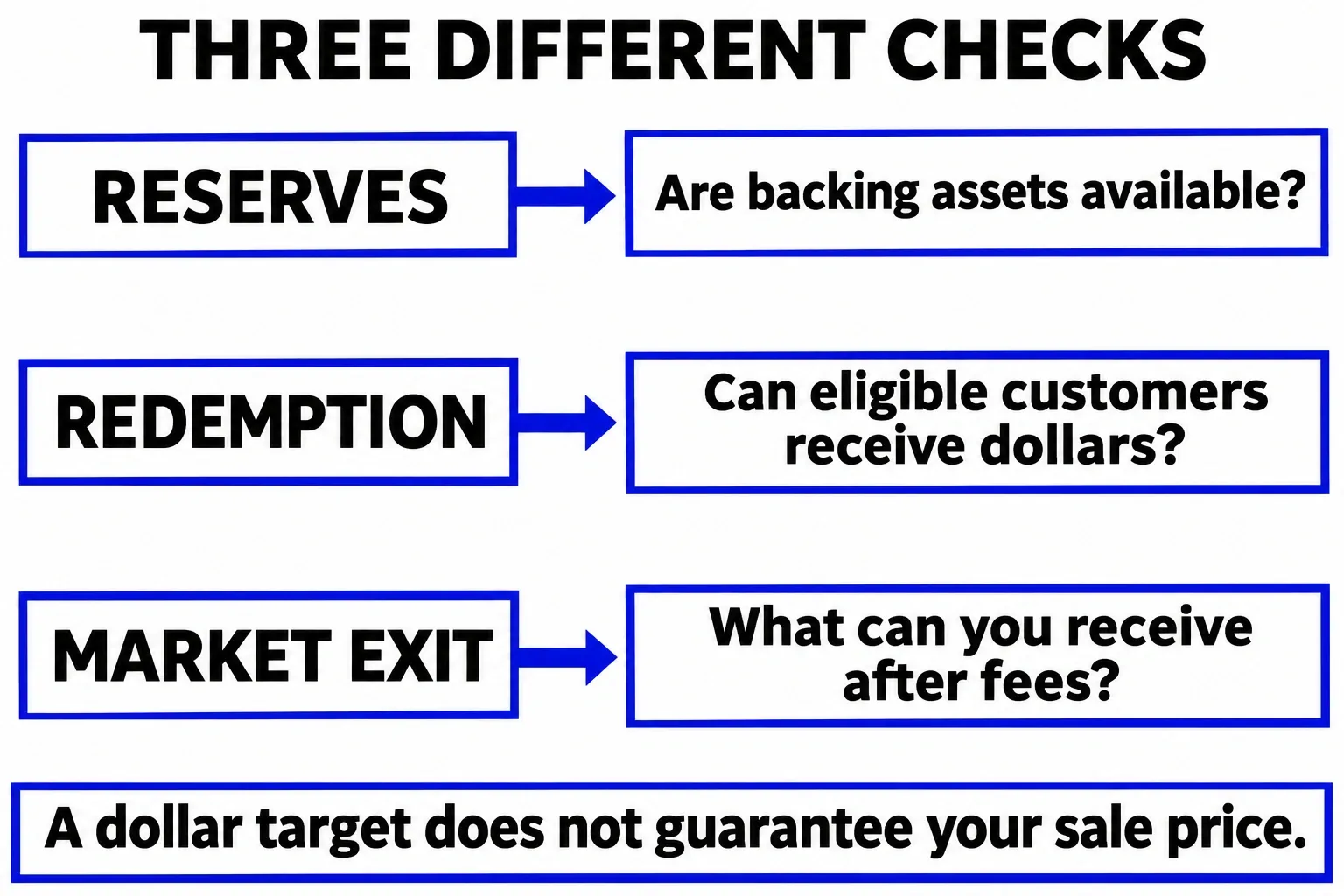
For a US holder, direct redemption isn't a universal emergency exit. Circle's non-EEA USDC terms condition direct redemption on an eligible Circle Mint account in good standing; Circle Mint serves institutional customers and isn't offered for personal retail use. EEA holders have a separate retail redemption policy with verification and bank-account requirements. Don't transfer tokens on the assumption that opening a new issuer account will solve an immediate cash need.
Read the affected components and incident details on Circle's service-status page, alongside your provider's notices. An operational token-transfer network doesn't prove that dollar withdrawals work, and a green service indicator doesn't replace a report about reserve exposure.
A USDC lending balance adds another access question: can the lending platform return the tokens? BPI's analysis explains that lenders can face losses or unavailable withdrawals even when a stablecoin is fully backed. Establish that the balance can be withdrawn before counting it among your available sale routes.
Why USDC depegged during the SVB failure
Silicon Valley Bank entered receivership on March 10, 2023. In its March 11 reserve update, Circle said $3.3 billion of USDC's cash reserves remained at SVB. Transfers initiated before the closure hadn't settled. Circle also explained that on-chain use could continue around the clock while issuance and redemption depended on US banking hours.
The uncertainty concerned both access and a possible shortfall if those uninsured deposits weren't recovered in full. Selling pressure continued on exchanges while primary-market processing fell to minimal levels over the weekend. The FEDS Notes study of the USDC episode, by Chuan Du, Ria Sonawane and Cy Watsky, traces the sequence using on-chain minting and burning plus exchange data. It is staff research, rather than a Federal Reserve policy commitment.
| Event | Evidence | Why it mattered |
|---|---|---|
| March 10–11 | SVB receivership; Circle disclosed $3.3 billion still at the bank. | The market faced uncertainty about access to part of the backing. |
| The weekend | Issuer processing fell to minimal levels while secondary-market trading continued. | Selling pressure couldn't be offset by normal primary-market arbitrage. |
| March 12, 6:15 p.m. Eastern | The joint government statement protected all SVB depositors, with access starting March 13. | It addressed the bank-deposit shortfall concern; secondary prices recovered sharply. |
| March 13 onward | Primary processing resumed. The FEDS study quotes Circle's March 15 report of $3.8 billion redeemed and $0.8 billion minted since Monday morning. | Actual processing supported the return to the peg. Those figures are token flows, not bank losses. |
The March 12 Treasury, Federal Reserve and FDIC statement protected SVB depositors under the bank resolution. It didn't create deposit insurance for USDC tokens. Circle's terms state that USDC itself has no FDIC deposit-insurance or SIPC protection.
Read the historical price numbers in context
The FEDS study describes a trough of $0.86, but its footnote explains that the charts use hourly opening prices, whose lowest observation is around $0.90. A brief intraday low and an hourly series need not match. CoinMarketCap's contemporaneous explainer reported a dip to almost $0.88, while Spark's depegging history gives approximately $0.87.
Those are separate published reports with different price observations, rather than repeated measurements under a shared method. I wouldn't average them into a supposedly exact minimum or use any one of them as a future stop-loss level. None establishes the price at which your whole balance could have been sold.
For its analysis, the FEDS study uses Allium on-chain data and CryptoCompare off-chain data. Its USDC primary-market observations cover Avalanche, Ethereum, Solana and TRON during the historical episode, rather than every then-supported chain. That evidence supports the link between disrupted issuer processing and secondary-market stress; it doesn't predict the depth or duration of another depeg.
A different ticker may share the exposure
Switching tokens can change your risks without removing them. In March 2023, DAI's Peg Stability Module accepted USDC at a fixed one-to-one rate. The FEDS study shows how that connection transmitted selling pressure to DAI and through its other stablecoin modules. A different issuer name or a decentralized label didn't prevent the economic link.
Before swapping, examine the destination token's backing, convertibility and usable dollar exit, then include the swap's spread, price impact and fees. I'd avoid adding borrowing or a leveraged position to solve a cash-access problem: liquidation and repayment obligations introduce another way to lose funds while the original uncertainty remains.
Choose by your cash deadline and verified options
If you need dollars promptly, compare the net amount and settlement time of the eligible routes already available to you. Establish that the destination accepts your exact token and network before moving anything, and confirm the bank-withdrawal conditions before selling. A quote for another stablecoin isn't yet cash in your bank.
If you can wait, identify the unresolved fact you are waiting on: access to a named bank deposit, resumed redemption processing, or a provider restoring withdrawals. Set your next review around that evidence rather than a promise that the token must return to a dollar. Waiting retains exposure to further loss; exiting realizes the discount and costs on your chosen route.
My rule is to act on verified access and the amount I can receive, rather than a screenshot of a headline price. The USDC network guides help resolve the token and transfer route; they don't turn an unavailable redemption service into a usable exit.