Chain Bridge

Contents
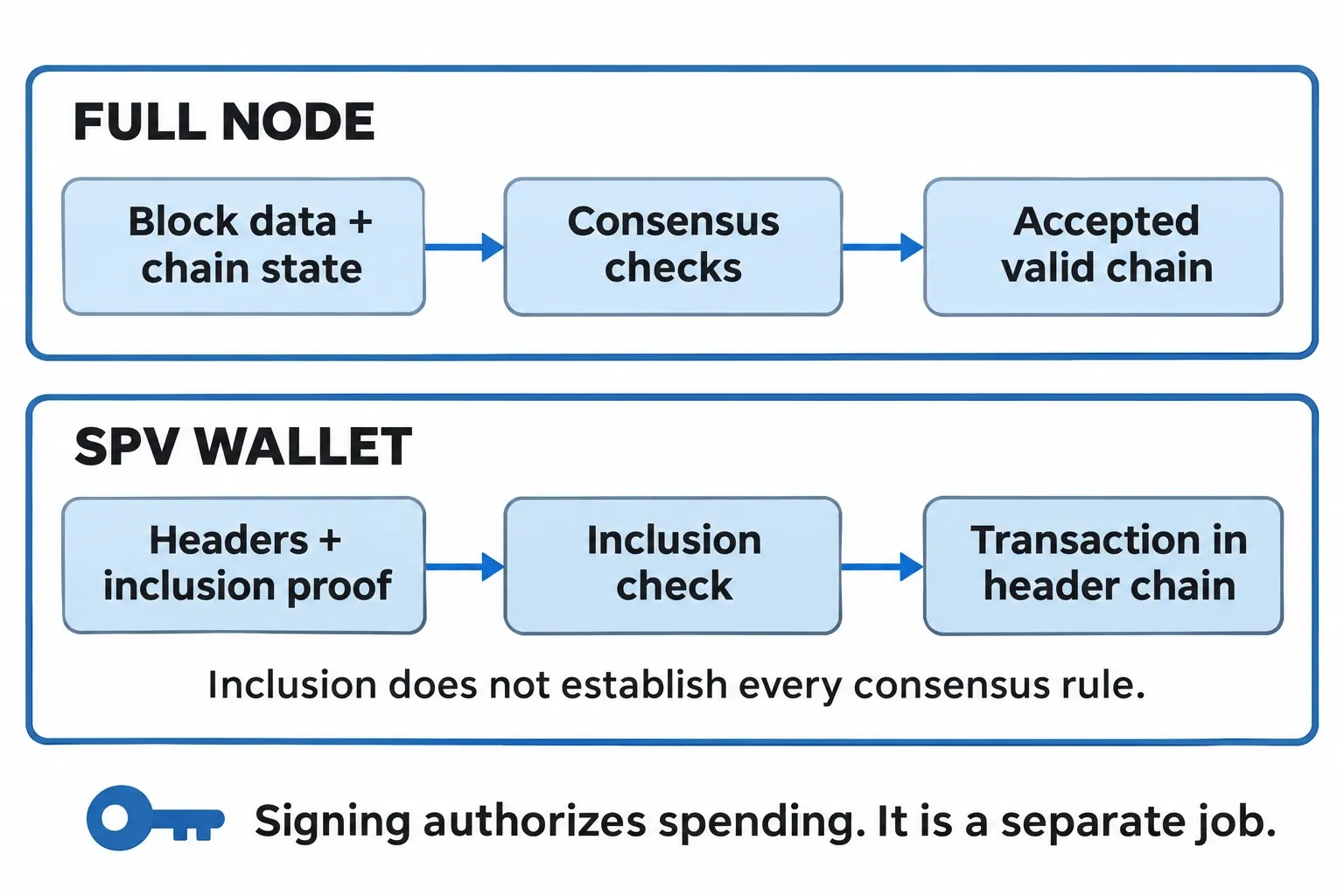
Use your own Bitcoin full node when you want to enforce Bitcoin’s rules independently for the payments your wallet sees. A light wallet reduces the work on your device, but its assurances depend on what it verifies and which services supply its data. An SPV wallet checks transaction inclusion against block headers; that isn’t the same as validating the complete chain. You can keep signing keys on a separate device while using your own node.
I’d choose the validation path and the key-storage arrangement separately. A hardware wallet can protect signing keys while its companion app still gets transaction history from a public server. A full node can validate the chain without holding any of your private keys. Neither label answers both questions.
Choose who checks the chain behind your wallet
A full node checks blocks and transactions against its consensus rules and maintains the validated state needed to check subsequent blocks. Bitcoin.org’s full-node definition is about this validation. Keeping every historical block permanently is a separate storage choice.
A pruned full node removes eligible old block files after processing them. It remains a full node; reducing retained history doesn’t turn it into an SPV wallet. An archival node keeps that history, which matters when another application needs old blocks or an additional index.
Scroll sideways on a phone to compare the verification and remaining dependency together.
| Arrangement | What establishes your chain view | Dependency to understand |
|---|---|---|
| Wallet using your full node | Your node enforces consensus rules and supplies the wallet’s chain data. | You maintain the node, its software and the actual wallet connection. |
| SPV wallet using other nodes or servers | Header-chain checks and transaction inclusion proofs, as implemented by that wallet. | Other participants supply information; the client doesn’t validate every transaction and block rule itself. |
| Compact-filter light client | Header-chain checks, local matching of downloaded filters and retrieval of relevant blocks. | Filter integrity, peer access and the client’s validation scope still matter. |
| Wallet displaying a service’s answer without inclusion verification | The service reports balances and transaction status. | Keeping keys locally doesn’t establish that those reports were independently checked. |
These are verification arrangements, not a ranking of every wallet with the word “light” in its description. A mobile app, a desktop app and a web interface can use different backends. Ask what the particular client verifies before treating it as SPV.
Understand what an inclusion proof establishes
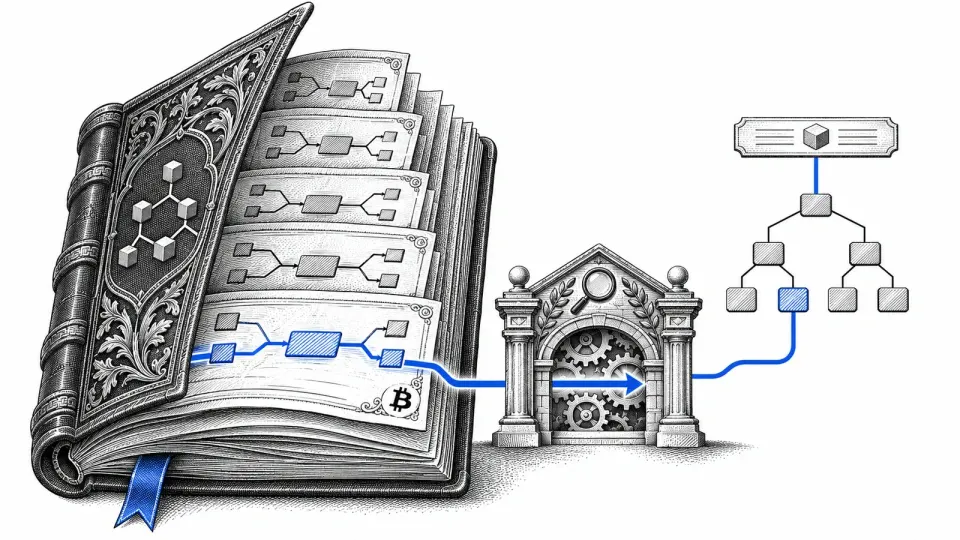
A block header contains a commitment to its transactions through a Merkle root. A Merkle branch lets the client check a transaction’s inclusion against that root without downloading the entire block. The developer guide’s SPV explanation draws the boundary: inclusion doesn’t guarantee that the embedded transactions satisfy all validation rules.
The client also needs an appropriate view of the header chain and its proof of work. A proof against an arbitrary header supplied by a stranger isn’t sufficient evidence of a payment on Bitcoin’s active chain. More accumulated work behind a payment can strengthen the SPV assumption, but more confirmations don’t turn the client into a full validator.
There’s also a difference between checking information and obtaining all the information you need. A server can omit a transaction from the history it reports. An inclusion proof for another transaction doesn’t prove that your history is complete or that a previously received output remains unspent. The developer guide’s SPV weaknesses describe omission and isolation risks.
Connecting to several peers can help detect disagreement, but a list of connections isn’t proof that they are independent or honest. A full node also needs access to current network data; independent validation doesn’t make it immune to isolation, software faults or reorganizations of valid history.
Read the server trust that remains in Electrum
Electrum provides a concrete example of a lightweight client that does verify inclusion. Its server-trust explanation says confirmed transactions are checked through SPV, while the server is trusted about unconfirmed transactions. It also explicitly allows for a server lying by omission.
The same explanation distinguishes the main server from other connections. The main server receives subscriptions for the wallet’s script hashes and supplies transaction history. Other server connections help with headers and fee information; they don’t mean every server independently supplies the wallet’s complete history.
Script hashes don’t make those subscriptions private from the server handling them. That server can reasonably group the requested addresses as belonging to one entity. Encryption of the connection protects traffic in transit; it doesn’t hide the requests from the destination server. A proxy can change the network address the server sees, while leaving that grouping available to it.
I’d use my own compatible server when the goal is to avoid giving a public server that view of my wallet. The server must use my validating backend, and the wallet must connect to it. An Electrum client doesn’t become a full node merely because its chosen server is privately operated.
Treat compact filters as a different light-client design
Not every lightweight wallet sends address queries to an Electrum server. With client-side block filtering, nodes supply compact filters describing block contents. The client checks those filters locally for data relevant to its wallet, then retrieves matching blocks.
This reverses the older Bloom-filter arrangement, where the wallet sends its filter to the serving peer. Local matching reduces what must be disclosed in the request, but fetching particular blocks can still reveal information. The protocol recommends comparing filter information across peers and downloading blocks from varying peers to reduce that exposure.
A filter match is a reason to inspect a block, not proof that a payment belongs to you. The compact-filter specification allows false positives. Nor does downloading a matching block mean the client has validated the full transaction history required for independent consensus validation. Check the wallet’s actual implementation rather than assuming “compact filters” means a full node on a phone.
Compare the checks in published test cases
The distinction is visible in the projects’ authored tests. The following compares expected verification behavior in Electrum and Bitcoin Core; it doesn’t assign a speed or security score to either product.
Electrum’s Merkle-verifier tests include an accepted valid branch and rejected forged constructions. Its verification implementation also compares the calculated root with the block header and treats a mismatch as a verification failure. These checks are useful, but their target is the inclusion proof.
Scroll sideways to compare that target with full-block validation.
| Published check | Expected behavior | Boundary it demonstrates |
|---|---|---|
| Electrum 4.8.4: valid Merkle branch | Calculates the expected Merkle root. | Inclusion verification performs a real cryptographic check. |
| Electrum 4.8.4: forged branch using a transaction as an inner node | Raises a verification exception. | A server response isn’t accepted merely because it claims to be a proof. |
| Bitcoin Core 32.1: duplicated transaction in a mutated block | Rejects the block even though its header and Merkle root match those of the original block. | A header commitment alone doesn’t establish the validity of the entire block body. |
Core’s invalid-block test constructs that mutated block and expects rejection with bad-txns-duplicate; it subsequently expects the original block to be accepted. This is why I wouldn’t equate a successful inclusion check with the full node’s broader acceptance decision.
Keep signing and validation separate
A wallet needs authorization to spend, while a node determines which chain data satisfies its rules. A watch-only wallet can monitor payments without possessing the keys needed to sign. Electrum’s cold-wallet guidance supports separating the online view from signing.
Using your own node doesn’t require moving the signing secret onto that node. Keep the keys in the intended wallet or compatible signing device. Conversely, putting keys on a hardware wallet doesn’t establish which backend checks the companion app’s transaction history.
A validating node also doesn’t fix a compromised signing computer, an incorrectly verified destination or a missing wallet backup. I wouldn’t replace a working key-storage arrangement simply to gain independent chain validation. Choose a compatible connection that preserves the custody arrangement you intended.
Check the complete wallet-to-node path
Before choosing hardware or changing a backend, establish what your wallet supports. Some wallets connect directly to Bitcoin Core; others require an Electrum-compatible server or another adapter. Sparrow’s Bitcoin Core connection guide, for example, documents a direct route and the constraints of using a pruned backend. Those details aren’t interchangeable with an Electrum server configuration.
- Validation: identify the node supplying the backend’s chain data. A privately named endpoint can still depend on someone else’s upstream service.
- Synchronization: establish that the node has caught up and that the wallet’s own scan or server index has completed. One application being ready doesn’t establish that the other has finished.
- History: check whether retained blocks cover the wallet’s recovery or rescan period. A pruned node may validate new blocks correctly while lacking old data needed to discover an existing wallet’s transactions.
- Connection: confirm the wallet uses the intended backend and Bitcoin network. Review whether an outage causes an error or a fallback to a public service.
- Custody: keep signing secrets in their intended location and preserve the wallet’s recovery material. A backend change isn’t a reason to give an unfamiliar service your seed or private keys.
Don’t expose Bitcoin Core’s administrative RPC interface to the public internet to make a connection easier. Core’s RPC security guidance warns against that exposure. Use the wallet’s documented, secured connection method. Opening the public peer-to-peer listening port is a separate choice; it isn’t required for your node’s basic outbound synchronization and validation.
If independent rule enforcement is the goal, choose your full-node backend and its supported wallet connection, then follow the Bitcoin Core setup route. Use the node hardware guide after checking whether the complete stack needs an archive or extra index. If limited device resources favor a light wallet, choose its verification model knowingly and keep unconfirmed status, omitted history and server privacy in view. The node library provides the next operational steps once that architecture is settled.