Chain Bridge

Contents
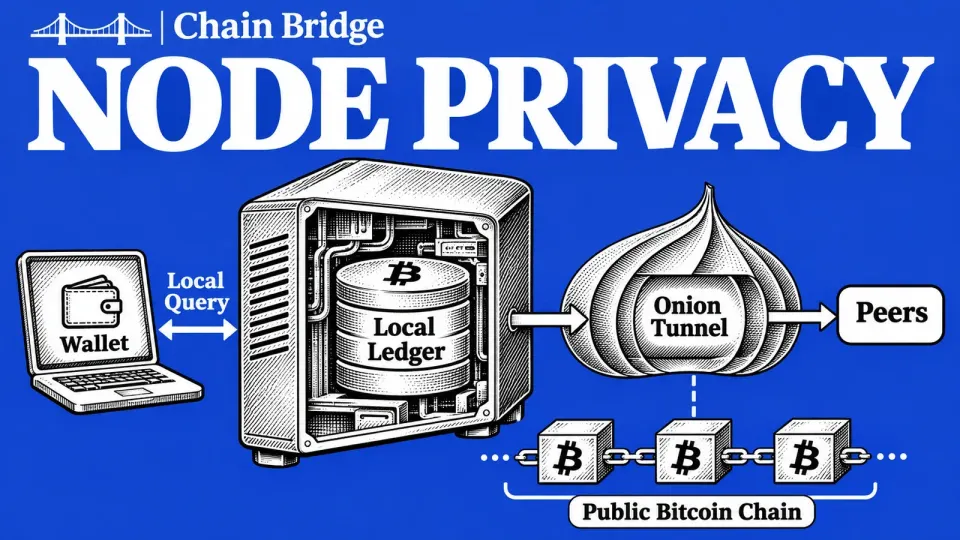
Your Bitcoin node improves wallet privacy when the wallet actually uses it for transaction history and broadcasting. Running a node beside a wallet that still queries a public server leaves that server in the path. I'd check the wallet backend first, then the node's peer and broadcast routes. Tor can reduce exposure of your network address; it doesn't hide the public transaction graph.
Treat these as separate checks. A private wallet connection, an encrypted peer connection and a healthy synchronized node each establish something useful, but none proves the whole arrangement is anonymous. If you still need a working node, finish the Bitcoin Core setup and synchronization checks before changing its privacy settings.
Make the wallet use your own backend
Find the server setting in the wallet or its companion app. A hardware signer can keep keys offline while the companion sends address queries to a public service. The node only removes that observer when the wallet's history requests go to a backend you control.
Electrum's server-trust explanation describes the exposure precisely: its main server receives subscriptions for the wallet's script hashes and can reasonably infer that those addresses belong together. Connected servers also see the client's IP address, or the address of its proxy. Tor changes the visible network address; the server still receives the wallet-specific requests.
You can use a wallet's direct Bitcoin Core connection or a compatible private Electrum server backed by your node. An Electrum server is required for an Electrum-protocol connection, but it isn't compulsory for every wallet. Sparrow's direct Bitcoin Core connection guide supports a local Core backend and default cookie authentication.
In Sparrow, open Settings and select Server. Choose Bitcoin Core for a direct Core connection, or Private Electrum for your own compatible Electrum service. With Core on the same computer and its default RPC configuration, the documented local route uses 127.0.0.1, port 8332 and Default authentication. A different machine needs its own secured connection; its loopback address points back to itself.
Select Enlarge image to read the details.
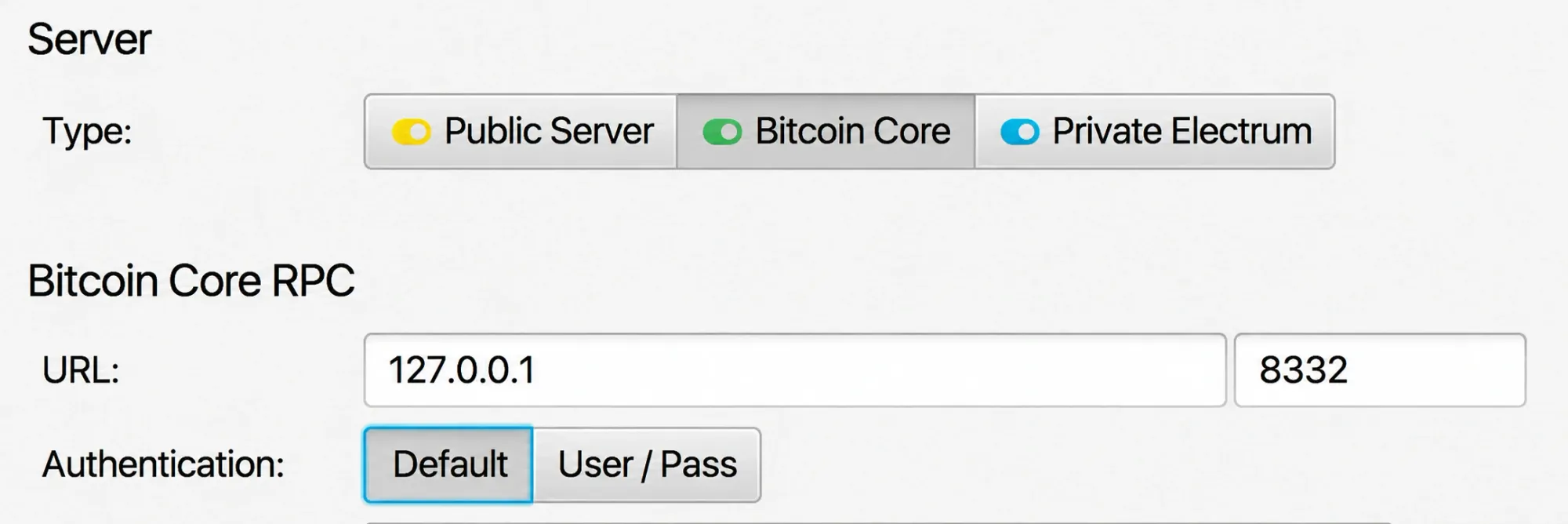
Before connecting, confirm Core exposes its local RPC service. Sparrow’s guide calls for server=1 when Core runs through its graphical interface and warns against disablewallet=1. Use Test Connection after matching the actual node, chain, data directory and authentication. Then confirm the wallet is using that backend for its history. A successful connection establishes access to a server, not that every external request uses it. Sparrow's documentation separately describes exchange-rate and fee-rate requests, and says its proxy isn't used for a direct Core connection unless that connection uses an onion address.
I'd keep the signing device and the data connection separate in this review. You can improve the wallet's backend without importing its recovery secret into the node. Check any public fallback or separate broadcast service too: an alternative endpoint can reintroduce an observer when your preferred node is unavailable.
Separate Tor routing from encrypted peer transport
Core's Tor configuration guidance distinguishes a general proxy from a proxy used only to reach onion peers. Setting onion= alone doesn't route ordinary IPv4 and IPv6 connections through Tor. The same document warns that DNS requests can use the operating system's resolver if no applicable DNS proxy is configured.
Check the effective configuration used by the running process, including command-line overrides and package-managed settings. Don't copy an old configuration over a working appliance. The options have specific boundaries:
| Control | What it changes | Remaining check |
|---|---|---|
| General Tor proxy | Routes the applicable outbound connections through the configured proxy | Effective per-network overrides, DNS route, listening addresses and wallet traffic |
onlynet=onion | Restricts automatic outbound peer selection to onion addresses | Manual and inbound connections aren't restricted by this option |
| BIP324 v2 transport | Encrypts a negotiated peer connection | Peer identity, IP visibility, v1 fallback and wallet queries remain separate |
BIP324 describes opportunistic, unauthenticated encryption. It raises the cost of passive observation; it doesn't conceal your IP from the peer you're connected to or establish that the peer is honest. Encryption and Tor address different parts of the problem.
For a trusted local inspection, getpeerinfo reports each peer's network and transport, along with its connection type and inbound state. transport_protocol_type distinguishes v1, v2 and a connection still being detected. The network field identifies the destination's network; an IPv4 destination can still be reached through a proxy. Read those fields alongside the active proxy configuration rather than treating one label as proof of the route. Core’s network RPC implementation also exposes getnetworkinfo: inspect networks for each network’s proxy and reachable values, and localaddresses for advertised listening addresses. These fields describe configuration and connections; they don’t trace every packet.
Also review inbound exposure. Core warns that a node reachable through both clearnet and Tor can have those identities correlated under some conditions. Mixing networks can improve connectivity and resistance to isolation, but that is a different goal from keeping the identities unlinkable. I'd choose that tradeoff explicitly instead of assuming more network types always means more privacy.
Check how the wallet submits transactions
A wallet can query your node and still submit a transaction through another service. Trace that submission path in the wallet's settings and documentation. Normal node relay also mixes your announcements with relayed transactions, but it isn't an anonymity guarantee.
Bitcoin Core's optional private-broadcast route needs its own version and configuration check. The 32.1 release notes describe an IP-leak fix affecting transactions submitted through sendrawtransaction with privatebroadcast=1: a failed v2 attempt could retry using v1 without preserving the required proxy override. The documented failure required specific advertised-peer and proxy conditions. Check the running daemon and the package's supported maintenance release before relying on that feature.
The project's published functional checks show why “connected” and “private” need separate evidence. These are defined checks in Core 32.1's test suite:
| Published check | Expected result | What to conclude |
|---|---|---|
| v2 peer connects to a v1 peer | They synchronize using v1 transport | Successful synchronization doesn't prove an encrypted connection |
| Privately submitted transaction returns from the network | It enters the originator's mempool and leaves its pending private-broadcast queue | Submission and return through the network are separate states |
| Private broadcast with neither Tor nor I2P reachable | Submission expects an RPC error | A running node doesn't establish a usable private-broadcast route |
The transport test checks v1 compatibility; the private-broadcast test checks the queue and unreachable-network behavior. They support those specific state checks, not a percentage chance of anonymity or a guarantee against a network observer.
Keep RPC and peer trust within their intended scope
Privacy settings can't compensate for giving an untrusted client control of the node. Core's RPC security guidance treats valid credentials as substantial control over the node and accessible filesystem resources. It warns against exposing RPC to the public internet, including through an onion service. Authentication doesn't add transport encryption, and a command whitelist isn't a dependable isolation boundary for untrusted users.
Keep local RPC local. For a remote wallet or service, use a deliberately secured private connection and the service's supported authentication method. A peer-to-peer listening port and the RPC port perform different jobs; opening the former doesn't justify exposing the latter. Keep credentials, wallet descriptors containing private material and unredacted logs out of support posts.
Review old peer-whitelist settings as well. The Tor whitelist disclosure describes vulnerable releases that granted incoming onion peers trusted-peer exemptions when a nondefault IP whitelist matched the Tor daemon. Nodes without that setting weren't affected. The advisory identifies fixes in 28.3, 29.2 and 30.0, with later releases in those fixed lines covered. Those historical fix versions aren’t a recommendation to stay on an unsupported branch. This was peer permission handling, not evidence that every Tor user exposed a wallet. Use a maintained release and understand any trust exemptions added by a node package.
Keep the public-chain limits in view
Your own backend removes a particular query recipient; it can't erase a third party's earlier records. Nor does Tor change the addresses, amounts and spending relationships published on Bitcoin's chain. Bitcoin.org's privacy guidance recommends a new receiving address for each payment and warns that publicly shared addresses and transaction details can connect activity to your identity.
Review spending choices too. Combining previously separate holdings can create visible links even when every network connection is routed correctly. Public explorer queries and shared transaction details can reveal information outside the node's peer configuration. Keep the claim attached to the observer you've actually reduced.
I'd finish with a concrete record: which backend the wallet queries, which service submits transactions, how Core reaches peers, what remains publicly reachable and which maintained software version handles the route. Recheck after changing the wallet, node package or remote-access method. For the surrounding setup and maintenance tasks, use the Bitcoin node library.