Chain Bridge

Contents
Choose a dedicated Bitcoin RPC service when your application needs reserved resources, a particular node configuration or sustained capacity that a shared endpoint cannot supply. For a small workload of standard calls, I’d start by checking a shared service’s limits before paying for a separate node. In either case, require the exact methods, historical data and recovery behavior your application uses; “dedicated” alone promises none of those.
A hosted endpoint also leaves the operator in control of the backend and able to observe requests. If your aim is to validate Bitcoin independently, running your own Bitcoin node addresses a different need from buying a managed API.
Define what must be dedicated
Ask which resources are exclusive to your service: a process, a virtual machine, a physical server, or a cluster. A private API key can identify your traffic while requests still use a shared node. Conversely, a dedicated node can sit behind a gateway shared with other customers. Put the node, CPU, memory, disk and gateway arrangements in the quote rather than accepting the label as a complete architecture.
These distinctions change the buying decision. RedSwitches describes single-tenant bare-metal Bitcoin servers with full, pruned and indexed configurations. NOWNodes describes dedicated infrastructure without fixed RPS, daily or monthly API caps, while explicitly tying throughput to allocated hardware. Those are different promises from a guarantee that every possible request finishes immediately.
Set the operating responsibilities too: who chooses the Core version, applies updates, rebuilds indexes, monitors disk growth and restores a failed machine. Agree on maintenance notice, compatibility checks and a recovery or rollback plan. Core’s RPC interface is implicitly versioned by major release, so an unannounced upgrade can matter even when the endpoint address stays the same.
I’d pay for dedicated capacity when a provider can explain which bottleneck it removes for the actual workload. A slow address-history query won’t become a supported Bitcoin Core method merely because the machine is yours.
Specify the API and history before comparing prices
Write down the network, method names, parameter combinations and oldest data the application needs. Bitcoin mainnet, signet and test networks are separate environments. Require a sample response schema and an explicit supported-method list for the proposed service, including anything filtered by its gateway.
Scroll sideways to read the capability checks on a phone.
| Application task | Capability to require | Acceptance question |
|---|---|---|
| Retrieve old transactions by transaction ID | Required retained history and a synchronized transaction index, or an application-supplied block hash with the block still available | Does the exact lookup work for the oldest transaction the application must retrieve? |
| List an address’s transactions or UTXOs | An address indexer/API supporting the required query | Which indexed interface provides it, with what pagination and history limits? |
| Read historical blocks with previous-output details | Required verbosity, retained blocks and the applicable undo data | Does the quoted service return those fields for the required block range? |
| Follow new blocks and transactions | A specified notification transport plus a way to recover missed events | Who supplies the stream, and how does the consumer catch up after disconnection? |
| Broadcast a signed transaction | An explicitly supported submission method and documented error handling | What does acceptance mean, and how does the application track the transaction afterward? |
The Core transaction-lookup reference explains why an archive and a transaction index are separate requirements. Without a supplied block hash, historical lookup outside the mempool needs txindex. With a block hash, the block must remain available. Keeping old blocks doesn’t automatically add an address-history search, either.
An indexed REST API can be the better fit for an address-based application. Esplora’s API includes address history, address UTXOs and transaction broadcasting through POST /tx. It is not a read-only substitute that always needs a second JSON-RPC endpoint to send a transaction. Confirm the provider’s supported subset and limits rather than treating all REST services as identical.
For block analysis, Core’s block reference makes previous-output detail conditional on undo availability; verbosity 3 is limited to unpruned blocks in the current best chain. Require the actual output your application needs, not a generic “archive” checkbox. The index-status response reports synchronization and best indexed height, useful evidence when the service exposes it.
Event interfaces deserve the same precision. Bitcoin Core’s native ZMQ notifications are read-only and unauthenticated, with sequence information to detect lost messages. A vendor’s WebSocket service is another layer, with its own authentication and recovery contract. Ask how gaps and reorganizations are reconciled against the chain; reconnecting a socket alone doesn’t recover missing events.
Separate monthly allowance from usable capacity
A dedicated plan can still carry a monthly request quota. On Zeeve’s Bitcoin-selected dedicated-node pricing panel, Basic displays $189 per month with 250 million monthly requests, Advance $319 with 2 billion, and Enterprise $599 with an unmetered monthly limit. These are the displayed monthly prices, separate from the annual-billing equivalents. Obtain a current Bitcoin-specific quote with taxes, billing commitment and included resources before buying.
That contrast with NOWNodes’ no-fixed-cap offer is useful, but it doesn’t identify a faster or cheaper service for your application. Monthly totals measure consumption over time. Peak request rate, concurrency, response size and compute determine whether a burst can be served. “Unmetered” also needs a defined scope: requests, traffic and machine capacity are different quantities.
Give each shortlisted provider the same call mix. Include large historical responses and expensive calls alongside lightweight status requests. Ask whether a batch counts as one request, several requests or weighted units; what the maximum batch and response sizes are; and whether retries are billed. Get the rate, concurrency, timeout, queue and egress rules in writing. An average requests-per-second number derived from a monthly allowance is not a promised burst rate.
For a managed server, include disk growth, additional indexes, backups, monitoring, replacement, support and any separate standby node in the total. If you’re choosing the resources yourself, size the complete Bitcoin node workload before comparing a small virtual machine with an indexed production backend.
Check renewal, cancellation, overage and automatic-upgrade terms before accepting the quote. Keep provider-specific address APIs or event formats behind a replaceable application layer, and estimate the work needed to move to another backend. A low entry price is less useful if leaving requires redesigning the integration.
Handle RPC failures as application outcomes
A successful HTTP response doesn’t prove a successful RPC call. Core’s published v32.1 RPC functional tests specify these error-handling expectations. They describe Core behavior under the stated test conditions; a provider gateway can impose additional limits and responses.
Scroll sideways to compare the expected responses and client checks.
| Published test case | Expected response in Core’s tests | What the application must check |
|---|---|---|
| JSON-RPC 2.0 request with an invalid method or parameters | HTTP 200 containing an RPC error | Inspect the response’s error field, even after HTTP success |
| Batch containing valid and invalid requests | HTTP 200 with separate successful and error results | Inspect each reply and match it to the request ID |
| Saturated queue with one RPC thread and queue depth set to one | HTTP 503, “Work queue depth exceeded” | Distinguish capacity pressure from an invalid request; bound retries |
The JSON-RPC batch specification permits replies in a different order from the requests, so array position is not a safe correlation mechanism. Require the gateway’s documented behavior for throttling, malformed bodies, timeouts and partial batches too. A gateway’s HTTP 429 and Core’s queue response can indicate different limiting layers.
I’d reject a retry policy that keeps increasing load during an outage. Use bounded retries with backoff for transient failures, and handle deterministic method or parameter errors separately. For transaction submission, an uncertain response needs a transaction-status check before another attempt; neither an HTTP success nor submission acceptance establishes confirmation.
Keep the access boundary and signing boundary separate
Use an authenticated TLS gateway or a properly secured private connection to the service, with the underlying daemon kept private. The Core RPC security guidance warns against exposing raw RPC to the public internet. A password or IP allowlist doesn’t encrypt that connection, and a method whitelist is not a complete isolation boundary.
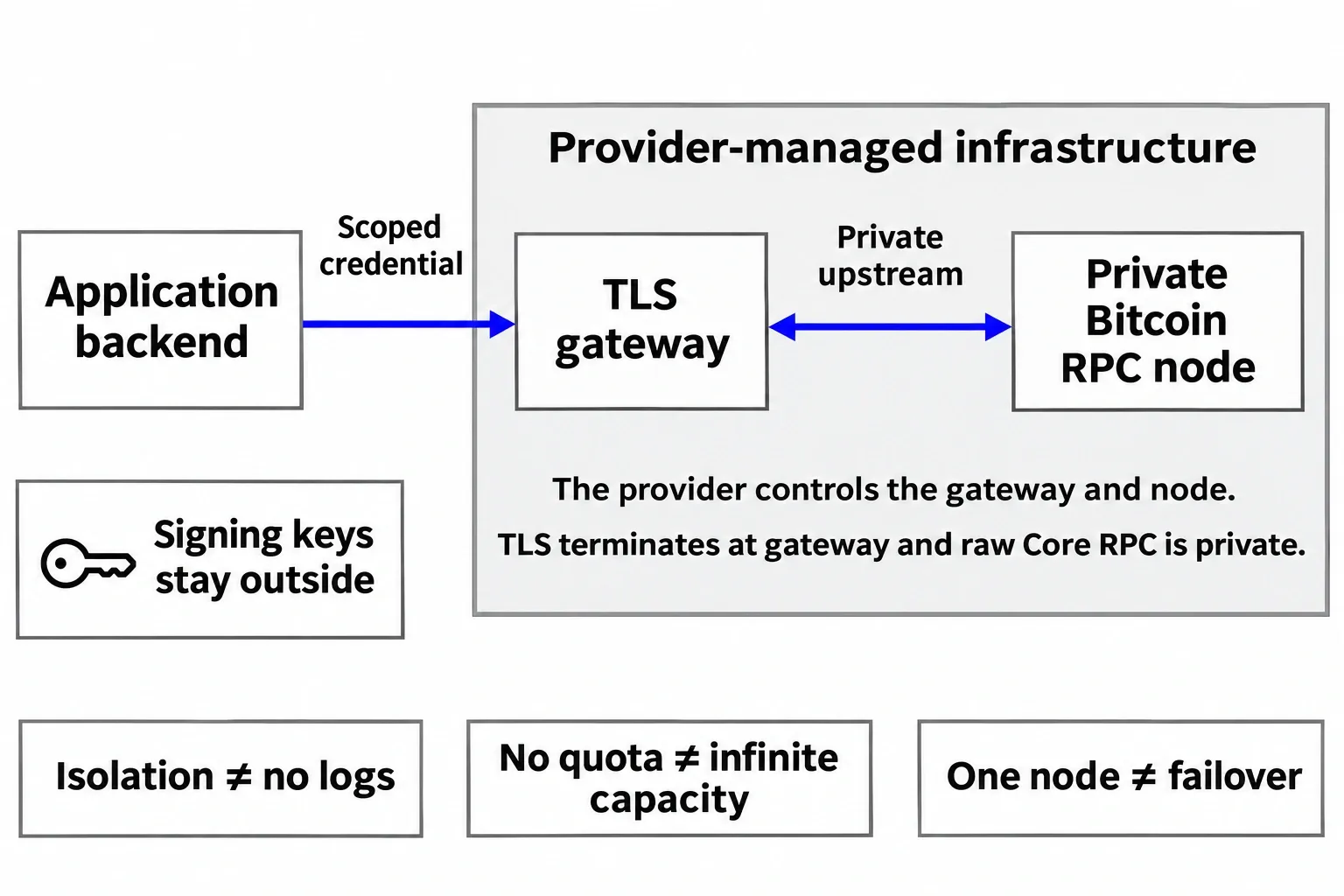
Keep service credentials in the application backend, scope them to the necessary operations where supported, and require rotation and revocation. A secret embedded in browser code or a distributed app can be recovered by its users. Confirm IP restrictions against the application’s real outbound addresses before relying on them.
Don’t upload seed phrases or private signing keys to obtain blockchain data. A provider can receive an already signed transaction for broadcasting without becoming the place that stores the wallet’s keys. That separation protects custody; it doesn’t make the operator’s replies independently verified.
“Private endpoint” doesn’t mean “no logs.” Ask whether the operator records request bodies, queried addresses or transaction IDs, source IPs and timestamps; who can access them; where they are stored; and when they are deleted, including backups. Dedicated hardware does not answer those questions. A fallback provider also receives the requests sent to it, so include failover in the privacy review.
Accept the service against a bounded workload
Before committing, agree on a permitted trial and load ceiling. Prepare a small representative set of calls without wallet secrets or customer-identifying data. Record the client region, concurrency, method mix, payload sizes, cache conditions and observation window so a later result has a meaningful comparison.
- Check the chain and readiness. Compare the expected network with
getblockchaininfo, then examine block height, header height, best block hash, initial-download state and pruning fields. Use an independent reference over time; a responding endpoint or matching height alone doesn’t establish freshness or the same chain tip. - Exercise the required data range. Include recent and old transaction lookups, needed block verbosity and indexed queries. Check response fields, pagination and index readiness. A fast recent lookup cannot stand in for the historical work the application needs.
- Observe normal load and permitted bursts. Record latency distributions such as median and 95th percentile alongside RPC errors, HTTP failures, timeouts and freshness. Separate cache hits from uncached work. Stay within the agreed ceiling; don’t stress a public endpoint without permission.
- Review failure and recovery. In the application’s permitted test environment, check how it handles invalid replies, unavailable service and uncertain broadcasts. Require a recovery procedure and a fallback with the same network, methods and historical capabilities.
The chain-status fields describe the node’s current state; use them as evidence rather than reducing health to HTTP uptime. Mempools are local node state too. The mempool-status response includes local memory limits and minimum fee rates. A different fallback node can therefore give a different unconfirmed view without either node being on the wrong confirmed chain.
A single dedicated node is still a single service instance. Ask whether a standby is independent of the primary machine, gateway and region, what failures it covers, and how quickly it becomes ready. Read the SLA’s measurement point, exclusions, support response, restoration commitments and credits. A credit for an outage doesn’t restore an application, and a reachable but stale backend can be unusable before an uptime monitor notices.
I’d approve the provider only when the required calls and history are supported, the agreed workload fits the capacity and billing rules, and access, logging and recovery have acceptable answers. Keep those requirements beside the final quote so a later plan change can be checked against the same criteria. The Bitcoin node library covers the operational tasks that follow that decision.