Chain Bridge

Contents
Use an ASIC miner profitability calculator with your own power rate, wall draw and revenue assumptions, then check the result after fees and other operating costs. For a Bitcoin ASIC, I'd start with a hashprice-based model because it makes the revenue units easy to reconcile. Compare a weaker revenue case before using the displayed profit to justify a hardware purchase.
Choose the calculator for your mining route
The Hashrate Index calculator suits a Bitcoin revenue-and-power check: its Simple view shows hashrate, power, electricity cost, machine price and hashprice. Bitmain's calculator also exposes coin-price and difficulty assumptions, quantity and other daily costs. Use one consistent set of assumptions when comparing machines.
Keep the algorithm and revenue route fixed. A Bitcoin hashprice applies to SHA-256 Bitcoin work; it can't price a Scrypt or kHeavyHash ASIC's raw hashrate. NiceHash estimates earnings for its hashrate marketplace, which is a different revenue source from a conventional Bitcoin pool. A directory's highest dollar figure doesn't establish the best machine for your supply, location or budget.
This calculation concerns pooled Bitcoin economics. Solo mining needs a separate probability and funding decision: a daily expected value doesn't provide daily spendable rewards.
Match the units before reading the profit
Copy the exact hardware configuration and operating profile. Use sustained hashrate and wall power under the same conditions when you have them; for a proposed purchase, keep the manufacturer's nominal inputs labeled as assumptions until you can check the actual unit. An overclocked hashrate combined with a stock-power figure describes an inconsistent model. For several identical miners, multiply hashrate and power by quantity, then distinguish per-miner charges from expenses charged once for the site.
Power and energy have different units. The EIA's electricity-unit explanation defines a kilowatt as 1,000 watts and a kilowatt-hour as the energy used by one kilowatt over one hour. Thus 3,200 W is 3.2 kW; running that load for 24 hours uses 76.8 kWh. Use wall draw including the PSU, and add any cooling or supporting equipment outside that measurement separately.
Check the currency unit too. A tariff of 6.5 cents/kWh is $0.065/kWh. Bitmain labels its electricity input in cents, while Hashrate Index's OPEX field uses dollars per kWh. Entering 6.5 in a dollar field would make the assumed rate 100 times too high.
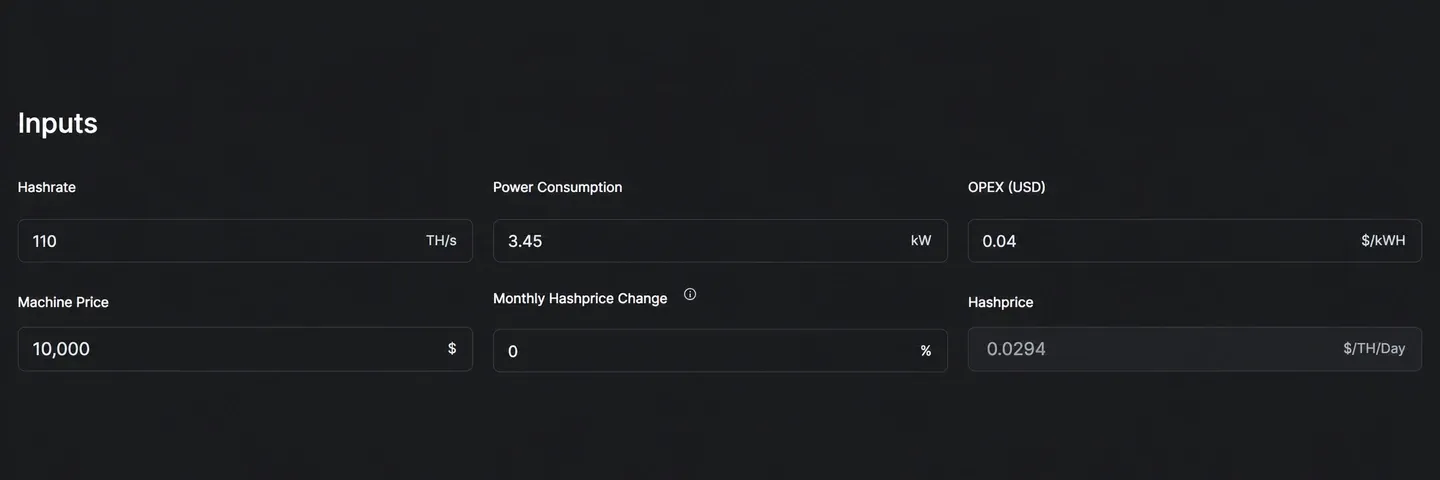
Hashrate Index's Simple panel below uses TH/s for hashrate, kW for power and $/TH/Day for hashprice. Its site ticker uses $/PH/DAY. One PH/s is 1,000 TH/s: a hypothetical $55 per PH/s/day equals $0.055 per TH/s/day. Match the two quantities before multiplying. The Simple view's hashprice field is read-only; the pictured values show the field layout, not the assumptions used in the example below.
Separate gross revenue from credited revenue
Luxor defines hashprice as the expected daily value of a unit of Bitcoin hashing power. It incorporates Bitcoin's price, network difficulty, transaction fees and block subsidy. If you use a dollar hashprice, don't multiply the resulting dollar revenue by Bitcoin's price again, or add another transaction-fee reward already included in that figure.
Establish the revenue basis before applying deductions. Gross network revenue needs the applicable pool and firmware costs accounted for; a pool's already-credited revenue has already passed through its relevant deductions. I would write the basis next to the input so a fee doesn't get subtracted twice. A firmware charge taken through diverted hashing time also needs a different adjustment from a cash fee deducted from credited rewards.
Use either on-time hashrate with a separate effective-work fraction or a calendar-period average that already includes lost work. For example, 160 TH/s delivering eligible work for 95% of a day has an effective daily average of 152 TH/s. Multiplying that 152 by 95% again would count the same loss twice. Pool accounting and rejected work can cause actual credited revenue to differ from a network estimate.
Work through one explicit daily example
The following hypothetical model uses a generic Bitcoin ASIC at 160 TH/s and 3.2 kW while hashing. Assume $55 per PH/s/day of gross hashprice, a 95% effective-work fraction and a single 2% fee on that gross earned revenue. Power is off during the remaining 5% of the day. Electricity costs $0.065/kWh, and other operating expenses are budgeted at $0.35 per calendar day. These are chosen inputs, not a current earnings quote or a measured hardware result.
Scroll sideways to read the calculations, or focus the table and use the arrow keys.
| Daily line | Calculation | Result |
|---|---|---|
| Gross revenue | 0.160 PH/s × $55 × 0.95 | $8.36 |
| Revenue after the 2% fee | $8.36 × 0.98 | $8.1928 |
| Energy | 3.2 kW × 24 h × 0.95 | 72.96 kWh |
| Electricity | 72.96 kWh × $0.065/kWh | $4.7424 |
| Other daily expenses | Fixed calendar-day allowance | $0.35 |
| Operating surplus | $8.1928 − $4.7424 − $0.35 | $3.1004, about $3.10 |
The surplus is before equipment cost, financing and income tax. Keep full precision through the calculation and round the final display. The other-expense allowance must be replaced by your own costs; it doesn't prove that cooling, maintenance or hosting can be bought for $0.35 a day.
For time-of-use electricity, calculate energy and cost in each rate period, then add them. Include applicable usage-based delivery charges and taxes in the energy price. Add a demand charge or another fixed charge separately if operating the miner creates it; spreading the household's entire existing bill across the miner's kWh can misstate the added cost.
Model downtime according to the bill
Lost hashing doesn't always mean the same reduction in costs. Simple Mining's calculator assumptions explicitly reduce hosting cost with uptime because that model assumes no hosting billing during downtime. A different contract or an ASIC that stays powered through a network outage needs different cost inputs.
In the example, power-off time reduces energy to 72.96 kWh. If the machine instead draws 3.2 kW for the entire day while delivering the same 95% effective work, energy rises to 76.8 kWh. At the same tariff and fee, the surplus falls from $3.1004 to $2.8508. The $0.35 calendar-day expense stays in both calculations.
Use separate assumptions for productive work, powered hours and billable hosting hours. If your revenue input is already a calendar-day credited amount, preserve that amount and model its associated costs rather than applying another uptime discount.
Find the break-even rate and a weaker case
For positive energy use, the operating break-even electricity rate is (revenue after applicable fees − other daily expenses) ÷ daily kWh. Here, ($8.1928 − $0.35) ÷ 72.96 gives about $0.1075/kWh, or 10.75 cents. That's the operating ceiling under these inputs, before recovering the purchase cost. If expenses other than electricity already exceed revenue, even free electricity won't make the modeled operation profitable.
I'd check lower revenue and a higher tariff together before accepting the base case. This matrix keeps the same hardware, 95% work and power fractions, 2% fee and $0.35 daily expense. Only gross hashprice and electricity rate change; each cell is the daily operating surplus rounded to cents.
Focus the table and scroll sideways to compare every tariff.
| Gross hashprice | $0.065/kWh | $0.10/kWh | $0.13/kWh |
|---|---|---|---|
| $55/PH/s/day, base case | $3.10 | $0.55 | −$1.64 |
| $44/PH/s/day, 20% lower | $1.46 | −$1.09 | −$3.28 |
| $33/PH/s/day, 40% lower | −$0.18 | −$2.73 | −$4.92 |
A $0.10 tariff leaves about $0.55 per day at the base hashprice, then loses money when hashprice falls by 20%. These scenarios test the budget's sensitivity; they don't assign probabilities to future prices or difficulty. Because hashprice already combines market and network inputs, don't add a separate difficulty penalty for the same change.
Use payback as a conditional purchase check
Simple payback divides the total upfront outlay by the modeled daily surplus. With a hypothetical $3,000 total purchase-and-setup outlay and the unrounded $3.1004 daily surplus, payback is about 968 days, or 32.3 months of 30 days. That answer assumes the surplus continues throughout the recovery period. A zero or negative surplus provides no finite simple payback under the same fixed conditions.
Include delivery, applicable purchase taxes, a missing PSU and necessary installation in the upfront outlay when they are required. Keep future repair spending in the operating or later cash-flow estimate so it isn't counted twice.
Check optional switches before comparing tools. Simple Mining enables an estimated equipment tax benefit by default and places the assumed savings in month 12. Turn it off for a before-tax comparison. That modeled deduction doesn't increase Bitcoin production, and its eligibility and timing aren't established by a calculator result.
I wouldn't use a long frozen-input payback as the deciding reason to buy. Hashprice can change, equipment can fail, and additional costs can delay or prevent recovery. A purchase decision needs a cash-flow scenario over your intended ownership period, including any explicitly assumed resale value. For equipment you already own, the relevant operating comparison starts with the revenue and avoidable costs from continuing to run it; the past purchase price alone doesn't settle that choice.
Reconcile the estimate with money you can use
Record the same period's credited rewards, unpaid balance and actual payments when checking the model. A payout threshold can leave earned credit at the pool while the electricity bill still needs cash. If you keep the mined BTC, its dollar valuation also doesn't pay that bill until you sell or fund the expense separately.
Simple Mining makes this distinction in its outputs: its BTC amount is after pool fees but before sales to cover hosting, while its USD profit subtracts operating costs. Read the meaning of each result before treating a coin total and a dollar surplus as equivalent take-home income.
Save your chosen inputs and the base and weaker cases before comparing hardware offers. If the operating margin already fails, resolve the tariff, cost or equipment assumption before spending on the miner. The mining library helps with equipment and location decisions; the mining-pools section continues from revenue assumptions to account and payout setup.