Chain Bridge

Contents
Choose immersion cooling only when the miner, fluid, tank and heat-removal system are supported as a complete package. I'd keep a stock air-cooled ASIC on its intended cooling system until that compatibility is documented: buying a tank and removing the fans doesn't establish a safe conversion. Immersion can change where heat and noise go, but you still need suitable power, an external heat sink and a service plan.
The buying question is whether the whole installation solves your constraint at a cost you can support. Start with the exact hardware and the hottest conditions the cooling system must handle.
Separate immersion from hydro cooling
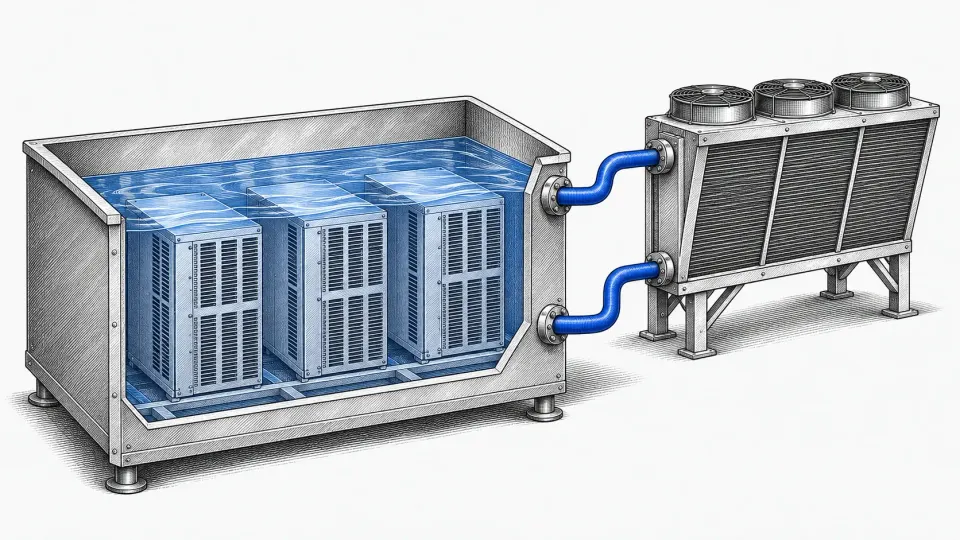
Immersion puts supported electronic hardware directly into a dielectric, electrically nonconductive fluid. Hydro miners use a specified liquid circuit and cold plates rather than an oil bath around the electronics. The Hashrate Index visit to MicroBT's liquid-cooling showroom describes both systems and their different coolant requirements. An immersion tank isn't a substitute for the circuit required by a hydro model.
Single-phase immersion keeps the coolant liquid during normal operation. Two-phase immersion uses a fluid that boils at the designed operating conditions and condenses back to liquid. Submer's explanation of the two approaches shows why their fluids and heat-transfer arrangements differ. Don't change between them by substituting a different bottle of coolant.
A second fluid loop is a different distinction. A single-phase system can use a separating heat exchanger to transfer heat from dielectric fluid to a facility-water circuit. Both liquids remain in their own circuits. “Two loops” doesn't mean the immersion fluid boils.
Confirm the exact miner, PSU and support terms
Get written confirmation for the miner model and revision, its power supply, operating mode, firmware and chosen fluid. Ask which parts are submerged, which stay outside, and which preparation procedure the equipment supplier supports. A bath large enough to hold the enclosure only answers the space question.
Purpose-built immersion hardware gives you a more useful starting point than an unspecified conversion. For example, Bitmain's S21 Imm. version 10 specification names inlet oil temperature and coolant flow, alongside a particular electrical supply. Its S21 Imm. product manual includes the APW11I supply and requires the server to be fully immersed in oil while running. Those instructions belong to that product; they don't approve submerging another ASIC or a spare PSU.
I'd reject a conversion offer that stops at fan removal or a fan-detection workaround. Ask the supplier to account for fluid compatibility, temperature sensing, protection, connectors and the return-to-service procedure. Don't remove heatsinks, alter wiring or disable protection on the strength of a generic immersion guide.
Clarify who handles a failed board or PSU after immersion, including draining, cleaning, packaging and transport. Bitmain's warranty terms make the sales contract controlling. Neither a blanket “all immersion voids warranty” claim nor a seller's general reassurance answers what your specific contract covers.
Check fluid compatibility beyond conductivity
Use the exact fluid approved for the equipment and tank system. Nonconductivity is necessary for direct contact with electronics, but it doesn't establish compatibility with every seal, cable jacket, adhesive or plastic in the installation.
Castrol's DC 15 material-compatibility guide lists good, moderate and poor compatibility across different materials and recommends checking the exact material grade before use. It is a guide for that fluid, not approval for every ASIC. Ask the miner, tank and fluid suppliers to resolve the complete materials list before filling.
Keep the product data sheet and safety data sheet with the system documents. The product data establishes properties such as viscosity and thermal behavior; the safety sheet governs handling precautions. Castrol's fluid pre-check procedure calls for clean, compatible transfer equipment, correct unopened product, inspection for debris and previous fluids, and the tank manufacturer's filling instructions. Don't mix coolants or substitute household oil without a supported procedure.
Follow the heat all the way out of the tank
The bath absorbs heat; it still needs somewhere to release it. MARA's overview of immersion-system layouts describes circulation, heat exchangers and external cooling equipment. Specify the complete heat-rejection path rather than ordering only the enclosure.
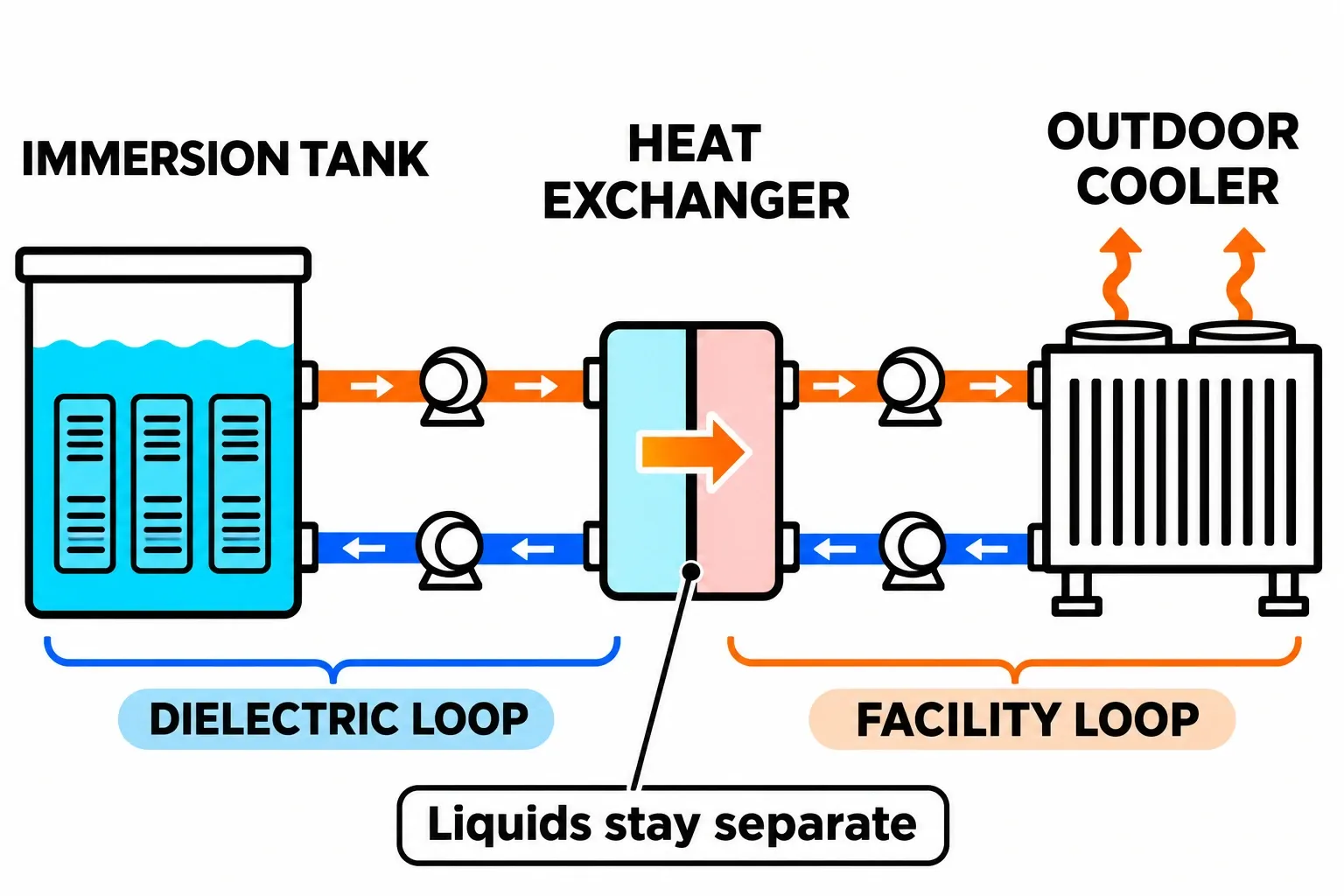
Ask the designer for the supported heat load at your design outdoor temperature, required inlet-fluid conditions, delivered flow through each miner and the pressure losses of the installed circuit. Include pumps, filters, pipework and heat exchangers. The DCX design brief for liquid-cooling projects asks for the hardware load, facility-loop temperature and flow, heat-rejection method, site and design ambient temperature. A tank's miner-slot count leaves those questions unanswered.
Here is what an exact model specification can change:
| Item | Published specification | Buying implication |
|---|---|---|
| Normal Energy Mode | 239 TH/s; 3,824 W; 16.0 J/TH | Use this mode's load for the initial equipment brief. |
| High Energy Mode | 301 TH/s; 5,569 W; 18.5 J/TH | Higher hashrate also brings more power and worse energy per hash. |
| Electrical input | Three-phase, 380–415 V | This configuration needs a suitable engineered supply. |
| Inlet oil and flow | 30–55°C; 1 m³/h coolant flow | Confirm conditions at the miner, including the specified altitude derating. |
Scroll the table sideways to read every column.
Bitmain gives the power and efficiency figures at 30°C inlet oil temperature. They are typical specifications, with stated tolerances, rather than a result for your installed system. The same model sheet supplies the conditions and altitude rule. Neither the bath temperature measured elsewhere nor the pump's unrestricted flow rating proves that the miner receives its specified conditions.
Compare the whole system's power, noise and cost
Budget for the miner and every supporting load: circulation pumps, external cooler fans, controls and any additional cooling equipment. Removing miner fans can reduce one load while adding others. I'd compare total electrical input at the same useful hashrate and ambient conditions before accepting an efficiency claim.
The Hashrate Index showroom report describes the M56 immersion installation as notably quiet. That is a useful qualitative observation of that installation, not a noise rating for a kit in your home. Request the noise specification for pumps and outdoor cooling equipment, the measurement conditions and the proposed location. Moving fan noise outdoors can still create a neighbor or property-line problem.
Get an itemized installed quote covering the tank, miners, compatible fluid and fill quantity, pumps, heat exchangers, heat rejection, controls, plumbing, electrical work, shipping and commissioning. Add fluid testing or replacement, filters, spare parts, service labor and downtime to the running budget. Castrol notes that retrofitting immersion can require greater floor loading and fluid-management infrastructure; a compact tank footprint doesn't remove those costs.
Run the comparison first at the supported operating mode. If the economics only work with promised overclocking gains, longer equipment life or heat sales, require evidence and an actual operating plan for those benefits before committing money. Cooling capacity doesn't establish mining revenue.
Require a service and shutdown plan before filling
Agree on checks for fluid level and condition, leaks, circulation, inlet and outlet temperatures, miner warnings and external-cooler operation. Castrol's pre-check guidance calls for regular fluid inspection and treats pronounced discoloration or cloudiness as a reason to seek supplier advice. Its fluid-specific instructions don't create a universal replacement interval for other coolants.
Ask the system supplier to document what happens after loss of flow, a pump fault, a high-temperature alarm or a leak, including how mining power is stopped and who responds. Commission those protections under the approved procedure before relying on unattended operation. Leave electrical isolation and hot-equipment handling to the documented service process; never reach into energized equipment because the liquid is dielectric.
Prepare the site for safe fluid handling, spill containment and lawful disposal. Castrol's site-preparation guidance calls for appropriate protective equipment, a spill-response plan, ignition precautions and a suitable waste-disposal route. Dielectric doesn't mean nonflammable, harmless or suitable for pouring down a drain.
My purchase threshold is a complete supported design, an installed quote and a named service route. If any of those is missing, pause the immersion purchase and keep the existing supported cooling arrangement. The mining library provides the next steps for matching the rest of the project to the hardware you can support.