Chain Bridge

Contents
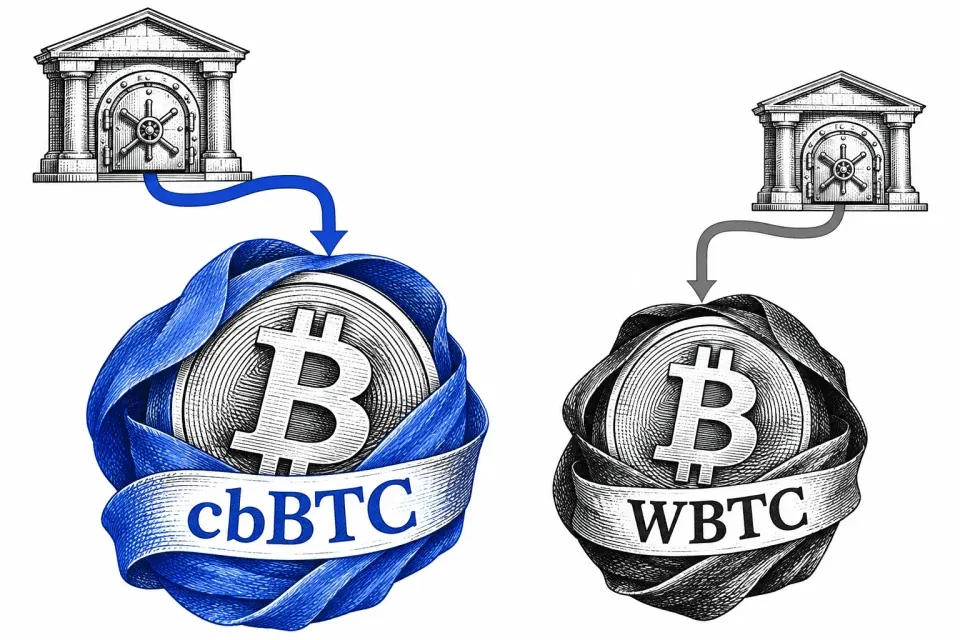
cbBTC and WBTC both represent Bitcoin on other blockchains, but they give you different custody and redemption routes. I'd choose between them by checking the exact token your intended DeFi market accepts and the route you can use to return to BTC. A familiar ticker or a promise of Bitcoin backing doesn't settle either question.
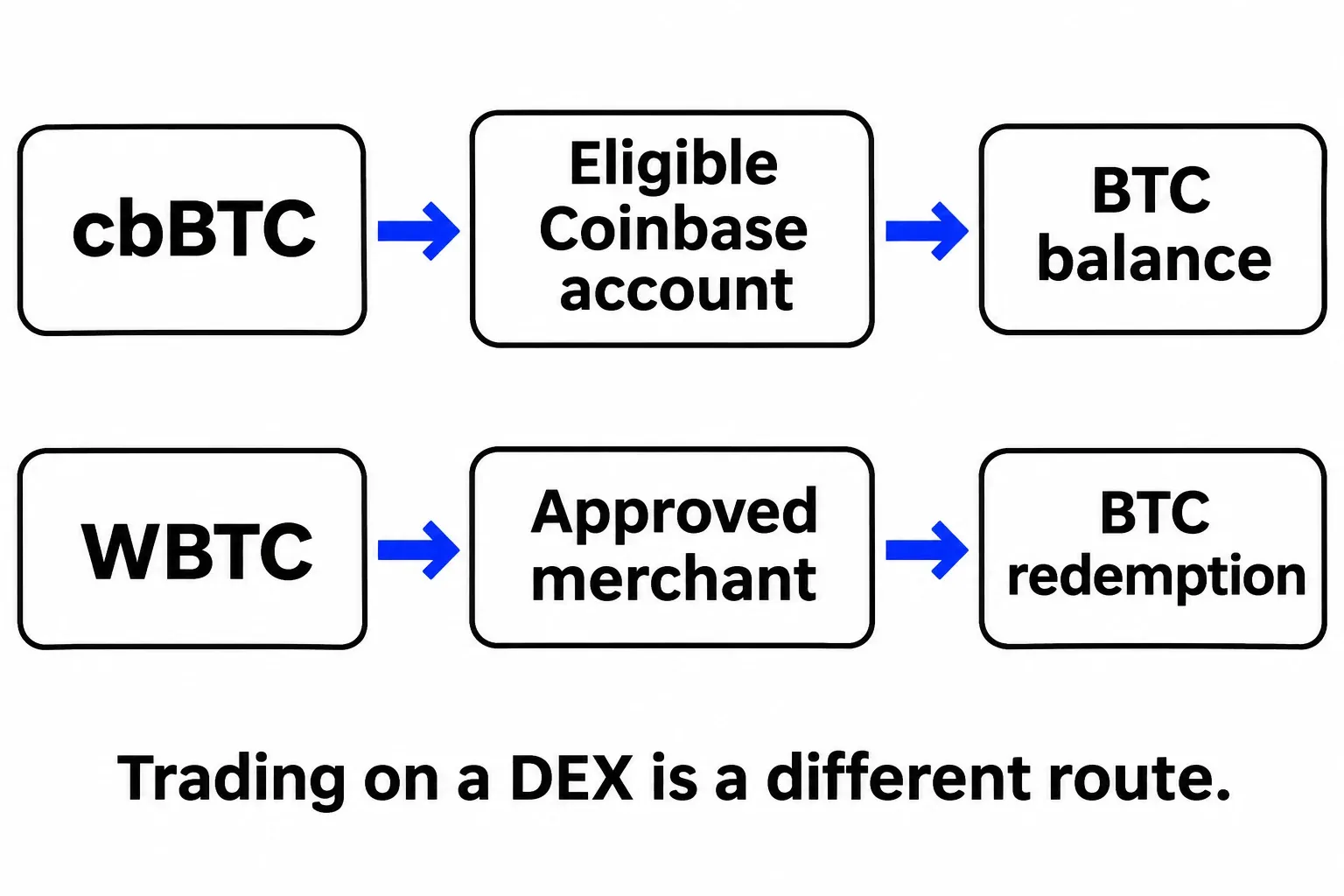
For an eligible Coinbase customer, cbBTC can provide a direct account-based conversion route. WBTC uses approved institutional merchants for minting and burning, while ordinary holders can obtain it through supported markets. If your only aim is to hold or send bitcoin on the Bitcoin network, native BTC avoids these additional wrapper dependencies.
Compare the redemption route before the ticker
The cbBTC project description on CoinMarketCap identifies Coinbase as the custodian of its backing BTC and describes conversion through Coinbase accounts. Its stated backing is one BTC for each cbBTC. That is a custody arrangement, not a Bitcoin full node independently enforcing your right to receive funds from Coinbase.
WBTC's current project description likewise states one-to-one BTC backing, but reserves minting and burning to identity-verified institutions approved through its governance process. Buying WBTC on a decentralized exchange doesn't make you one of those merchants. Separate the ability to trade a token from the ability to redeem it directly with its issuer or custodian.
| Question | cbBTC | WBTC |
|---|---|---|
| Who supplies the backing arrangement? | Coinbase holds the backing BTC under its custody and account terms. | The WBTC custody framework holds the backing BTC; approved merchants handle mint and burn requests. |
| Can a retail holder redeem directly? | Check eligibility and current supported deposit instructions in your Coinbase account. | Don't assume merchant access. Establish a provider that accepts your token and delivers native BTC. |
| Which token does a DeFi market accept? | The exact cbBTC asset on that market's chain. | The exact WBTC asset on that market's chain. A cbBTC position won't substitute automatically. |
| Does backing fix the trading price? | No. A market trade has its own available liquidity and quote. | No. A market trade has its own available liquidity and quote. |
Read reserve evidence within its limits
WBTC's transparency dashboard separates circulating supply from reserve BTC and lists authorized chain supplies, reserve addresses and mint/burn records. Compare corresponding supply and backing at the same time; don't compare an old market listing with a new reserve total or count a bridged representation twice.
Those records help you inspect the backing claim. They don't prove that your particular redemption will be accepted immediately, establish the custodian's complete liabilities or remove the risk of losing control of reserve keys. I treat reserve visibility and my ability to exit as separate checks. For cbBTC, inspect the current issuer's reserve disclosures and applicable account terms before committing funds; a token price page alone cannot establish either.
Price tracking is also separate from backing. CoinLedger's cbBTC explanation describes its intended Bitcoin price relationship and account conversion. A seller's quote can still include a spread, network cost or poor execution. Compare the actual amount delivered by the route you can use, rather than assuming the stated backing ratio is an executable trade.
Check contract powers and the DeFi position separately
Coinbase's published wrapped-token code describes an owner who can change administrative roles, including the pauser, blacklister and master minter. The shared architecture also includes a proxy and rate-limited minting. Check the deployed token's implementation and current administrators when evaluating those powers; the repository alone doesn't establish every deployment's active configuration. Open-source code doesn't make the underlying custodian unnecessary.
The repository's published mint-forwarder tests specify rejection of an unauthorized caller and a mint above the caller's allowance. They also check the recipient balance and total supply after an allowed mint. These are contract-level expectations in the shared wrapped-token codebase, not measurements of reserve sufficiency, withdrawal speed or the safety of a live DeFi position.
For either token, a lending deposit adds that protocol's contract and withdrawal conditions to the wrapper's custody risks. Aave's risk explanation, for example, separates smart-contract, oracle and collateral risks; borrowing against a deposit can expose it to liquidation. I wouldn't choose a wrapper on the strength of a headline yield without examining the position that produces it.
Choose for your market and your exit
I'd favor cbBTC when the intended market explicitly accepts it and an eligible Coinbase account provides the return route I need. I'd favor WBTC when the required market accepts WBTC and I've established a satisfactory sale or redemption provider. Neither choice follows automatically from issuer size, a token's age or a market-cap ranking.
Before acquiring either asset, work through these checks:
- Open the intended protocol's official market and verify the full asset identifier and chain. A matching symbol in a wallet isn't enough.
- Confirm that deposits are enabled and inspect the position's withdrawal and risk conditions. Acceptance as collateral isn't the same as an unconditional promise to return the deposit.
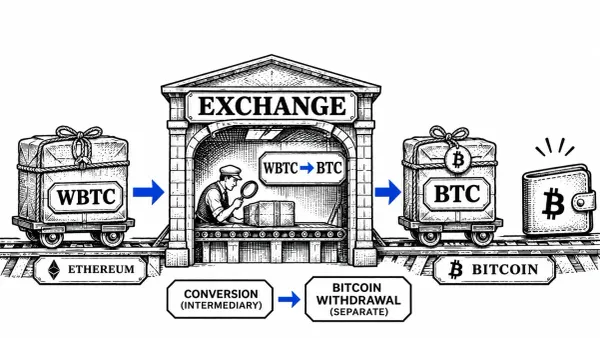
- Identify your eventual exit: an eligible issuer-account conversion, an approved merchant arrangement or a market sale through a service that delivers native BTC.
- Read that provider's current network, minimum, fee and account restrictions before sending. Retain the receiving instructions and compare them again at the transfer.
- Compare the complete quoted output and keep the required network fee asset available. A cheap purchase is little use if your intended exit doesn't support the token you bought.
For the network compatibility question, start with sending wrapped Bitcoin to a Bitcoin wallet: an ordinary token transfer cannot turn WBTC or cbBTC into native BTC. The bridges and wrapped-assets hub connects the related network decisions. Choose the asset only after both its intended use and its exit are clear.