Chain Bridge


Contents
A Bitcoin nodes map shows endpoints a particular crawler can discover and reach, with location data where available. It isn't a census of every validating node, a count of independent owners or a map of mining power. Start with the snapshot time and network coverage, then read the country percentages against their own denominator.
I use these maps to understand the visible network and its hosting patterns. I wouldn't use a bright cluster to decide who controls Bitcoin, or an absent dot to decide that my own node has stopped validating.
Choose a node map for a node question
For reachable peer-to-peer endpoints, the current BTC Nodes dashboard combines a map with network and country breakdowns. Its live crawl view separates a completed snapshot from changing crawler state. Keep those two views separate when quoting a total.
There is a continuity issue with older bookmarks. The Bitnodes homepage describes an independent rebuild under a new operator and explicitly says it isn't affiliated with or endorsed by the original project's creator. Its API and dashboard routes lead to BTC Nodes. An old article linking Bitnodes does not establish that the present service has the same historical coverage or collection settings.
Other Bitcoin maps answer different questions. BTC Map lists places that accept bitcoin, using OpenStreetMap data. The Chain Bulletin mining map presents hashrate and pool information. Neither a merchant marker nor a hashrate estimate should be counted as a validating endpoint. Use the mining collection for the equipment and pool questions behind that second task.
Read the timestamp before the headline number
The dashboard below separates a completed snapshot from a changing live crawl. The black snapshot columns and orange live columns describe different populations at the pictured time; neither is a current total to carry into another report. Select Enlarge image to read the details.
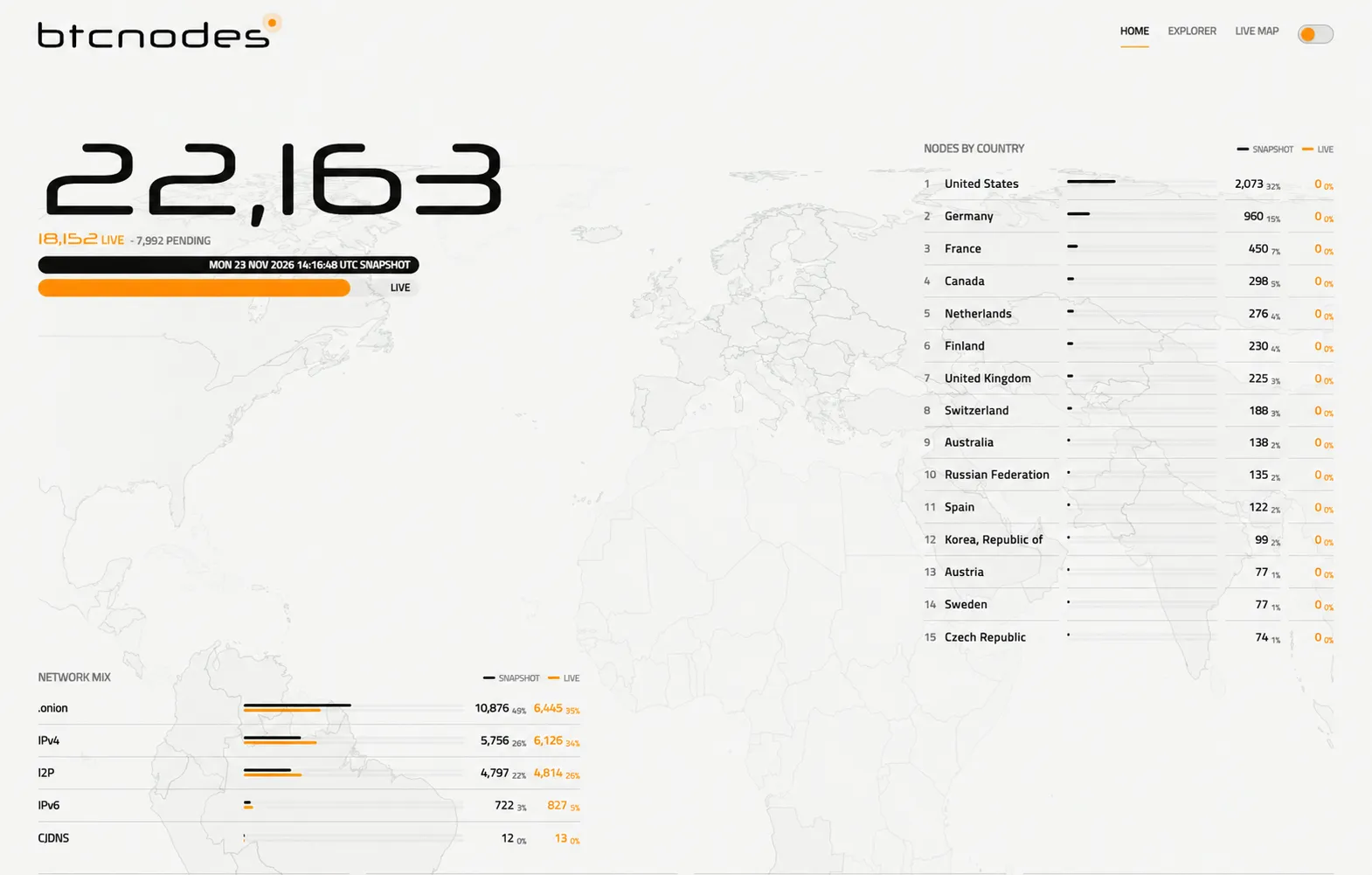
- Identify the population. The headline is a reachable-endpoint snapshot, not everyone running Bitcoin software.
- Read its time. This example says November 23, 2026, at 14:16:48 UTC. Opening the page later doesn't advance that timestamp.
- Check the included networks. The network panel includes onion, IPv4, I2P, IPv6 and CJDNS entries. A geographic map can't place all of those endpoints in countries.
- Inspect each percentage's basis. The country and network panels need not divide by the same total.
In this example, the headline is 22,163 and the United States row is 2,073 with a rounded 32% label. Dividing 2,073 by 22,163 gives about 9.35%, so the displayed country percentage clearly isn't a share of the headline total. Don't rewrite it as “32% of all Bitcoin nodes are in the US.” Establish which endpoints received a country assignment before making that claim.
The current API documentation distinguishes the raw snapshot export from the searchable node list with location metadata. The export's timestamp and total can help verify which completed snapshot you're reading. An address seen by the crawler, a successful connection and an entry with usable location data are different observations.
Understand what the crawler can see
The original Bitnodes methodology describes starting from seed nodes and recursively requesting peer addresses with getaddr. Discovery supplies candidates to try; an advertised address isn't itself proof that a reachable, current node is waiting there.
Bitcoin's peer-discovery protocol explains why this view is incomplete. Nodes learn addresses through other peers and make connections subject to their network configuration. A crawler observes the endpoints available from its position and supported networks, during its collection window. Discovery, connection failures and collection settings affect the result.
A node can make outbound connections, receive blocks and validate them without accepting unsolicited inbound connections. A machine behind a firewall can therefore do its owner's validation work while remaining absent from a listening-node map. Conversely, a successful public handshake doesn't audit the operator's wallet use or every rule enforced by its binary.
Nor is an endpoint necessarily a separate machine or owner. Core's Tor documentation describes a node reachable over multiple networks. One operator can also run several nodes. Deduplicating address records doesn't automatically establish independent ownership, so I'd call these endpoint observations unless a service documents a stronger identity method.
Treat countries as IP-location estimates
A country row usually describes the location assigned to an IP endpoint. It doesn't establish the operator's nationality, residence or legal jurisdiction. A hosting provider's address can locate infrastructure without locating the person using it.
MaxMind's geolocation limits make the distinction explicit: IP data can't identify a specific household or individual, and locating a hosted server or VPN does not locate its end user. City-level placement is less precise than a pinpoint on a map suggests. Keep unknown locations unknown rather than moving them to a convenient capital city.
Tor is a network category, not a country. Bitref's node-statistics methodology says its charts mostly cover reachable, listening nodes and explains that Tor entries don't reveal their actual geographic location. A map with few dots in a region may reflect the observable address mix, missing geolocation or crawler coverage. It doesn't prove there are no validating users there.
I look at country and hosting-network concentration as separate questions. A shared provider can be a useful infrastructure dependency to investigate. It isn't proof that all its customers are one operator, and it doesn't turn a percentage into a measure of consensus authority.
Compare definitions before comparing counts
Public observations give a useful cross-check, provided their scope stays attached. The illustrated BTC Nodes export and dashboard agree on 22,163 reachable endpoints. A Coin Dance public-node summary sample shows 22,062 and says it corrects for duplicate and non-listening nodes. Bitref describes approximately daily snapshots; a page whose counters still say “loading” supplies no usable total.
Those displays don't establish an outage, growth or a contradiction by themselves. They may cover different times, supported networks and filtering rules. They also aren't automatically independent measurements simply because they appear on different websites. An average of incompatible totals would give a more precise-looking number without establishing the size of the whole network.
Scroll sideways to compare the measurement questions.
| Displayed measure | What to establish | What it cannot establish alone |
|---|---|---|
| Reachable snapshot | Completion time, networks included and successful-connection criteria. | Every private or temporarily unreachable validator. |
| Known or pending addresses | Whether candidates have been checked and whether stale entries remain. | A completed reachable-node total. |
| Country percentage | Country-assigned population, unknown locations and excluded networks. | Share of owners, mining power or all validating nodes. |
| Client or user-agent share | Reported string, classification method and population used. | Proof of the binary's complete configuration or a consensus vote. |
| Change over time | Comparable collection settings, coverage and intervals. | A network event merely from two unmatched screenshots. |
For a trend, compare completed snapshots from the same measurement series, then check whether the collector changed. A gap in collection belongs in the interpretation. An old static map embedded in a newly opened page remains an old map.
If your node is missing, check your actual goal
If your goal is personal validation, first check your own node's synchronization, peers and errors. Map inclusion isn't a prerequisite for that task. The Bitcoin Core setup guide separates ordinary outbound operation from the optional choice to provide incoming peer connections.
If you deliberately want to serve inbound peers, use the service's documented reachability check for your own P2P endpoint and network. A negative result is evidence about that attempted connection, not a complete diagnosis. Confirm the advertised address, listening configuration, firewall and the snapshot's age before changing anything. Never expose the administrative RPC interface just to make a dot appear.
I wouldn't weaken network isolation to improve a map count. Decide whether you need independent validation or a publicly reachable peer, then investigate that specific outcome. The node guide collection provides the setup and maintenance routes; a map is most useful when you already know which observation would answer your question.