Chain Bridge

Contents
getmempoolentry returns one transaction's entry in your Bitcoin Core node's local mempool. Give it the txid, then read fees.base for the fee in BTC and vsize_bip141 for BIP 141 virtual bytes. If Core returns Transaction not in mempool, the transaction is absent from that node's current pool; the error alone doesn't establish confirmation or explain its disappearance.
I start with that local presence check because an explorer and your node can have different pending transactions. Once the entry exists, its fee and relationships become useful evidence. None of those fields reserves a place in the next block.
Query the right node with the transaction ID
Use the node and network you intended to inspect. A mainnet transaction won't become a test-network entry by querying its ID there. If the node is still catching up or has no transaction-relaying peers, establish that context before comparing its mempool with someone else's. The Bitcoin node setup and synchronization checks cover those prerequisites.
The examples below use bitcoin-cli with your existing local connection settings. Replace YOUR_TXID with the transaction ID, keeping the quotes. This argument is the txid, not the witness-inclusive wtxid returned inside the entry.
bitcoin-cli help getmempoolentry
bitcoin-cli getmempoolentry "YOUR_TXID"
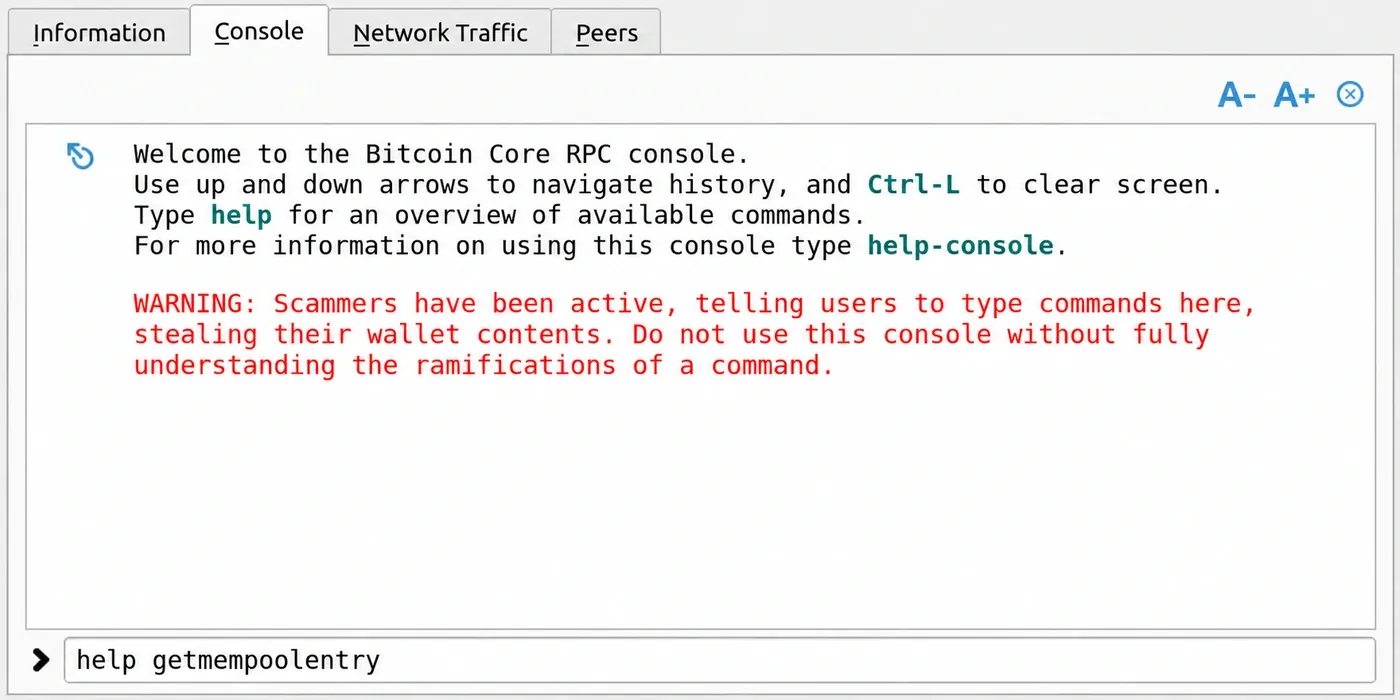
In the GUI's Console, omit the bitcoin-cli prefix. Begin with help getmempoolentry to see your installed version's fields. The image shows that help command still in the input, before execution. Keep the Console's scam warning in mind: a read-only lookup never requires pasting someone else's wallet-unlocking or sending commands.
The field choices here follow the 32-series entry reference and the 32.1 implementation. Core's RPC interface can change between major versions, so a missing field should send you back to local help before you change a parser.
Calculate the fee rate with explicit units
fees.base is the transaction's fee in BTC. fees.modified includes fee deltas used for local mining priority. A delta changes that node's accounting for priority; it doesn't add satoshis to the fee paid by the transaction.
| Field | Read it as | Avoid this mistake |
|---|---|---|
fees.base | Transaction fee, in BTC. | Reading a BTC amount directly as satoshis or sat/vB. |
fees.modified | Fee including local priority deltas, in BTC. | Treating a priority delta as an additional payment. |
vsize_bip141 | BIP 141 virtual size, in vbytes. | Using serialized bytes, which treat witness data differently. |
vsize_adjusted | The larger of BIP 141 vsize and the sigop-adjusted size determined using -bytespersigop. | Assuming it must equal vsize_bip141. |
For the transaction's paid fee rate on a BIP 141 basis, calculate fees.base × 100,000,000 ÷ vsize_bip141. The result is sat/vB. As an illustrative calculation, a fee of 0.00002000 BTC is 2,000 sat; divided by 200 vB, that is 10 sat/vB. These are example inputs, not a node response or a confirmation estimate.
I use the explicitly named size because it makes the comparison reproducible. In this version, the old vsize field is deprecated and retains the sigops-adjusted behavior. Earlier documentation described it as BIP 141 vsize in error. The 32.1 release explanation of the size-field change distinguishes the two replacements. For scripts, keep the chosen size basis in the column name and use decimal or integer-satoshi arithmetic for amounts.
Separate direct parents from all ancestors
depends lists direct unconfirmed parents: transactions whose outputs this transaction spends. spentby lists direct unconfirmed children spending its outputs. An indirect grandparent won't appear in depends merely because it is an ancestor.
The aggregate fields have a different boundary. ancestorcount and descendantcount include the transaction itself, as do ancestorsize and descendantsize. In 32.1, those size totals sum the sigops-adjusted sizes. fees.ancestor and fees.descendant also include the transaction, with priority deltas. Don't add fees.base to one of those totals as though the entry had been left out.
To inspect the actual transitive sets, use the ancestor lookup and descendant lookup. Their lists exclude the transaction you queried. With the default false verbosity they return transaction IDs; true returns objects keyed by transaction ID, with entry details.
bitcoin-cli getmempoolancestors "YOUR_TXID" false
bitcoin-cli getmempooldescendants "YOUR_TXID" true
For example, suppose a parent and its child are the only two related transactions in the pool. The child's ancestorcount is 2, while its ancestor-ID list contains only the parent. That difference is expected. It isn't a lost transaction or a JSON parsing error.
Separate calls can observe a changing pool. If a parent confirms between your entry lookup and the ancestor query, don't force those replies into a single frozen dependency graph. Recheck the relevant entry before drawing a conclusion about a changed count.
Use chunk fields for current ordering context
Ancestor totals remain useful for understanding dependencies, but they aren't a complete description of current selection policy. Core 31 introduced cluster mempool, replacing the old ancestor/descendant size and count limits with limits on connected clusters. Its ordering considers chunks of transactions that would be included together.
In an entry, fees.chunk is the chunk's fee amount in BTC and chunkweight is its sigops-adjusted weight. That denominator is weight, not vbytes. I keep it separate from the transaction's BIP 141 sat/vB calculation so the two rates don't end up mislabeled in a spreadsheet.
bitcoin-cli getmempoolcluster "YOUR_TXID"The cluster result lists chunks in mining order and the transactions within them. Use it to inspect your node's grouping rather than inferring the group from depends alone. A node's current grouping still isn't a promise about another miner's next block.
Older examples may also expect bip125-replaceable in every entry. In 32.1 it is returned only when the deprecated bip125 RPC option is enabled. Its absence is a schema change, not evidence that the transaction cannot be replaced.
Investigate a missing entry without guessing the cause
Transaction not in mempool is an RPC error, not a successful null entry. It tells you the requested transaction isn't in this node's pool at the time of the lookup. Confirmation, replacement, eviction and failure to reach this node need separate evidence.
| Observation | Next check | Limit of the inference |
|---|---|---|
| ID copied from a wallet or explorer | Verify the txid, network and node endpoint. Compare the wallet's transaction status with the chain your node follows. | A witness hash or the wrong network can make the lookup irrelevant. |
| The wallet shows confirmation | Verify the transaction in its reported block on the intended chain. | Absence from the mempool alone didn't establish that confirmation. |
| The entry disappeared while pending | Check wallet replacement/conflict history. If you know its input outpoints, inspect current spenders of those same outputs. | A different spender is relevant evidence; a missing entry doesn't identify one. |
| An explorer has it, this node doesn't | Check synchronization, peer connectivity and the node's mempool state. | Different local pools don't by themselves establish an invalid transaction. |
For input-outpoint checks, gettxspendingprevout can identify a transaction spending a specified txid and output index. Set its mempool_only option explicitly to true when you want only the current local pool. Current versions can also consult txospenderindex when available; leaving the option at its default doesn't always mean a mempool-only search. No current spender in this lookup is not a network-wide certificate that the output is unspent.
getmempoolinfo supplies useful node context. Its loaded flag means the initial attempt to load the persisted mempool has finished; it doesn't certify chain synchronization. mempoolminfee is an admission threshold in BTC/kvB, not a transaction fee in BTC or a confirmation target. It also doesn't reconstruct the historical reason an entry disappeared.
Read entry status as local evidence
time is this node's local entry time, in seconds since the Unix epoch. It isn't a globally agreed first-broadcast time. height is the block height when the transaction entered the pool, not its confirmation height.
unbroadcast: true means the initial broadcast hasn't yet been acknowledged by any peers. A value of false doesn't establish network-wide receipt or confirmation. If you need to investigate relay, check the node's connectivity before repeatedly submitting the transaction or changing its fee.
Keep the entry, the node/network identity and the observation time together when comparing results. Then choose the next task from the node guides: repair a connection problem before retrying a lookup, or inspect the reported block when there is actual confirmation evidence.