Chain Bridge


Contents
estimatesmartfee estimates a fee rate for a confirmation target in blocks. Its feerate is in BTC/kvB: multiply by 100,000 to convert it to sat/vB. Read the returned blocks and any errors alongside the rate; neither a successful estimate nor the target guarantees a confirmation deadline.
I use the estimate as an input to a transaction decision, keeping the units and the node's available data visible. A missing estimate needs investigation before a wallet treats it as a usable rate. It must never become a zero-fee recommendation through a parser's default value.
Start with local help and a block target
Use your existing trusted connection to the intended Bitcoin Core node and network. If it is still catching up or has no transaction-relaying peers, first work through the node synchronization and connectivity checks. A connection failure occurs before fee estimation and won't be fixed by changing the target.
bitcoin-cli help estimatesmartfee
bitcoin-cli estimatesmartfee 6 economical
The second command requests an economical estimate for a target of 6 blocks. In the GUI Console, omit the bitcoin-cli prefix. The request reads an estimate; it doesn't create, sign or broadcast a transaction.
The behavior below follows the 32-series RPC reference and the 32.1 implementation. Check local help before putting options into an older installation's script. The required conf_target accepts 1–1008 blocks, but the returned target can differ from the request.
economical is the current default mode. conservative can return a higher rate, although the two needn't differ for every set of data. Specify the mode when comparing results so an older example's different default doesn't silently change the comparison.
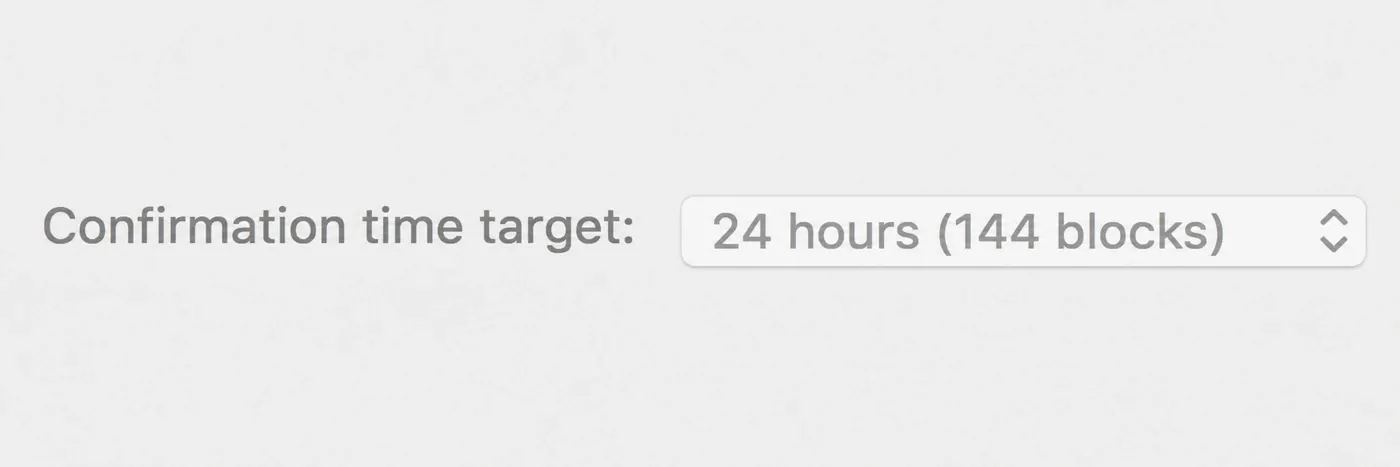
In the GUI fee panel, Recommended uses estimation while Custom selects a manually entered rate. The confirmation-target control belongs to the recommended path; it can be disabled while Custom is selected. Read the currency unit beside a fee display too: a GUI value per kvB isn't automatically a sat/vB value.
Choose the estimation method deliberately
Current Core separates the mode from the estimation method. The fee_rate_estimator option selects the method; estimate_mode selects economical or conservative behavior. They are different choices.
| Method | Behavior | Important boundary |
|---|---|---|
auto, the default | Starts with the block-policy estimate, then selects the lower of it and an available mempool-policy estimate. | Requires a block-policy estimate first. A populated mempool alone doesn't make auto succeed. |
block_policy | Uses the estimator that learns from transactions and their confirmation history. | Needs usable historical estimation data for the target. |
mempool_policy | Uses the mempool estimator, subject to checks on recent block data and the reliability of the local pool. | Its returned target is always 2 blocks, even if the request names another target. |
The estimator selection code makes auto's prerequisite explicit: it returns the block-policy error immediately if that estimate is unavailable. If block policy succeeds but the mempool estimator can't produce a rate, auto uses the block-policy result. An explicit mempool-policy request has its own availability checks and may therefore behave differently from auto.
The RPC also raises the selected rate to at least the larger of the node's current mempool minimum and minimum relay fee. That floor reflects local policy. It doesn't establish the lowest fee that every miner will accept or a rate guaranteed to confirm.
Named arguments make the method choice explicit. This example uses a Bash-style shell, asks for auto and includes mempool health statistics:
bitcoin-cli -named estimatesmartfee conf_target=6 estimate_mode=economical options='{"fee_rate_estimator":"auto","verbosity":2}'The shell must pass the JSON object as one argument with its inner double quotes preserved; Windows shells can require different quoting. For a method comparison, change only fee_rate_estimator to block_policy or mempool_policy, keeping the mode and node fixed. Separate calls can still observe a changing pool, so record the time and returned target with each result.
Read the result before using its rate
feerate is optional. An estimation failure can appear as an errors array inside an otherwise successful RPC result, without a feerate. Handle that separately from authentication, transport or invalid-argument errors. Don't substitute a hosted provider's generic null example for Core's actual result structure.
For block policy, blocks is the target at which the estimate was found, clamped to at least 2 and no more than the estimator's maximum usable target. For mempool policy it is always 2. It isn't the chain's block height, a fixed number of minutes or necessarily an echo of conf_target.
estimator identifies the selected method only for a successful auto estimate. Its absence from an explicit-method result doesn't mean the rate failed. With verbosity of 2 or higher, mempool_health_statistics adds recent block information, including block height and the weight of transactions removed from the local pool for that block. Those statistics help explain estimator availability; they aren't individual transaction confirmation predictions.
Convert BTC/kvB to sat/vB, then estimate the total fee
One BTC contains 100,000,000 satoshis, and one kvB contains 1,000 virtual bytes. Dividing those conversion factors gives 100,000. For an illustrative rate of 0.00002000 BTC/kvB:
0.00002000 BTC/kvB × 100,000 = 2 sat/vB
250 vB × 2 sat/vB = 500 sat
The example assumes a transaction of 250 vB; it isn't a returned node estimate or a measured transaction. The fee-rate definition distinguishes BTC/kvB and sat/vB formats. In a script, preserve decimal precision or use integer-satoshi arithmetic rather than letting a display rounding choice determine the fee.
I keep the rate conversion separate from transaction construction because the final virtual size determines the total fee. Adding an input or changing an output can change that size. A wallet's completed fee calculation is more useful than multiplying the rate by a guessed serialized byte count.
Compare estimates with the same objective
A low-fee transaction that recently confirmed doesn't prove that a higher earlier estimate was wrong. A target estimate addresses uncertain future confirmation, while the cheapest transaction in a completed block is a hindsight observation. The discussion of apparently high Core estimates explains that distinction, though its description of the default mode belongs to an older version.
An explorer may use a different pool, sampling time or target. Core's block-history estimate can also react differently from its mempool estimate. Compare the same units and intended confirmation window before treating two displayed numbers as competing answers. Neither method can reserve future block space.
Investigate missing data without destroying it
Insufficient data or no feerate found means the block-policy estimator didn't find a usable estimate. A shorter target or a nonempty pool isn't proof that auto must now succeed. Check node readiness and the method's data requirements before changing persistent files.
Core's published functional test scenarios distinguish these cases. They test behavior under controlled conditions rather than provide live-mainnet rates to reuse:
| Condition | Expected branch | Practical interpretation |
|---|---|---|
| No usable initial block-policy estimate | Auto returns an estimation error. | Current pending transactions don't replace its historical prerequisite. |
| Usable block estimate; healthy but sparse pool | The mempool estimate can reach the local policy floor and auto can select it. | An empty or small pool isn't automatically a missing-data error. |
| Recent blocks have insufficient local mempool coverage | Explicit mempool policy can fail; auto can retain the block estimate. | Method availability and the presence of pending transactions are different checks. |
| Node runs in blocks-only mode | The RPC reports Fee estimation disabled. | Changing the target won't enable the estimator. |
The mempool estimator's health checks also wait for the initial mempool-load attempt to finish and require enough recent block data. Its errors can say mempool_policy: Not enough recent block data for fee rate estimation or mempool_policy: Mempool is unreliable for fee rate estimation. Use the exact error and health statistics to distinguish those branches.
Don't delete fee history, reindex the chain or send test transactions merely to make an estimate appear. Repeated restarts don't supply missing observations. If a GUI shows a fallback-fee warning, don't treat the displayed fallback as a successful estimate for your chosen target.
Before constructing the payment, keep the chosen mode, method, returned target and converted rate together. If the node can't provide a usable estimate, resolve the stated data or configuration condition before using it for an automated fee decision. The node guides cover the surrounding setup and troubleshooting tasks.